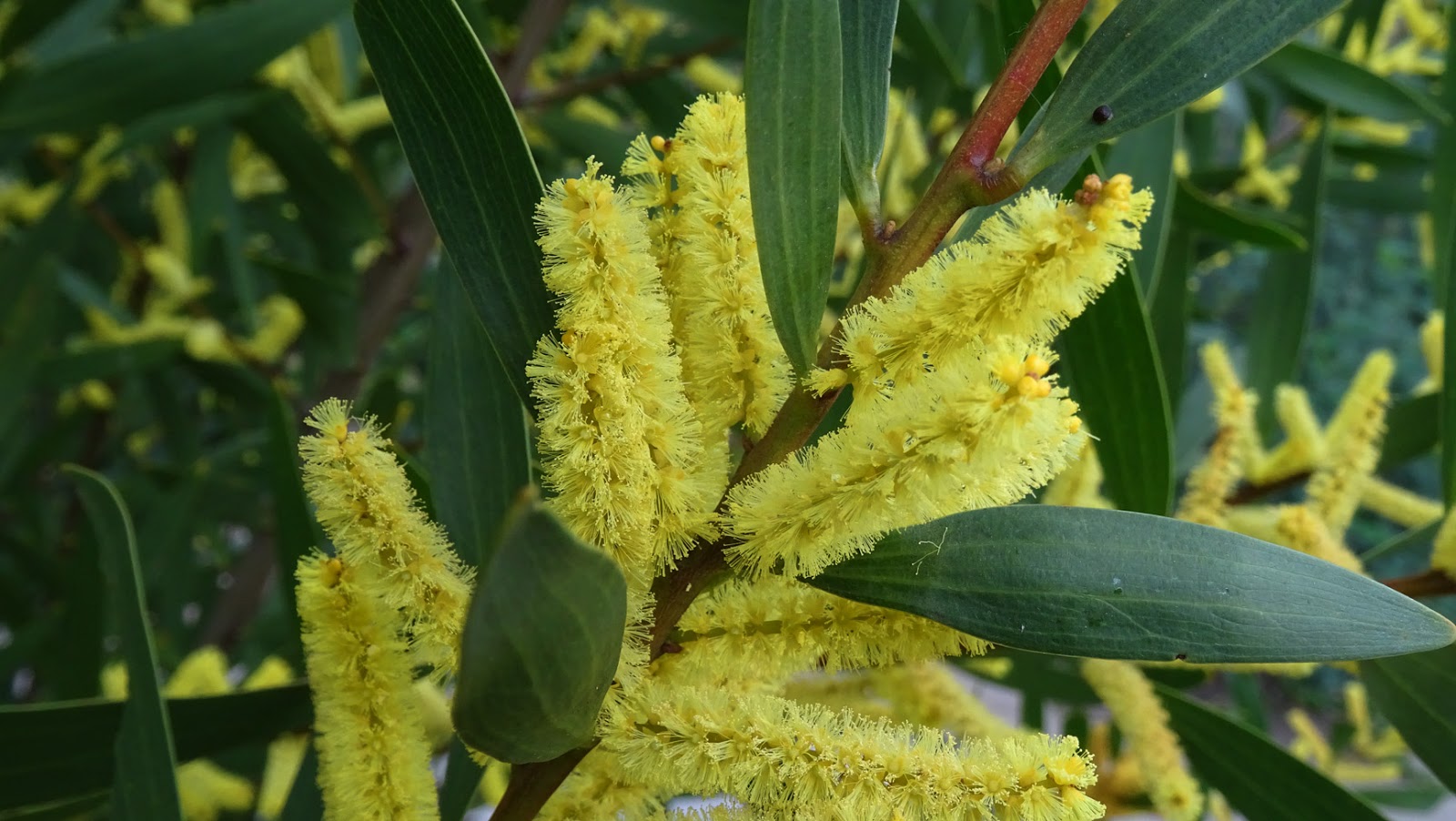
Acacia longifolia is a species of Acacia native to southeastern Australia, from the extreme southeast of Queensland, eastern New South Wales, eastern and southern Victoria, and southeastern South Australia. Common names for it include Long-leaved wattle, Acacia Trinervis, Aroma Doble, Golden Wattle, Coast Wattle, Sallow Wattle and Sydney Golden Wattle. It is not listed as being a threatened species, and is considered invasive in Portugal and South Africa. It is a tree that grows very quickly reaching 7–10 m in five to six years.
This tree is widely cultivated in subtropical regions of the world. Its uses include prevention of soil erosion, food (flowers, seeds and seed pods), yellow dye (from the flowers), green dye (pods) and wood. The flower colour derives from the organic compound kaempferol. The tree's bark has limited use in tanning, primarily for sheepskin. It is useful for securing uninhabited sand in coastal areas, primarily where there are not too many hard frosts.
It is a highly attractive small tree or large rounded shrub. There is a striking flower display in late winter when nearly the entire plant is covered in flowers. It tolerates a range of soils provided they are not overly alkaline. Grows best in full sun, may get a bit thin and stretched in shaded conditions. Frost tolerant. Borers may be an issue in older trees. Other useful applications include erosion control and windbreaks, it is a low maintenance plant. This species is a nitrogen fixer. Heavy flowering provides resources for a wide range of invertebrates, particularly bees. Seed pods and seeds are eaten by parrots. Older plants attract wood boring insects.
This post is part of the Floral Friday Fotos meme,
and also part of the Friday Greens meme,
and also part of the Trees & Bushes meme.
Yering Station was established in 1838 by the pioneering Ryrie brothers who adopted the Aboriginal name “Yering” for their new station. In 1996 the Rathbone family purchased the property drawn to its natural beauty, history and the great promise of its wines. Today Yering Station is one of the jewels of the Yarra Valley region, attracting tourists and wine enthusiasts from around the globe. Recognised for its landmark winery/restaurant complex, the building sits harmoniously within the landscape of heritage architecture and the beautiful vineyards from which expert winemakers craft award winning wines.
This post is part of the Weekend Reflections meme,
and also part of the Scenic Weekends meme.
The almond (Prunus dulcis, syn. Prunus amygdalus, Amygdalus communis, Amygdalus dulcis) is a species of tree native to the Middle East and South Asia. "Almond" is also the name of the edible and widely cultivated seed of this tree. Within the genus Prunus, it is classified with the peach in the subgenus Amygdalus, distinguished from the other subgenera by the corrugated shell (endocarp) surrounding the seed.
The fruit of the almond is a drupe, consisting of an outer hull and a hard shell with the seed (which is not a true nut) inside. Shelling almonds refers to removing the shell to reveal the seed. Blanched almonds are shelled almonds that have been treated with hot water to soften the seed-coat, which is then removed to reveal the white embryo.
The almond is a deciduous tree, growing 4–10 m in height, with a trunk of up to 30 cm in diameter. The young twigs are green at first, becoming purplish where exposed to sunlight, then grey in their second year. The leaves are 7.5-12 cm long, with a serrated margin and a 2.5 cm petiole.
The flowers are white to pale pink, 3–5 cm diameter with five petals, produced singly or in pairs and appearing before the leaves in early spring. Almond grows best in Mediterranean climates with warm, dry summers and mild, wet winters. The optimal temperature for their growth is between 15 and 30 °C and the tree buds have a chilling requirement of between 300 and 600 hours below 7.2 °C to break dormancy. Almonds begin bearing an economic crop in the third year after planting. Trees reach full bearing five to six years after planting. The fruit matures in the autumn, 7–8 months after flowering.
This post is part of the Floral Friday Fotos meme.
The Macpherson Robertson Fountain, designed by Philip Hudson and sculpted by Paul Montford is a granite, bronze and concrete fountain made in 1934 and located in the Shrine Gardens, corner of Domain and St Kilda Roads.
Architect Philip Hudson moved from New Zealand to Melbourne in 1903. He designed several grammar schools, as well as the Shrine of Remembrance, near which this fountain is sited. On this work he collaborated with celebrated sculptor Paul Montford, who migrated to Australia from England in 1921. The fountain consists of one pool within another, and a central column upon which sits a bronze figure of a boy catching a dolphin. Water sprays into the pools from bronze animals.
The fountain was a gift from Sir Macpherson Robertson to celebrate Victoria's centenary. Robertson was a successful businessman and a philanthropist, making his money and name in confectionery; he was responsible for introducing chewing gum and fairy floss into Australia. Robertson gave to many causes and expeditions, Sir Douglas Mawson even naming Mac Robertson Land in Antarctica in his honour. In celebration of Victoria's centenary, Robertson donated £15 000 as first prize in the Centenary Air Race from London to Melbourne and £100 000 for works to be undertaken around the city. The fountain is one result of this donation.
This post is part of the Wednesday Waters meme,
and also part of the Waterworld Wednesday meme,
and also part of the Outdoor Wednesday meme,
The State Library of Victoria is the central library of the state of Victoria, Australia, located in Melbourne. It is on the block bounded by Swanston, La Trobe, Russell, and Little Lonsdale streets, in the northern centre of the central business district. The library holds over 2 million books and 16,000 serials, including the diaries of the city's founders, John Batman and John Pascoe Fawkner, and the folios of Captain James Cook, R.N.. It also houses the original armour of Ned Kelly.
In 1853, the decision to build a state library was made at the instigation of Lieutenant-Governor Charles La Trobe and Mr Justice Redmond Barry, Q.C. (Sir Redmond from 1860). A competition was held to decide who would design the new building; local architect Joseph Reed, who later designed the Melbourne Town Hall, Ormond College and the Royal Exhibition Building, won the commission. On 3 July 1854, the recently inaugurated Governor Sir Charles Hotham laid the foundation stone of both the new library and the University of Melbourne. The library opened in 1856, with a collection of 3,800 books chosen by Mr Justice Barry, the President of Trustees. Augustus H. Tulk, the first librarian, was appointed three months after the opening.
The library underwent major refurbishments between 1990 and 2004, designed by architects Ancher Mortlock & Woolley. The project cost approximately A$200 million. The reading room closed in 1999 to allow for renovation, during which natural light was returned. The renamed La Trobe Reading Room reopened in 2003.
The Library’s vast collection dates back to 1854 and includes material on almost every subject you can think of, with a special focus on material from Victoria. From art, children’s books, war and family history to film, business and industry, and Australian history, there is plenty for curious browsers and serious researchers alike. While most people know about the Library's extensive book collections, there's plenty to surprise in other historical collections, which date back to 1854. They include more than 350,000 photographs, personal manuscripts & diaries, maps, old magazines & journals, newspapers, comics, and even old advertising and theatre programs. There is also an eclectic array of textiles and personal items.
This post is part of the Our World Tuesday meme,
and also part of the Ruby Tuesday meme,
and also part of the Wordless Wednesday meme.