Showing posts with label Verbenaceae. Show all posts

Thursday, 25 July 2019

LANTANA

Lantana is a genus of about 150 species of perennial flowering plants in the verbena family, Verbenaceae. They are native to tropical regions of the Americas and Africa but exist as an introduced species in numerous areas, especially in the Australian-Pacific region. The genus includes both herbaceous plants and shrubs growing to 0.5–2 m tall. Their common names are shrub verbenas or lantanas. Some species are invasive, and are considered to be noxious weeds, such as in South Asia, Southern Africa and Australia. In the United States, lantanas are naturalised in the southeast, especially coastal regions of the Carolinas, Georgia, Florida, and the Gulf Coast.

The generic name originated in Late Latin, where it refers to the unrelated Viburnum lantana. Lantana's aromatic flower clusters (called umbels) are a mix of red, orange, yellow, or blue and white florets. Other colours exist as new varieties are being selected. The flowers typically change colour as they mature, resulting in inflorescences that are two- or three-coloured. "Wild lantanas" are plants of the unrelated genus Abronia, usually called "sand-verbenas".

Lantana camara blanca, shown here is a small perennial shrub which can grow to around 2m in height and forms dense thickets in a variety of environments. It has small tubular shaped flowers, each of which has four petals and are arranged in clusters at the end of stems. Flowers are yellow and white and after pollination occurs the colour of the flowers change (typically from yellow to white); this is believed to be a signal to pollinators that the pre-change colour contains a reward as well as being sexually viable, thus increasing pollination efficiency.

This post is part of the Floral Friday Fotos meme.

Thursday, 6 June 2019

DURANTA

Duranta erecta is a species of flowering shrub in the verbena family Verbenaceae, native from Mexico to South America and the Caribbean. It is widely cultivated as an ornamental plant in tropical and subtropical gardens throughout the world, and has become naturalised in many places. It is considered an invasive species in Australia, China, South Africa and on several Pacific Islands.

The genus name is in honour of Castore Durante, a fifteenth-century Italian botanist. The specific epithet erecta means "upright" in Latin. The plant is also known as D. repens, from the Latin for "creeping". The latter name was originally used to identify smaller-leaved varieties of the species. Common names include golden dewdrop, pigeon berry, and skyflower. In Mexico, the native Nahuatl name for the plant is xcambocoché. In Tonga it is known as mavaetangi (tears of departure). Duranta is registered as an invasive weed by many councils of Australia. It is a prolific, fast growing weed that is spread by birds from domestic areas to natural reserves. It was introduced and marketed as a hedge plant some years ago. Many people now fight to keep this thorny pest under control. It is highly ranked in the most invasive weeds in Australia.

Duranta erecta is a sprawling shrub or (infrequently) a small tree. It can grow to 6 m tall and can spread to an equal width. Mature specimens possess axillary thorns, which are often absent on younger specimens. The leaves are light green, elliptic to ovate, opposite, and grow up to 7.5 cm long and 3.5 cm broad, with a 1.5 cm petiole. The flowers are light-blue or lavender, produced in tight clusters located on terminal and axillary stems, blooming almost all year long. The fruit is a small globose yellow or orange berry, up to 11 mm diameter and containing several seeds. The leaves and berries of the plant are toxic, and are confirmed to have killed children, dogs and cats. However, songbirds eat the fruit without ill effects.

This post is part of the Floral Friday Fotos meme.

Thursday, 6 April 2017

VERVAIN BY THE CREEK

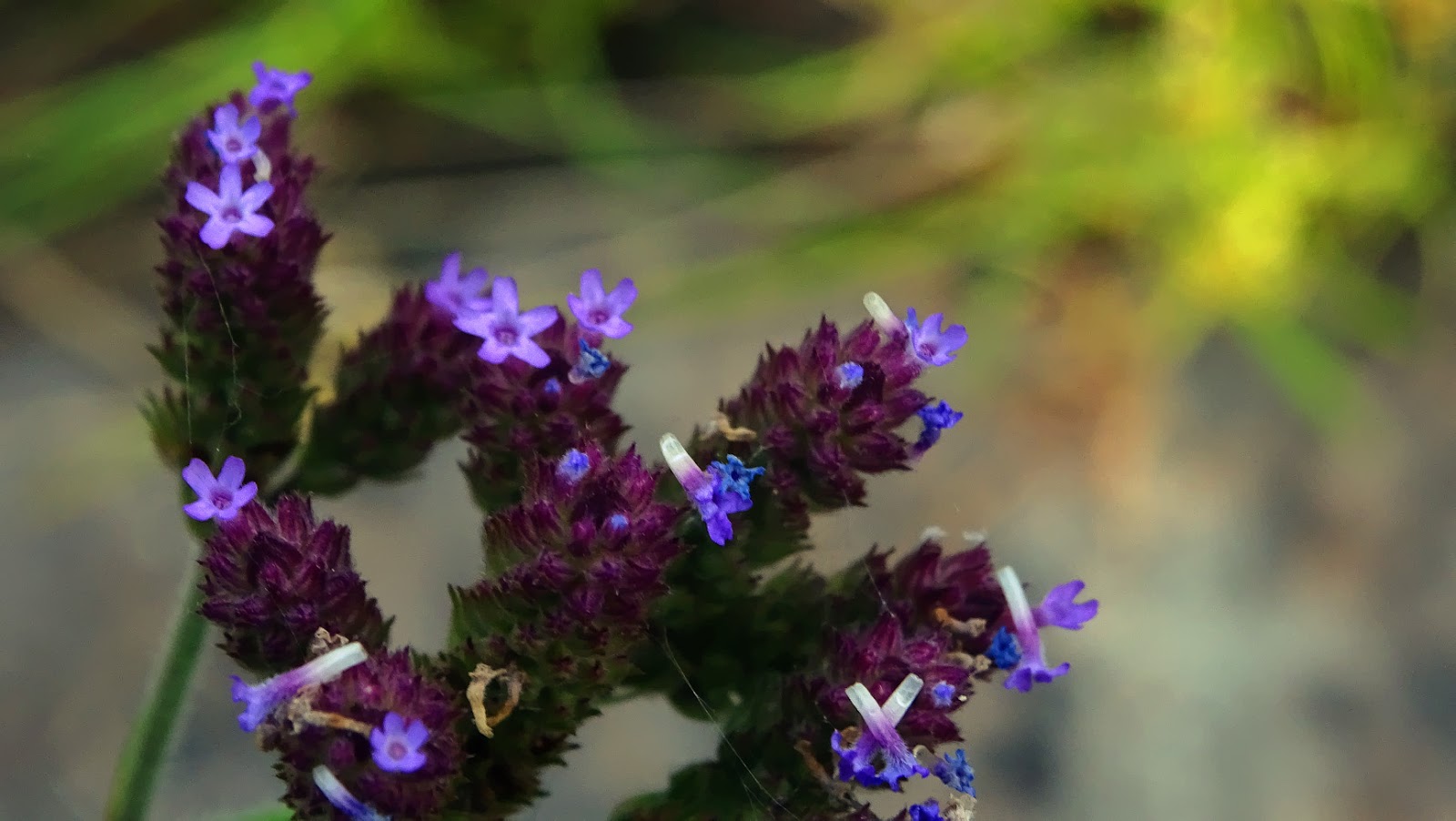
Verbena bonariensis (purpletop vervain, clustertop vervain, Argentinian vervain , tall verbena, or pretty verbena) is a member of the Verbenaceae family cultivated as a flowering annual or herbaceous perennial plant. In USA horticulture, it is also known by the ambiguous names "purpletop" (also used for the grass Tridens flavus) and "South American vervain" (which can mean any of the numerous species in the genus Verbena occurring in that continent). It is native to tropical South America where it grows throughout most of the warm regions, from Colombia and Brazil to Argentina and Chile.

Verbena bonariensis is a tall and slender-stemmed perennial. It can grow to 120 cm tall and can spread to 90 cm wide. At maturity, it will develop a woody base. Fragrant lavender to rose-purple flowers are in tight clusters located on terminal and axillary stems, blooming from mid-summer until Autumn frosts. The stem is square with very long internodes. Leaves are ovate to ovate-lanceolate with a toothed margin and grow up to 10 cm long.

V. bonariensis self-seeds readily. This ability has raised concerns that it may become an invasive species and noxious weed in favourable habitats. It has naturalised in a number of southern United States. Presently, the plant is on the invasive species watchlist for Washington state, naturalised in tropical and southern Africa, temperate Asia, Australia, New Zealand, the United States (including Hawaii), the West Indies, Macaronesia and the Mascarene Islands. According to Pacific Island Ecosystems at Risk, it is considered a weed in Fiji, New Guinea and other South Pacific islands.

Here it is growing as a weed by the Darebin Creek in Preston, in suburban Melbourne. It is very commonly encountered, but is not considered a noxious weed at the present time.

This post is part of the Floral Friday Fotos meme.


Thursday, 23 April 2015

MELBOURNE STREET TREES 110 - DURANTA

Duranta erecta is a species of flowering shrub in the verbena family Verbenaceae, native from Mexico to South America and the Caribbean. It is widely cultivated as an ornamental plant in tropical and subtropical gardens throughout the world, and has become naturalised in many places. It is considered an invasive species in Australia, China, South Africa and on several Pacific Islands. Common names include golden dewdrop, pigeon berry, and skyflower. In Mexico, the native Nahuatl name for the plant is xcambocoché. In Tonga it is known as mavaetangi (tears of departure).

Duranta erecta is a sprawling shrub or (infrequently) a small tree. It can grow to 6 m tall and can spread to an equal width. Mature specimens possess axillary thorns, which are often absent on younger specimens. The leaves are light green, elliptic to ovate, opposite, and grow up to 7.5 cm long and 3.5 cm broad, with a 1.5 cm petiole. The flowers are light-blue or lavender, produced in tight clusters located on terminal and axillary stems, blooming almost all year long. The fruit is a small globose yellow or orange berry, up to 11 mm in diameter and containing several seeds. The leaves and berries of the plant are toxic, and are confirmed to have killed children, dogs and cats. However, songbirds eat the fruit without ill effects.

This post is part of the Floral Friday Fotos meme.