Showing posts with label annual. Show all posts

Thursday, 8 August 2024

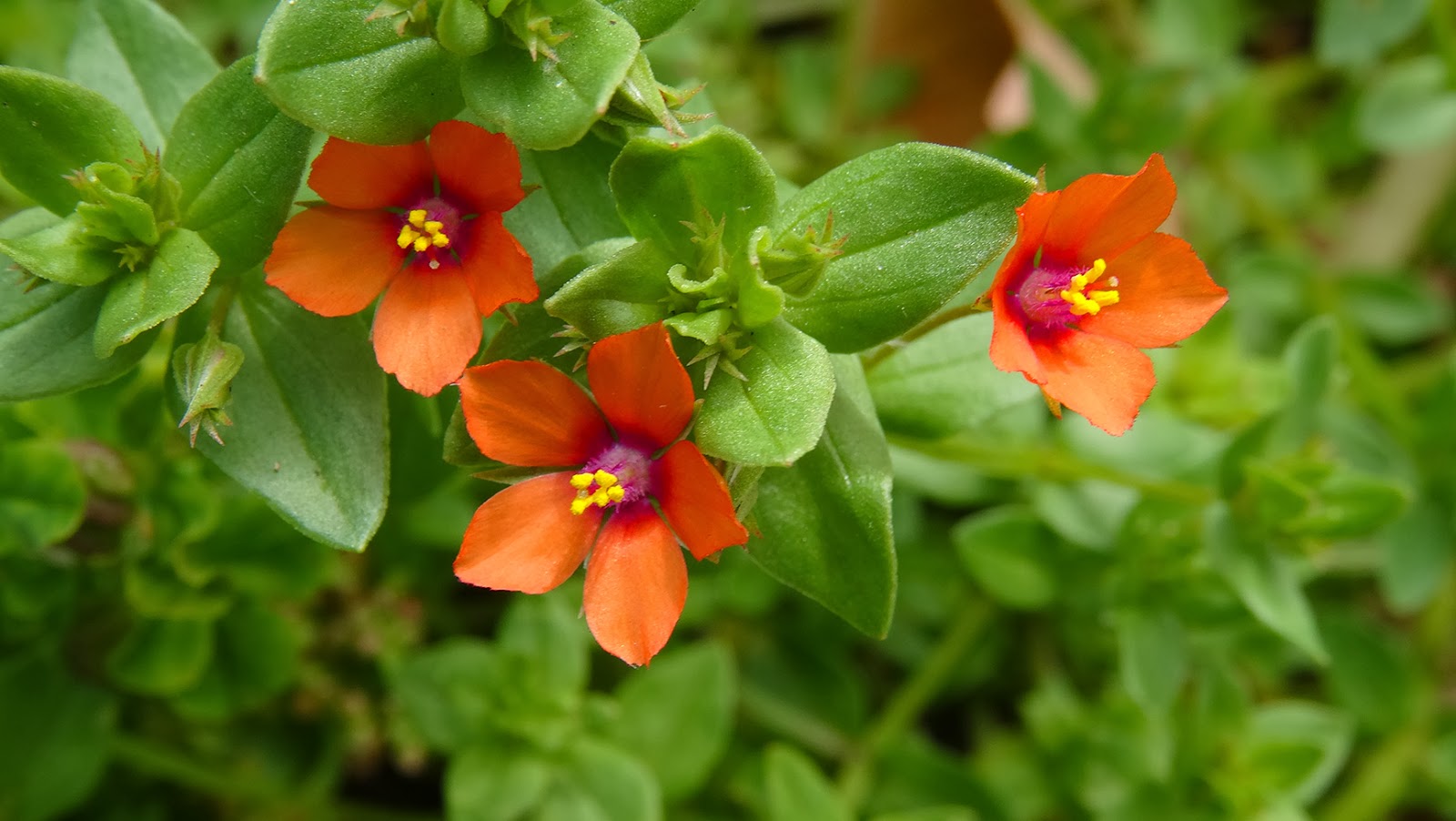
SCARLET PIMPERNEL

Scarlet pimpernel (Anagallis arvensis), also known as red pimpernel, red chickweed, poorman's barometer, poor man's weather-glass, shepherd's weather glass or shepherd's clock, is a low-growing annual plant. The native range of the species is Europe and Western and North Africa. The species has been distributed widely by humans, either deliberately as an ornamental flower or accidentally. A. arvensis is now naturalised almost worldwide, with a range that encompasses The Americas, Central and East Asia, the Indian Subcontinent, Malaysia, the Pacific Islands, Australasia and Southern Africa.

Although traditionally included in the family Primulaceae, the genus Anagallis is now considered to be better placed within the related family Myrsinaceae. In the APG III system, Primulaceae is expanded to include Myrsinaceae, thus Anagallis is in Primulaceae sensu lato.This common European plant is generally considered a weed and is an indicator of light soils. It is most well known for being the emblem of the fictional hero "The Scarlet Pimpernel", a novel written by the Baroness Emma Orczy.

This post is part of the Floral Friday Fotos meme
Thursday, 29 February 2024

COREOPSIS

Coreopsis is a genus of flowering plants in the family Asteraceae. Common names include calliopsis and tickseed, a name shared with various other plants. These plants range from 46–120 centimetres in height. The flowers are usually yellow with a toothed tip, but may also be yellow-and-red bicolor. They have showy flower heads with involucral bracts in two distinct series of eight each, the outer being commonly connate at the base.

The flat fruits are small and dry and look like insects. There are 75–80 species of Coreopsis, all of which are native to North, Central, and South America. The name Coreopsis is derived from the Greek words κόρις (koris), meaning "bedbug", and ὄψις (opsis), meaning "view", referring to the shape of the achene.

This post is part of the Floral Friday Fotos meme


Thursday, 22 February 2024

SUNFLOWERS

The common sunflower (Helianthus annuus) is a species of large annual forb of the genus Helianthus. It is commonly grown as a crop for its edible oily seeds. Apart from cooking oil production, it is also used as livestock forage (as a meal or a silage plant), as bird food, in some industrial applications, and as an ornamental in domestic gardens.

Wild H. annuus is a widely branched annual plant with many flower heads. The domestic sunflower, however, often possesses only a single large inflorescence (flower head) atop an unbranched stem. The plant was first domesticated in the Americas.

Sunflower seeds were brought to Europe from the Americas in the 16th century, where, along with sunflower oil, they became a widespread cooking ingredient. With time, the bulk of industrial-scale production has shifted to Eastern Europe, and (as of 2020) Russia and Ukraine together produce over half of worldwide seed production.

This post is part of the Floral Friday Fotos meme


Thursday, 28 December 2023

ANGELONIA

Angelonia is a genus of about 30 species which occur from Mexico to Argentina and is classified in the Plantaginaceae family. They are herbaceous plants occurring mainly in arid and semi-arid habitats. Most Angelonia species can be found in Northeastern Brazil in the Seasonally Dry Tropical Forest, namely Caatinga.

The flowers of Angelonia are highly specialized for pollination because they have hairs in the inner corolla, which produce oils collected by oil bee pollinators, especially of the genus Centris.

Many hybrids are cultivated as ornamental plants for their snapdragon-like flowers, but need warm temperatures and large amounts of sunlight. Garden varieties are mainly cultivars of A. angustifolia.

This post is part of the Floral Friday Fotos meme


Thursday, 12 January 2023

NEMESIA

Nemesia is a genus of annuals, perennials and sub-shrubs which are native to sandy coasts or disturbed ground in South Africa. Numerous hybrids have been selected, and the annual cultivars are popular with gardeners as bedding plants. In temperate regions the annual cultivars are usually treated as half-hardy bedding plants, sown from seed in heat and planted out after all danger of frost has passed.

The flowers are two-lipped, with the upper lip consisting of four lobes and the lower lip two lobes. The cultivar 'Innocence', a low-growing bushy perennial with white flowers, has gained the Royal Horticultural Society's Award of Garden Merit. The cultivar shown here is 'Sunsatia Banana', which is a popular ornamental hybrid.

This post is part of the Floral Friday Fotos meme

Thursday, 13 October 2022

LEWISIA

Lewisias are small, colourful flowering plants in the Montiaceae family, which are native to the Rocky Mountains of Colorado. Named after the US explorer Lieutenant Meriwether Lewis, these plants are wonderful for providing colour in rock crevices in a cool climate.

Lewisia cotyledon 'Elise' shown here flowers in the first season without a cold period and can be used as an annual for rockeries, beds and containers. The plant starts flowering 4-5 months after sowing and is sturdy, with attractive fleshy, succulent leaves and flowers all season long in shades of pastel pink, rose, salmon, orange, white and yellow, and bicolour patterns.

This post is part of the Floral Friday Fotos meme.