Showing posts with label snakes. Show all posts

Saturday, 31 October 2026

HAPPY HALLOWEEN!

Three poor creatures with bad press: Australian Golden Orb-Weaving Spider (Trichonephila edulis); Grey-headed flying fox (Pteropus poliocephalus), Australia's largest native bat species; and a poisonous Tiger Snake (Notechis scutatus). They're all getting ready for a Halloween party.

This post is part of the Saturday Critters meme.


HAPPY HALLOWEEN!

Tuesday, 13 January 2026

BEAUTY HIDES DANGER

Walking along the Darebin Creek in Thornbury, an inner suburb, one can enjoy the natural beauty of the bush in the midst of the City. However, in Summer especially, there may be some untoward encounters, such as meeting this Tiger Snake.

The Tiger Snake (Notechis scutatus) is a large and highly venomous snake of southern Australia, including its coastal islands and Tasmania. These snakes are often observed and locally well known by their banding, black and yellow like a tiger, although the species can be highly variable in colouration and patterning. All populations are classified within the genus Notechis (Elapidae). Their diverse characteristics have been classified either as distinct species or by subspecies and regional variation. While tiger snakes are usually ground-dwelling, they are able to swim as well as climb into trees and buildings.

This post is part of the Travel Tuesday meme
and also part of the Saturday Critters meme


Saturday, 4 October 2025

SNAKE SEASON

Australia has nearly 200 known species of snake, only 25 of which are considered potentially deadly. Common snakes in the Melbourne area and surrounding suburbs include the Tiger Snake, Eastern Brown Snake, Copperhead Snake, White-Lipped Snake, Small-Eyed Snake and Red-Bellied Black Snake. There are over 27 types of snake in Victoria and a number of these are venomous, including the tiger snake, the copperhead, the brown snake and the red-bellied black snake.

Darebin Parklands is a nature reserve in the midst of inner suburban Melbourne. It has a host of animal species, many of them native that live happily in its confines. These creatures of course include snakes. Numerous signs relating to snakes are found throughout the Parklands, reminding people to take care during the Summer between the months of October to April.

I have seen snakes a number of times, in the Parklands and elsewhere, but fortunately these encounters have been innocent enough. While seeing a snake may be an intimidating experience, they are typically shy creatures and most will try to avoid confrontation with humans and quickly slither away (how quickly they can move is indeed a sobering experience).

Snakes go into brumation during the cooler months. Brumation is a state of winter dormancy exhibited by cold-blooded animals, such as reptiles and amphibians, during periods of low temperatures or reduced daylight. It is a naturally occurring process where an animal's metabolic rate slows down, leading to increased sleep, decreased appetite, and reduced activity. This state differs from true hibernation in that it is not dependent on the animal's body temperature but rather on environmental conditions.

Brumation is officially ending in October in Melbourne and snakes are becoming more active, as this wide-awake tiger snake is exhibiting in the Darebin Parklands. I said hello, took its photo discreetly and quietly left...

This post is part of the Saturday Critters meme


Saturday, 8 January 2022

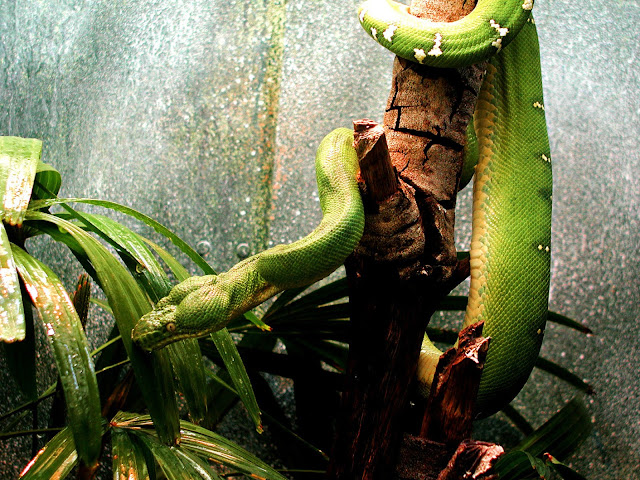
GREEN TREE PYTHON

Morelia viridis, commonly known as the green tree python, or as it is known in the herpetoculture hobby, 'chondro' (due to its former classification in the genus Chondropython) is a species of python found in New Guinea, islands in Indonesia, and Cape York Peninsula in Australia. The species usually reaches a total length of 150–180 cm, but large females may reach 200 cm. The size also varies depending on the region of origin.

The weight is highly dependent upon the nutritional status of the animal. Males can weigh about 1100-1400 g, females up to 1,600 g, although wild specimens are typically much lighter than this. Especially large specimens up to 2,200 g are invariably females, which like most snakes are slightly larger and heavier than males. Its main habitat is typically in or near rainforest, and is primarily arboreal, residing in trees, shrubs and bushes. Occasionally it is seen on the ground. This species is not currently thought to be threatened in its natural habitat, although it remains very popular in the pet trade. Some hunting for food is known to occur in New Guinea.

The diet of these pythons consists mostly of small mammals, such as rodents, and sometimes reptiles. Prey is captured by holding onto a branch using the prehensile tail and striking out from an s-shaped position and constricting the prey. Wild specimens have also been observed and photographed wrapped around the base of small tree trunks, facing down in an ambush position, presumably waiting for ground mammals to prey upon.

Morelia viridis is oviparous, laying 1-25 viable eggs per clutch. Breeding has never been reported from the wild, however in captivity eggs are incubated and protected by the female. Hatchlings are lemon-yellow with broken stripes and spots of purple and brown, or golden or orange-red. These snakes are often bred and kept in captivity, although they are usually considered an advanced species due to their specific care requirements; once these are met, they usually thrive in captivity.

This post is part of the Saturday Critters meme


Wednesday, 15 May 2019

S for SNAKE

Australia has nearly 200 known species of snake, only 25 of which are considered potentially deadly. Common snakes in the Melbourne area and surrounding suburbs include the Tiger Snake, Eastern Brown Snake, Copperhead Snake, White-Lipped Snake, Small-Eyed Snake and Red-Bellied Black Snake. There are over 27 types of snake in Victoria and a number of these are venomous, including the tiger snake, the copperhead, the brown snake and the red-bellied black snake.

Darebin Parklands being a nature reserve in the midst of inner suburban Melbourne, has a host of animal species, many of them native that live happily in its confines. These creatures of course include snakes. Numerous signs relating to snakes are found throughout the Parklands, reminding people to take care during the Summer between the months of October to April.

I have seen snakes a number of times, in the Parklands and elsewhere, but fortunately these encounters have been innocent enough. While seeing a snake may be an intimidating experience, they are typically shy creatures and most will try to avoid confrontation with humans and quickly slither away (how quickly they can move is indeed a sobering experience). My latest encounter was with a 1.2 m tiger snake that was crawling along the path, rushing to get to an area well-covered with grass and bushes. This was a couple of months ago and the day was very hot and the snake moved extremely quickly, rushing away from me towards cover. It was fortunate I had the camera in my hands and was able to take a few photos.

Tiger snakes, like this one, are a highly venomous snake species found in the southern regions of Australia, including its coastal islands, such as Tasmania. These snakes are highly variable in their colour, often banded like those on a tiger, and forms in their regional occurrences. All populations are in the genus Notechis, and their diverse characters have been described in further subdivisions of this group; they are sometimes described as distinct species and/or subspecies. Tiger snakes accounted for 17% of identified snakebite victims in Australia between 2005 and 2015, with four deaths recorded from 119 confirmed envenomations.

Tiger snake venoms possess potent neurotoxins, coagulants, haemolysins, and myotoxins. Symptoms of a bite include localised pain in the foot and neck region, tingling, numbness, and sweating, followed by a fairly rapid onset of breathing difficulties and paralysis. In a study, the mortality rate from untreated bites is reported to be between 40 and 60%. The risk of being bitten by a snake or dying from a snake bite is extremely low. While highly variable, it is estimated that no more than 100 or 200 people each year get bitten by snakes in Victoria. Despite this, on average only one person every 5 years dies of a snake bite. The last recorded fatal snake bite in Victoria was by a tiger snake in November 2014. To put the risk of dying from a snake bite in perspective, consider that each year in Victoria about 40 people die from drowning in waterways and about 250 people die in car accidents. 

Treatment is the same for all Australian venomous snakes. The pressure immobilisation method is used to inhibit the flow of venom through the lymphatic system. Broad, thick bandages are applied over the bite, then down and back along the limb to the armpit or groin. The affected limb is then immobilised with a splint. Identification of the venom is possible if traces are left near the wound. The availability of antivenom has greatly reduced the incidence of fatal tiger snake bites. Among the number of deaths caused by snakebite in Australia, those from tiger snakes are exceeded only by the brown snake. In most Australian states, tiger snakes are protected species, and to kill or injure one incurs a fine up to $7,500, as well as a jail sentence of 18 months in some states. It is also illegal to export a native Australian snake.

This post is part of the Wordless Wednesday meme,
and also part of the ABC Wednesday meme,
and also part of the Nature Notes meme.


Saturday, 8 December 2018

SNAKE SEASON!

Australia has nearly 200 known species of snake, only 25 of which are considered potentially deadly. Common snakes in the Melbourne area and surrounding suburbs include the Tiger Snake, Eastern Brown Snake, Copperhead Snake, White-Lipped Snake, Small-Eyed Snake and Red-Bellied Black Snake. There are over 27 types of snake in Victoria and a number of these are venomous, including the tiger snake, the copperhead, the brown snake and the red-bellied black snake.

Darebin Parklands is a nature reserve in the midst of inner suburban Melbourne. It has a host of animal species, many of them native that live happily in its confines. These creatures of course include snakes. Numerous signs relating to snakes are found throughout the Parklands, reminding people to take care during the Summer between the months of October to April.

I have seen snakes a number of times, in the Parklands and elsewhere, but fortunately these encounters have been innocent enough. While seeing a snake may be an intimidating experience, they are typically shy creatures and most will try to avoid confrontation with humans and quickly slither away (how quickly they can move is indeed a sobering experience).

The latest encounter was with a 1.2 m tiger snake that was crawling along the path, rushing to get to an area well-covered with grass and bushes. The day was very hot and the snake moved extremely quickly, rushing away from me towards cover. It was fortunate I had the camera in my hands and was able to take a few photos.

Tiger snakes are a highly venomous snake species found in the southern regions of Australia, including its coastal islands, such as Tasmania. These snakes are highly variable in their colour, often banded like those on a tiger, and forms in their regional occurrences. All populations are in the genus Notechis, and their diverse characters have been described in further subdivisions of this group; they are sometimes described as distinct species and/or subspecies.

Tiger snakes accounted for 17% of identified snakebite victims in Australia between 2005 and 2015, with four deaths recorded from 119 confirmed envenomations. Tiger snake venoms possess potent neurotoxins, coagulants, haemolysins, and myotoxins. Symptoms of a bite include localised pain in the foot and neck region, tingling, numbness, and sweating, followed by a fairly rapid onset of breathing difficulties and paralysis. In a study, the mortality rate from untreated bites is reported to be between 40 and 60%.

The risk of being bitten by a snake or dying from a snake bite is extremely low. While highly variable, it is estimated that no more than 100 or 200 people each year get bitten by snakes in Victoria. Despite this, on average only one person every 5 years dies of a snake bite. The last recorded fatal snake bite in Victoria was by a tiger snake in November 2014. To put the risk of dying from a snake bite in perspective, consider that each year in Victoria about 40 people die from drowning in waterways and about 250 people die in car accidents.

Treatment is the same for all Australian venomous snakes. The pressure immobilisation method is used to inhibit the flow of venom through the lymphatic system. Broad, thick bandages are applied over the bite, then down and back along the limb to the armpit or groin. The affected limb is then immobilised with a splint. Identification of the venom is possible if traces are left near the wound.

The availability of antivenom has greatly reduced the incidence of fatal tiger snake bites. Among the number of deaths caused by snakebite in Australia, those from tiger snakes are exceeded only by the brown snake. In most Australian states, tiger snakes are protected species, and to kill or injure one incurs a fine up to $7,500, as well as a jail sentence of 18 months in some states. It is also illegal to export a native Australian snake.

This post is part of the Saturday Critters meme,
and also part of the Camera Critters meme.