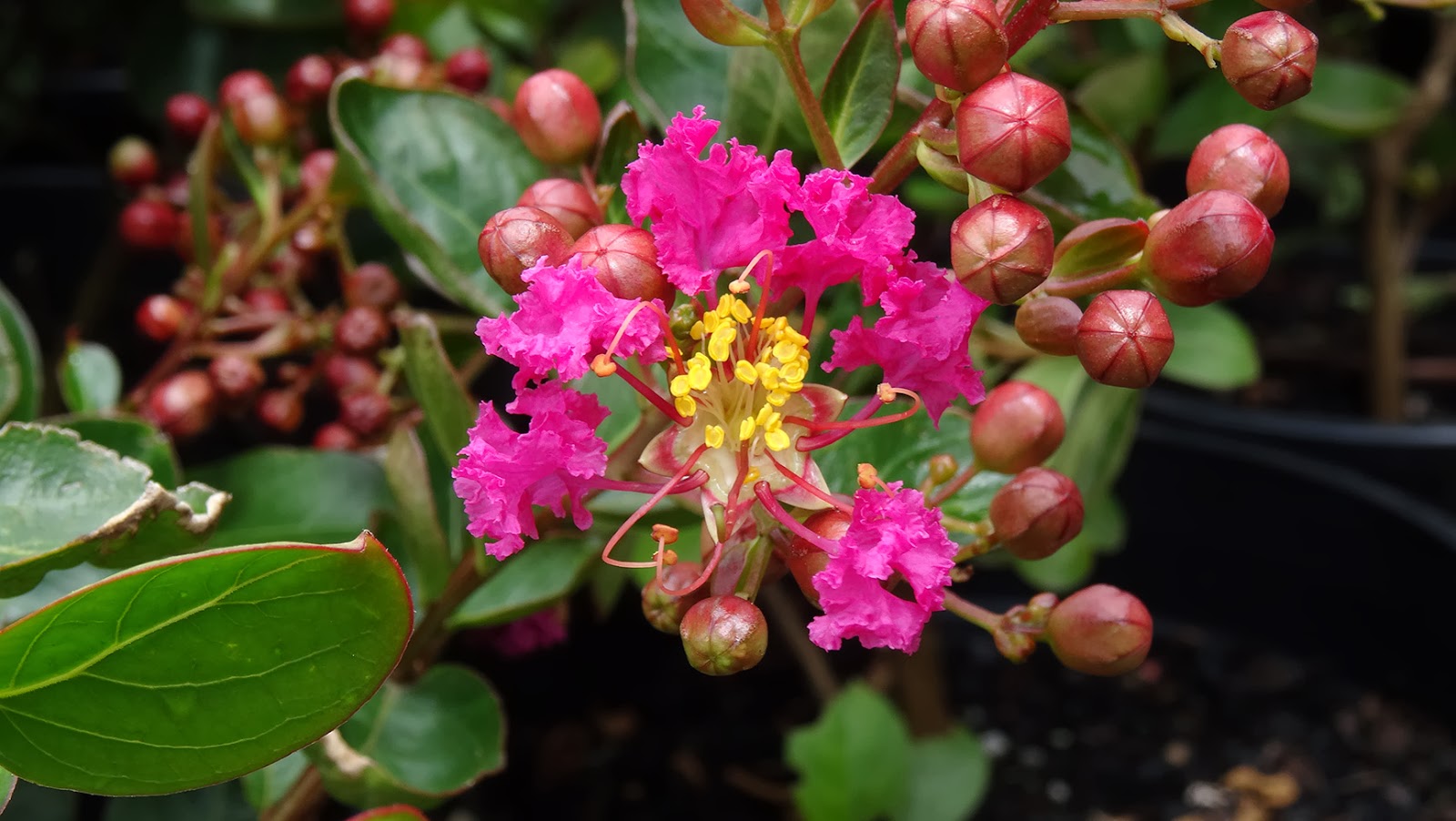
Lagerstroemia, commonly known as crepe myrtle, is a genus of around 50 species of deciduous and evergreen trees and shrubs native to the Indian Subcontinent, southeast Asia, northern Australia and parts of Oceania, cultivated in warmer climates around the world. It is a member of the Lythraceae, which is also known as the loosestrife family. The genus is named after the Swedish merchant Magnus von Lagerström, who supplied Carolus Linnaeus with plants he collected. These flowering trees are beautifully coloured and are often planted both privately and commercially. Popular varieties used in modern landscaping include the bright red Dynamite Crepe Myrtle, the deep pink Pink Velour Crepe and the purple Twilight Crepe Myrtle, which also has a bark that changes colours.
Crepe myrtles are chiefly known for their colourful and long-lasting flowers which occur in summer months. Most species of Lagerstroemia have sinewy, fluted stems and branches with a mottled appearance that arises from having bark that sheds throughout the year. The leaves are opposite, simple, with entire margins, and vary from 5–20 cm. While all species are woody in nature, they can range in height from over 30 metres to under one 30 cm, most, however are small to medium multiple-trunked trees and shrubs. The leaves of temperate species provide autumn colour.
Flowers are borne in Summer and Autumn in panicles of crinkled flowers with a crepe-like texture. Colours vary from deep purple to red to white, with almost every shade in between. Although no blue-flowered varieties exist, it is toward the blue end of the spectrum that the flowers trend, with no sight of orange or yellow except in stamens and pistils. The fruit is a capsule, green and succulent at first, then ripening to dark brown or black dryness. It splits along six or seven lines, producing teeth much like those of the calyx, and releases numerous, small, winged seeds.
This post is part of the Floral Friday Fotos meme.
Lagerstroemia, commonly known as crepe myrtle, is a genus of around 50 species of deciduous and evergreen trees and shrubs native to the Indian Subcontinent, southeast Asia, northern Australia and parts of Oceania, cultivated in warmer climates around the world. It is a member of the Lythraceae, which is also known as the loosestrife family. The genus is named after the Swedish merchant Magnus von Lagerström, who supplied Carolus Linnaeus with plants he collected. These flowering trees are beautifully coloured and are often planted both privately and commercially. Popular varieties used in modern landscaping include the bright red Dynamite Crepe Myrtle, the deep pink Pink Velour Crepe and the purple Twilight Crepe Myrtle, which also has a bark that changes colours.
Crepe myrtles are chiefly known for their colourful and long-lasting flowers which occur in summer months. Most species of Lagerstroemia have sinewy, fluted stems and branches with a mottled appearance that arises from having bark that sheds throughout the year. The leaves are opposite, simple, with entire margins, and vary from 5–20 cm. While all species are woody in nature, they can range in height from over 30 metres to under one 30 cm, most, however are small to medium multiple-trunked trees and shrubs. The leaves of temperate species provide autumn colour.
Flowers are borne in Summer and Autumn in panicles of crinkled flowers with a crepe-like texture. Colours vary from deep purple to red to white, with almost every shade in between. Although no blue-flowered varieties exist, it is toward the blue end of the spectrum that the flowers trend, with no sight of orange or yellow except in stamens and pistils. The fruit is a capsule, green and succulent at first, then ripening to dark brown or black dryness. It splits along six or seven lines, producing teeth much like those of the calyx, and releases numerous, small, winged seeds.
This post is part of the Floral Friday Fotos meme.
Lagerstroemia, commonly known as crepe myrtle, is a genus of around 50 species of deciduous and evergreen trees and shrubs native to the Indian Subcontinent, southeast Asia, northern Australia and parts of Oceania, cultivated in warmer climates around the world. It is a member of the Lythraceae, which is also known as the loosestrife family. The genus is named after the Swedish merchant Magnus von Lagerström, who supplied Carolus Linnaeus with plants he collected. These flowering trees are beautifully coloured and are often planted both privately and commercially. Popular varieties used in modern landscaping include the bright red Dynamite Crepe Myrtle, the deep pink Pink Velour Crepe and the purple Twilight Crepe Myrtle, which also has a bark that changes colours.
Crepe myrtles are chiefly known for their colourful and long-lasting flowers which occur in summer months. Most species of Lagerstroemia have sinewy, fluted stems and branches with a mottled appearance that arises from having bark that sheds throughout the year. The leaves are opposite, simple, with entire margins, and vary from 5–20 cm. While all species are woody in nature, they can range in height from over 30 metres to under one 30 cm, most, however are small to medium multiple-trunked trees and shrubs. The leaves of temperate species provide autumn colour.
Flowers are borne in Summer and Autumn in panicles of crinkled flowers with a crepe-like texture. Colours vary from deep purple to red to white, with almost every shade in between. Although no blue-flowered varieties exist, it is toward the blue end of the spectrum that the flowers trend, with no sight of orange or yellow except in stamens and pistils. The fruit is a capsule, green and succulent at first, then ripening to dark brown or black dryness. It splits along six or seven lines, producing teeth much like those of the calyx, and releases numerous, small, winged seeds.
This post is part of the Floral Friday Fotos meme.
The pomegranate, scientific name Punica granatum, is a fruit-bearing deciduous shrub or small tree growing between 2–8 metres tall.The pomegranate is widely considered to have originated in the vicinity of Iran and has been cultivated since ancient times. Today, it is widely cultivated throughout the Mediterranean region of southern Europe, the Middle East and Caucasus region, northern Africa and tropical Africa, the Indian subcontinent and the drier parts of southeast Asia.
Introduced into Latin America and California by Spanish settlers in 1769, the pomegranate is also cultivated in parts of California and Arizona. In the Northern Hemisphere, the fruit is typically in season from September to February. In the Southern Hemisphere, the pomegranate is in season from March to May.The pomegranate has been mentioned in many ancient texts, notably in Babylonian texts, the Book of Exodus, the Homeric Hymns and the Quran. In recent years, it has become more common in the commercial markets of North America and the Western Hemisphere. Pomegranates are used in cooking, baking, juices, smoothies and alcoholic beverages, such as martinis and wine.
Walking around our neighbourhood recently we discovered this wonderful specimen of pomegranate and it was good see the ripe fruits bursting open to display their jewel-like seeds.
This post is part of the Ruby Tuesday meme.