

Showing posts with label Magnoliaceae. Show all posts
Showing posts with label Magnoliaceae. Show all posts
Thursday, 14 August 2025

Thursday, 2 January 2025
MAGNOLIA
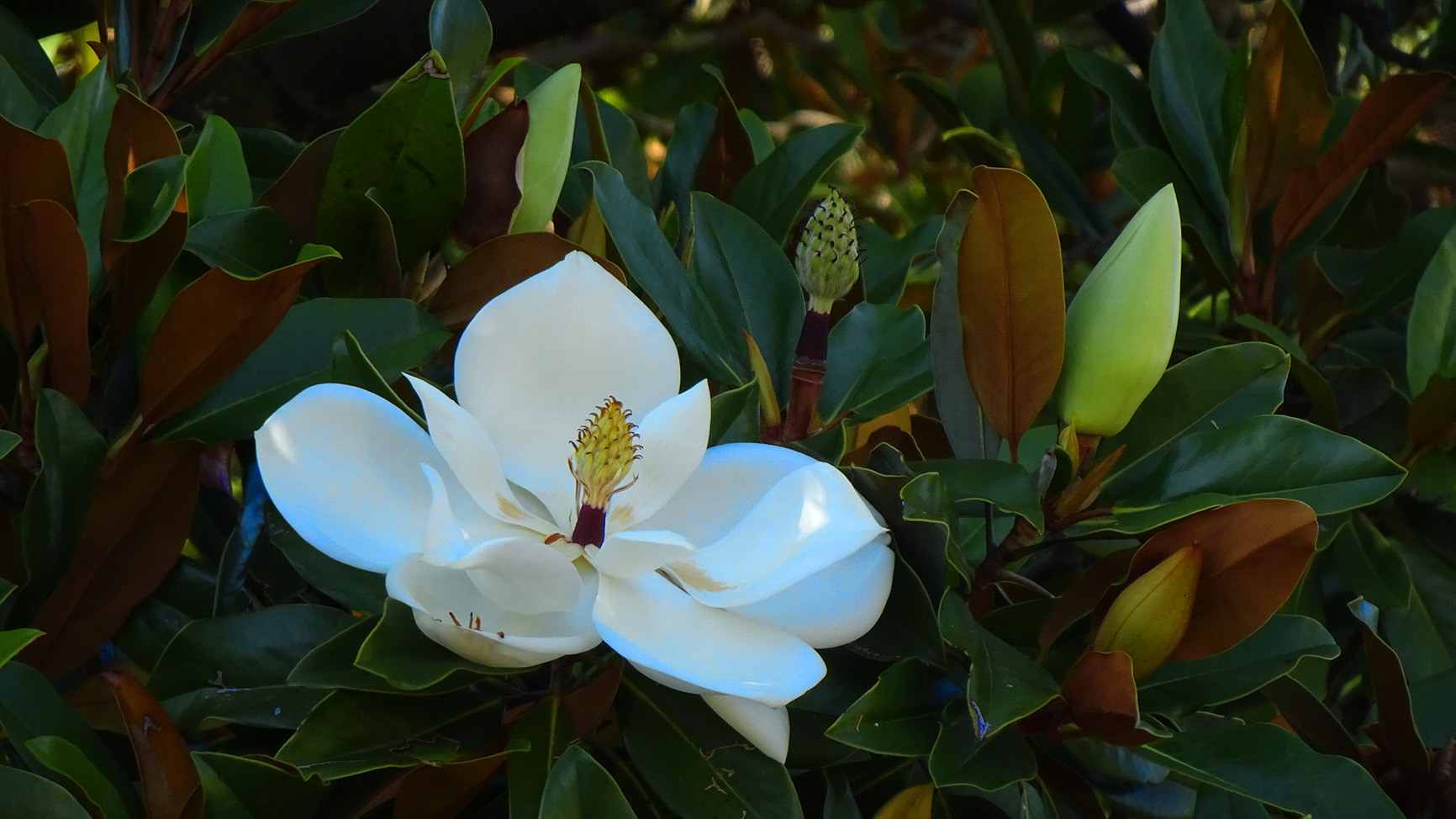
Magnolia grandiflora, commonly known as the southern magnolia or bull bay, is a tree of the family Magnoliaceae native to the Southeastern United States, from Virginia to central Florida, and west to East Texas. Reaching 27.5 m in height, it is a large, striking evergreen tree, with large, dark-green leaves up to 20 cm long and 12 cm wide, and large, white, fragrant flowers up to 30 cm in diameter.
Although endemic to the evergreen lowland subtropical forests on the Gulf and South Atlantic coastal plain, M. grandiflora is widely cultivated in warmer areas around the world. The timber is hard and heavy, and has been used commercially to make furniture, pallets, and veneer.
This post is part of the Floral Friday Fotos meme

Thursday, 9 February 2023
MAGNOLIA
Magnolia is a large genus of about 210 to 340 flowering plant species in the subfamily Magnolioideae of the family Magnoliaceae. It is named after French botanist Pierre Magnol. Illustrated here is the magnificent Magnolia grandiflora.
This post is part of the Floral Friday Fotos meme
Thursday, 11 August 2022
MAGNOLIA
Magnolia laevifolia grows as a small tree bearing multitudes of golden buds. Unlike other magnolia relatives, the buds form in the leaf axils and along the stem. The bright, hairy bud scales (perules) split off at blooming time to reveal an ivory flower with "butter-yellow stamens like lashes opening to the sun," described one grower. The waxy, chalice-like flower has a delicate perfume, and can bloom from mid-winter and continue late into the autumn. A tree in full bloom can perfume the air for several metres around it.
The leaves are oval-shaped and tough with a golden edge.There are 41 species of what was once called Michelia in China (all of which have been lumped into the genus Magnolia), and 23 of these grow in Yunnan. Some are two hundred years old and grow at altitudes as high as 9000 feet, far higher than other varieties of magnolias can survive.
This post is part of the Floral Friday Fotos meme.

Thursday, 8 September 2016
MELBOURNE STREET TREES 156 - FAIRY MAGNOLIA
Michelia is a genus of flowering plants belonging to the magnolia family (Magnoliaceae). The genus includes about 50 species of evergreen trees and shrubs, native to tropical and subtropical south and southeast Asia (Indomalaya), including southern China.
The Magnoliaceae is an ancient family; fossil plants identifiably belonging to the Magnoliaceae date back 95 million years. A primitive aspect of the Magnolia family is that their large, cup-shaped flowers lack distinct petals or sepals. The large non-specialised flower parts, resembling petals, are called tepals. The leaves, flowers, and form of Michelia resemble Magnolia, but the blossoms of Michelia generally form clusters among the leaves, rather than singly at the branch ends as Magnolia does.
Currently popular in Melbourne is a new hybrid of Michelia, called 'Fairy Magnolia'. This is designated Michelia x MicJUR01 and was bred in New Zealand by Mark Jury in the late 1990s. It produces masses of beautiful fragrant flowers blushed with lilac-pink in early Spring. These plants are so free flowering that they have a flower bud at each leaf axil and have been known to provide a light flush of flowers during summer too. The plants are bushy with rich evergreen foliage, which makes them ideal in the garden as a flowering hedge or specimen plant.
This post is part of the Floral Friday Fotos meme.


This post is part of the Floral Friday Fotos meme.


Thursday, 7 July 2016
MELBOURNE STREET TREES 152 - STAR MAGNOLIA
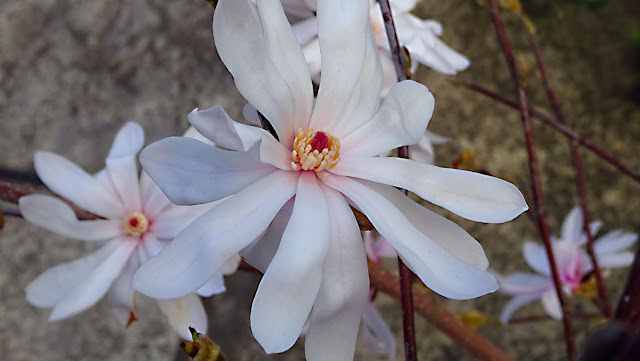
Magnolia stellata, sometimes called the star magnolia, is a slow-growing shrub or small tree in the Magnoliaceae family, native to Japan. It bears large, showy white or pink flowers in early spring, before its leaves open. This species is closely related to the Kobushi magnolia (Magnolia kobus), and is treated by many botanists as a variety or even a cultivar of that. However, Magnolia stellata was accepted as a distinct species in the 1998 monograph by Hunt.
This tree grows 1.5 to 2.5 m in height, spreading to 4.6m in width at maturity. Young trees display upright oval growth, but the plants spread and mound with age. The tree blooms at a young age, with the slightly fragrant 7-10 cm flowers covering the bare plant in late winter or early spring before the leaves appear. There is natural variation within the flower colour, which varies from white to rich pink; the hue of pink magnolias also changes from year to year, depending on day and night air temperatures prior to and during flowering.
The flowers are star-shaped, with at least 12 thin, delicate petal-like tepals—some cultivars have more than 30 tepals. The leaves open bronze-green, turning to deep green as they mature, and yellow before dropping in autumn. They are oblong and about 10 cm long by about an 4 cm wide. These magnolias produce a reddish-green, knobby aggregate fruit about 2 in long that matures and opens in early autumn. Mature fruit opens by slits to reveal orange-red seeds, but the fruits often drop before developing fully.
Young twigs have smooth, shiny chestnut brown bark, while the main trunks have smooth, silvery gray bark. Like the saucer magnolia (Magnolia × soulangeana), it is deciduous, revealing a twiggy, naked frame in winter. Plants have thick, fleshy roots which are found fairly close to the surface and do not tolerate much disturbance. Spring frosts can damage the flowers. The shrub prefers deep, acidic soil. It may be propagated by seed, or more easily by rooting cuttings taken after the flower buds have formed.
This post is part of the Floral Friday Fotos meme.


This tree grows 1.5 to 2.5 m in height, spreading to 4.6m in width at maturity. Young trees display upright oval growth, but the plants spread and mound with age. The tree blooms at a young age, with the slightly fragrant 7-10 cm flowers covering the bare plant in late winter or early spring before the leaves appear. There is natural variation within the flower colour, which varies from white to rich pink; the hue of pink magnolias also changes from year to year, depending on day and night air temperatures prior to and during flowering.
The flowers are star-shaped, with at least 12 thin, delicate petal-like tepals—some cultivars have more than 30 tepals. The leaves open bronze-green, turning to deep green as they mature, and yellow before dropping in autumn. They are oblong and about 10 cm long by about an 4 cm wide. These magnolias produce a reddish-green, knobby aggregate fruit about 2 in long that matures and opens in early autumn. Mature fruit opens by slits to reveal orange-red seeds, but the fruits often drop before developing fully.
Young twigs have smooth, shiny chestnut brown bark, while the main trunks have smooth, silvery gray bark. Like the saucer magnolia (Magnolia × soulangeana), it is deciduous, revealing a twiggy, naked frame in winter. Plants have thick, fleshy roots which are found fairly close to the surface and do not tolerate much disturbance. Spring frosts can damage the flowers. The shrub prefers deep, acidic soil. It may be propagated by seed, or more easily by rooting cuttings taken after the flower buds have formed.
This post is part of the Floral Friday Fotos meme.


Thursday, 30 July 2015
MELBOURNE STREET TREES 123 - MAGNOLIA
Magnolia × soulangeana (saucer magnolia) is a hybrid plant in the genus Magnolia and family Magnoliaceae. It is a deciduous tree with large, early-blooming flowers in various shades of white, pink, and purple. It is one of the most commonly used magnolias in horticulture, being widely planted in the British Isles, especially in the south of England; in the United States, especially the east and west coasts, in the Southern parts of Australia and in New Zealand.
Magnolia × soulangeana was initially bred by French plantsman Étienne Soulange-Bodin (1774–1846), a retired cavalry officer in Napoleon's army, at his château de Fromont near Paris. He crossed Magnolia denudata with M. liliiflora in 1820, and was impressed with the resulting progeny's first precocious flowering in 1826. From France, the hybrid quickly entered cultivation in England and other parts of Europe, and also North America. Since then, plant breeders in many countries have continued to develop this magnolia, and over a hundred named horticultural varieties (cultivars) are now known.
Growing as a multistemmed large shrub or small tree, Magnolia × soulangeana has alternate, simple, shiny, dark green oval-shaped leaves on stout stems. Its flowers emerge dramatically on a bare tree in early spring, with the deciduous leaves expanding shortly thereafter, lasting through summer until autumn. Magnolia × soulangeana flowers are large, commonly 10–20 cm across, and coloured various shades of white, pink, and maroon. An American variety, 'Grace McDade' from Alabama, is reported to bear the largest flowers, with a 35 cm, white tinged with pinkish-purple. Another variety, Magnolia × soulangeana 'Jurmag1', is supposed to have the darkest and tightest flowers. The exact timing and length of flowering varies between named varieties, as does the shape of the flower. Some are globular, others a cup-and-saucer shape.
This post is part of the Floral Friday Fotos meme,
and also part of the Skywatch Friday meme.


Magnolia × soulangeana was initially bred by French plantsman Étienne Soulange-Bodin (1774–1846), a retired cavalry officer in Napoleon's army, at his château de Fromont near Paris. He crossed Magnolia denudata with M. liliiflora in 1820, and was impressed with the resulting progeny's first precocious flowering in 1826. From France, the hybrid quickly entered cultivation in England and other parts of Europe, and also North America. Since then, plant breeders in many countries have continued to develop this magnolia, and over a hundred named horticultural varieties (cultivars) are now known.
Growing as a multistemmed large shrub or small tree, Magnolia × soulangeana has alternate, simple, shiny, dark green oval-shaped leaves on stout stems. Its flowers emerge dramatically on a bare tree in early spring, with the deciduous leaves expanding shortly thereafter, lasting through summer until autumn. Magnolia × soulangeana flowers are large, commonly 10–20 cm across, and coloured various shades of white, pink, and maroon. An American variety, 'Grace McDade' from Alabama, is reported to bear the largest flowers, with a 35 cm, white tinged with pinkish-purple. Another variety, Magnolia × soulangeana 'Jurmag1', is supposed to have the darkest and tightest flowers. The exact timing and length of flowering varies between named varieties, as does the shape of the flower. Some are globular, others a cup-and-saucer shape.
This post is part of the Floral Friday Fotos meme,
and also part of the Skywatch Friday meme.


Thursday, 15 January 2015
MELBOURNE STREET TREES 99 - MAGNOLIA
Magnolia grandiflora, commonly known as the southern magnolia or bull bay, is a tree of the family Magnoliaceae native to the southeastern United States, from Virginia south to central Florida, and west to East Texas and Oklahoma. Reaching 28 m in height, it is a large, striking, evergreen tree with large, dark green leaves up to 20 cm long and 12 cm wide, and large, white, fragrant flowers up to 30 cm in diameter. Widely cultivated in warmer areas around the world, over 50 cultivars have been bred and marketed commercially. The timber is hard and heavy, and has been used commercially to make furniture, pallets, and veneer.
The climate in Melbourne suits this tree very well and there are many fine specimens in gardens, parks, streets and reserves. Once established, the trees are drought tolerant, and are indeed the most drought tolerant of all the Magnolia species.
This post is part of the Floral Friday Fotos meme.


The climate in Melbourne suits this tree very well and there are many fine specimens in gardens, parks, streets and reserves. Once established, the trees are drought tolerant, and are indeed the most drought tolerant of all the Magnolia species.
This post is part of the Floral Friday Fotos meme.
Thursday, 8 January 2015
MELBOURNE STREET TREES 98 - MICHELIA
Michelia is a genus of flowering plants belonging to the Magnolia family (Magnoliaceae). The genus includes about 50 species of evergreen trees and shrubs, native to tropical and subtropical south and southeast Asia (Indomalaya), including southern China.
The Magnoliaceae are an ancient family; fossil plants identifiably belonging to the Magnoliaceae back date back 95 million years. A primitive aspect of the Magnolia family is that their large, cup-shaped flowers lack distinct petals or sepals. The large non-specialised flower parts, resembling petals, are called tepals. The leaves, flowers, and form of Michelia resemble Magnolia, but the blossoms of Michelia generally form clusters among the leaves, rather than singly at the branch ends as Magnolia does.
Several of the larger species are locally important sources of timber. Some species, including the Champak (Michelia champaca) and M. doltsopa are grown for their flowers, both on the tree and as cut flowers. Champak flowers are also used to produce an essential oil for perfume. A few species have been introduced to gardens or as street trees outside of the Indomalaya region, including Michelia figo, M. doltsopa, and M. champaca. The genus is named after the Florentine botanist Pietro Antonio Micheli (1679–1737).
The form shown here is Michelia x alba, a hybridised form not found in the wild and very popular as a garden ornamental. It is rather fashionable in Melbourne at the moment to plant these trees in one's garden!
This post is part of the Floral Friday Fotos meme.


The Magnoliaceae are an ancient family; fossil plants identifiably belonging to the Magnoliaceae back date back 95 million years. A primitive aspect of the Magnolia family is that their large, cup-shaped flowers lack distinct petals or sepals. The large non-specialised flower parts, resembling petals, are called tepals. The leaves, flowers, and form of Michelia resemble Magnolia, but the blossoms of Michelia generally form clusters among the leaves, rather than singly at the branch ends as Magnolia does.
Several of the larger species are locally important sources of timber. Some species, including the Champak (Michelia champaca) and M. doltsopa are grown for their flowers, both on the tree and as cut flowers. Champak flowers are also used to produce an essential oil for perfume. A few species have been introduced to gardens or as street trees outside of the Indomalaya region, including Michelia figo, M. doltsopa, and M. champaca. The genus is named after the Florentine botanist Pietro Antonio Micheli (1679–1737).
The form shown here is Michelia x alba, a hybridised form not found in the wild and very popular as a garden ornamental. It is rather fashionable in Melbourne at the moment to plant these trees in one's garden!
This post is part of the Floral Friday Fotos meme.
Thursday, 10 April 2014
MELBOURNE STREET TREES 69 - MAGNOLIA SEEDS
Magnolia × soulangeana (saucer magnolia) is a hybrid plant in the genus Magnolia and family Magnoliaceae. It is a deciduous tree with large, early-blooming flowers in various shades of white, pink, and purple. It is one of the most commonly used magnolias in horticulture, being widely planted in the British Isles, especially in the south of England; Australia, South Africa and in the United States, especially the east and west coasts.
The first photo below was taken several months ago in Spring and shows off the abundant flowers of this magnificent tree. Now in Autumn, in the next three photos show that seed has set, the pink seed pods and bright red seeds looking quite striking as well!
This post is part of the Floral Friday Fotos meme.


The first photo below was taken several months ago in Spring and shows off the abundant flowers of this magnificent tree. Now in Autumn, in the next three photos show that seed has set, the pink seed pods and bright red seeds looking quite striking as well!
This post is part of the Floral Friday Fotos meme.
Thursday, 17 October 2013
MELBOURNE STREET TREES 48 - TULIP TREE
Liriodendron tulipifera (known as the tulip tree, American tulip tree, tuliptree, tulip poplar, whitewood, fiddle-tree, and yellow poplar) is the Western Hemisphere representative of the two-species genus Liriodendron, and the tallest eastern hardwood. It is native to eastern North America from Southern Ontario and Illinois eastward across southern New England and south to central Florida and Louisiana.
It can grow to more than 50 m in virgin cove forests of the Appalachian Mountains, often with no limbs until it reaches 25–30 m in height, making it a very valuable timber tree. It is fast-growing, without the common problems of weak wood strength and short lifespan often seen in fast-growing species. April marks the start of the flowering period in the southern USA; trees at the northern limit of cultivation begin to flower in June. The flowers are pale green or yellow (rarely white), with an orange band on the tepals; they yield large quantities of nectar. The tulip tree is the state tree of Indiana, Kentucky, and Tennessee.
Tulip trees make magnificently shaped specimen trees, but are very large, growing to about 35 m in good soil. Liriodendron tulipifera has been introduced to many temperate parts of the world, at least as far north as Sykkylven, Norway. The magnificent specimen photographed here is growing outside the Heidelberg Town Hall in Melbourne. Surprisingly, the flower-bearing branches make good cut flower displays.
This post is part of the Floral Friday Fotos meme.


It can grow to more than 50 m in virgin cove forests of the Appalachian Mountains, often with no limbs until it reaches 25–30 m in height, making it a very valuable timber tree. It is fast-growing, without the common problems of weak wood strength and short lifespan often seen in fast-growing species. April marks the start of the flowering period in the southern USA; trees at the northern limit of cultivation begin to flower in June. The flowers are pale green or yellow (rarely white), with an orange band on the tepals; they yield large quantities of nectar. The tulip tree is the state tree of Indiana, Kentucky, and Tennessee.
Tulip trees make magnificently shaped specimen trees, but are very large, growing to about 35 m in good soil. Liriodendron tulipifera has been introduced to many temperate parts of the world, at least as far north as Sykkylven, Norway. The magnificent specimen photographed here is growing outside the Heidelberg Town Hall in Melbourne. Surprisingly, the flower-bearing branches make good cut flower displays.
This post is part of the Floral Friday Fotos meme.


Thursday, 18 July 2013
MELBOURNE STREET TREES 39 - MAGNOLIA
Walking in the Flagstaff Gardens a couple of days ago, I became aware of a delicious floral scent. Nothing was apparent int eh immediate vicinity, so I looked further afield and about 60 metres away there was a magnificent specimen of Magnolia laevifolia in bloom, perfuming the atmosphere for several tens of metres around it.
The province of Yunnan, the native home of Magnolia laevifolia, is one of China's richest botanical areas. The size of California, Yunnan has great variety in elevation from valley and plateau to high mountain, resulting in many different microclimates. Half of all the plants found in China grow there.
Magnolia laevifolia grows as a small tree bearing multitudes of golden buds. Unlike other magnolia relatives, the buds form in the leaf axils and along the stem. The bright, hairy bud scales (perules) split off at blooming time to reveal an ivory flower with "butter-yellow stamens like lashes opening to the sun," described one grower. The waxy, chalice-like flower has a delicate perfume, and can bloom from mid-winter and continue late into the autumn.
The leaves are oval-shaped and tough with a golden edge.There are 41 species of what was once called Michelia in China (all of which have been lumped into the genus Magnolia), and 23 of these grow in Yunnan. Some are two hundred years old and grow at altitudes as high as 9000 feet, far higher than other varieties of magnolias can survive.
This post is part of the Floral Friday Fotos meme.


The province of Yunnan, the native home of Magnolia laevifolia, is one of China's richest botanical areas. The size of California, Yunnan has great variety in elevation from valley and plateau to high mountain, resulting in many different microclimates. Half of all the plants found in China grow there.
Magnolia laevifolia grows as a small tree bearing multitudes of golden buds. Unlike other magnolia relatives, the buds form in the leaf axils and along the stem. The bright, hairy bud scales (perules) split off at blooming time to reveal an ivory flower with "butter-yellow stamens like lashes opening to the sun," described one grower. The waxy, chalice-like flower has a delicate perfume, and can bloom from mid-winter and continue late into the autumn.
The leaves are oval-shaped and tough with a golden edge.There are 41 species of what was once called Michelia in China (all of which have been lumped into the genus Magnolia), and 23 of these grow in Yunnan. Some are two hundred years old and grow at altitudes as high as 9000 feet, far higher than other varieties of magnolias can survive.
This post is part of the Floral Friday Fotos meme.


Subscribe to:
Posts (Atom)