Showing posts with label exotics. Show all posts

Thursday, 19 December 2024

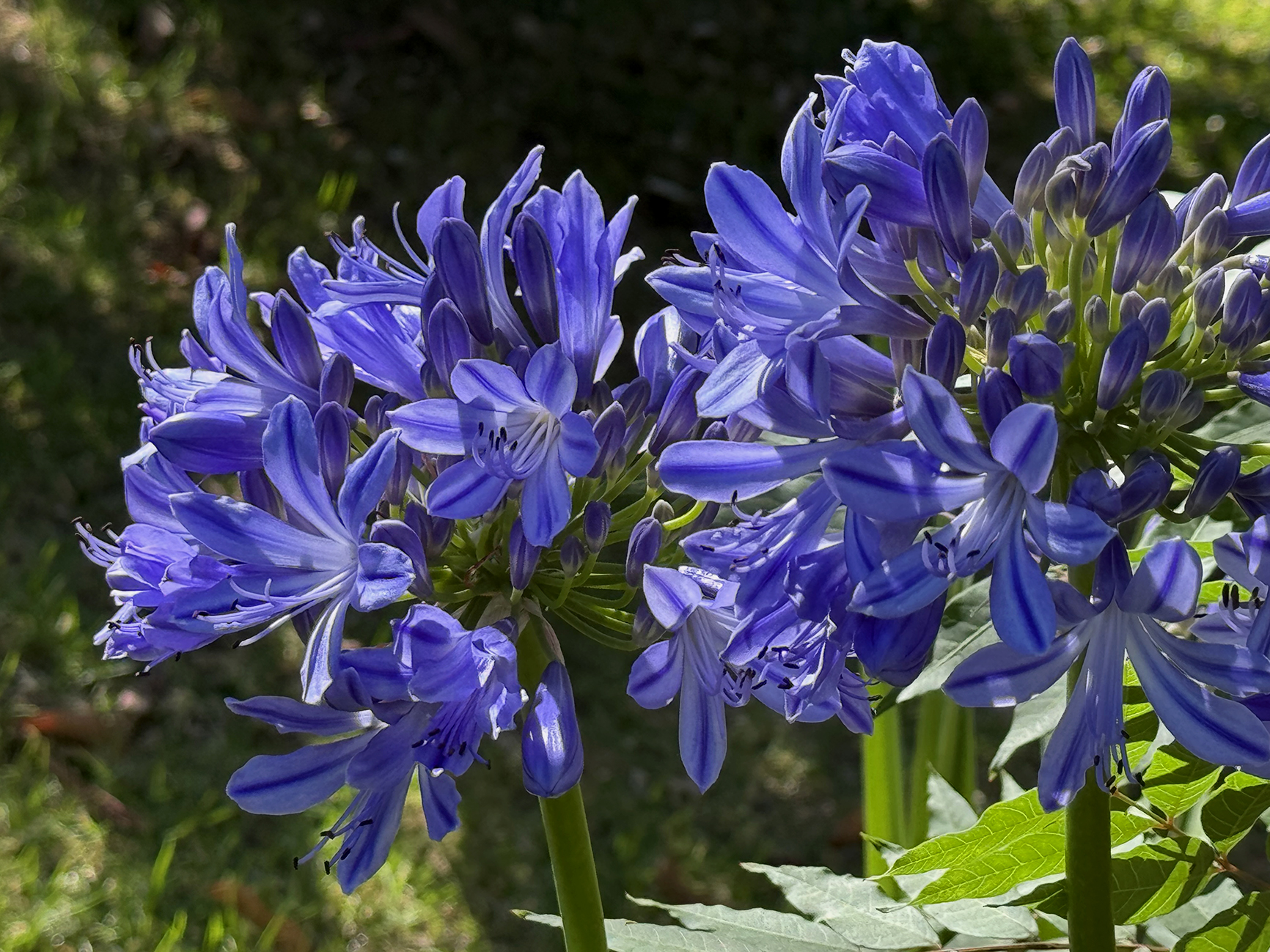
AGAPANTHUS

Agapanthus praecox (Common Agapanthus, Blue Lily, African Lily, or Lily of the Nile) is a native of Natal and Cape of Good Hope in South Africa. Local names for this species include agapant, bloulelie, isicakathi and ubani. Most of the cultivated plants of the genus Agapanthus are hybrids or cultivars of this species. The plant is reportedly naturalised in Great Britain, Madeira, the Canary Islands, Eritrea, Ethiopia, St. Helena, Victoria, Norfolk Island, New Zealand, Mexico, Honduras, Costa Rica and Tristan da Cunha.

Agapanthus praecox subspecies orientalis (shown here) occurs in Eastern Cape and southern KwaZulu-Natal. It has up to 20 poisonous, strap-like leaves per plant which are arching and are not leathery. These range in length from 20 to 70 cm long and 3 to 5 cm wide. Flower colour ranges from various shades of blue to white. Shiny black seeds are produced in three-sided capsules. These have perianth segments which are less than 50 mm in length.

Agapanthus praecox subsp. orientalis is highly regarded for being tough in sun and heat, long-flowering, and is a favourite for many councils in Australia for the landscaping of roads and other public areas which do not get watered. The plant is still widely planted but in some areas it is considered a weed, and planting has been discontinued, although it is not generally regarded as highly invasive. In Melbourne these plants grow luxuriantly and bloom for several weeks around Christmas. They are a common garden plant, but are also planted on nature reserves and verges along roads.

This post is part of the Floral Friday Fotos meme
Thursday, 4 April 2024

CRUCIFIX ORCHID

Crucifix orchid (Epidendrum ibaguense) is a species of the Orchidaceae family that occurs naturally from Mexico to Colombia. It has long, thin stems and leathery leaves. The flowers bloom in clusters, with up to 20 flowers open on a stem at once. They come in orange, red, mauve, purple, pink and yellow. We have the orange, pink and red varieties growing profusely as potted specimens in our garden and they are very rewarding plants.

The common name 'crucifix orchid' refers to the lip of the flower (called the labellum), which resembles a small, gold cross. Crucifix orchids are tough, easy to grow, easily propagated and they have vivid, long lasting flowers. In fact, they are an excellent beginner's orchid. They can be grown in containers in a free-draining mix, amongst rocks in the garden, or in soil. They like a frost-free climate and flower best in a full sun position.

This post is part of the Floral Friday Fotos meme


Thursday, 15 June 2023

CASSIA

Cassia leptophylla, or the Gold Medallion Tree, is a semi-deciduous tree native to southern Brazil but growing well in subtropical  and warm temperate regions of the world. This tree requires well-drained soil with little threat of freezing temperatures and should be grown in direct sunlight for full flowering potential. The gold medallion tree can reach heights of 8 metres with proper pruning.

This post is part of the Floral Friday Fotos meme


Thursday, 3 November 2022

PAULOWNIA

Paulownia is a genus of seven to 17 species of hardwood tree (depending on taxonomic authority) in the family Paulowniaceae, the order Lamiales. They are present in much of China, south to northern Laos and Vietnam and are long cultivated elsewhere in eastern Asia, notably in Japan and Korea. It was introduced to North America in 1844 from Europe and Asia where it was originally sought after as an exotic ornamental tree.

Its fruits (botanically capsules) were also used as packaging material for goods shipped from East Asia to North America, leading to Paulownia groves where they were dumped near major ports. The tree has not persisted prominently in US gardens, in part due to its overwintering brown fruits that some consider ugly. In some areas it has escaped cultivation and is found in disturbed plots. Some US authorities consider the genus an invasive species, but in Europe, where it is also grown in gardens, it is not regarded as invasive.

The genus, originally Pavlovnia but now usually spelled Paulownia, was named in honour of Anna Paulowna, queen consort of The Netherlands (1795–1865), daughter of Tsar Paul I of Russia. It is also called "princess tree" for the same reason. Paulownia trees produce as many as 20 million tiny seeds per year. However, the seeds are very susceptible to soil biota and only colonise well on sterile soils (such as after a high temperature wildfire). Well-drained soil is also essential. Successful plantations usually purchase plants that have been professionally propagated from root cuttings or seedlings.

Although seeds, seedlings, and roots of even mature trees are susceptible to rot, the wood is not and is used for boat building and surfboards. Trees can grow to maturity in under 10 years and produce strong, lightweight timber, good as firewood, with an even higher strength to weight ratio than balsa wood. Its density is low at around 0.28 kg/litre, although significantly higher than balsa's very low 0.16 kg/litre.

This post is part of the Floral Friday Fotos meme


Thursday, 11 August 2022

MAGNOLIA

Magnolia laevifolia grows as a small tree bearing multitudes of golden buds. Unlike other magnolia relatives, the buds form in the leaf axils and along the stem. The bright, hairy bud scales (perules) split off at blooming time to reveal an ivory flower with "butter-yellow stamens like lashes opening to the sun," described one grower. The waxy, chalice-like flower has a delicate perfume, and can bloom from mid-winter and continue late into the autumn. A tree in full bloom can perfume the air for several metres around it.

The leaves are oval-shaped and tough with a golden edge.There are 41 species of what was once called Michelia in China (all of which have been lumped into the genus Magnolia), and 23 of these grow in Yunnan. Some are two hundred years old and grow at altitudes as high as 9000 feet, far higher than other varieties of magnolias can survive.

This post is part of the Floral Friday Fotos meme.


Thursday, 21 April 2022

MILTONIA

Miltonia, abbreviated Milt. in the horticultural trade, is an orchid genus formed by nine epiphyte species and eight natural hybrids inhabitants of the Brazilian Atlantic Forest, one species reaching the northeast of Argentina and east of Paraguay. This genus was established by John Lindley in 1837, when he described its type species, Miltonia spectabilis. Many species were attributed to Miltonia in the past, however, today, the species from Central America and from cooler areas on northwest of South America have been moved to other genera.

Miltonia species have large and long lasting flowers, often in multifloral inflorescences. This fact, allied to being species that are easy to grow and to identify, make them a favourite of orchid collectors all over the world. Species of this genus are extensively used to produce artificial hybrids. Despite the fact that Miltonia is now a well established genus, most of its species were originally classified under other genera as Cyrtochilum, Oncidium, Odontoglossum, and Brassia. All were discovered between 1834 and 1850 with the exception of M. kayasimae, discovered only in 1976. 

These epiphytic orchids occur from Central to Southern Brazil down to Argentina. These orchids have two leaves, arising from a pseudobulbs, covered with a foliaceous sheath. The inflorescence consists of waxy, nonspurred flowers. The lip is large and flat and lacks a callus at its base. They possess a footless column with two hard pollinia. The flowers have a delicate, exotic scent, some compare to that of roses. They are named after Charles Wentworth-Fitzwilliam, 5th Earl Fitzwilliam, formerly Viscount Milton, an English orchid enthusiast. The species in this genus are sometimes referred to as the "pansy orchids", but it is the Miltoniopsis orchids that have flowers that closely resemble the pansy. Almost everyone except for the most serious orchid hobbyists use the name pansy orchids interchangeably, which may cause confusion.

Miltonia looks more like Oncidium than the other pansy orchids. The most "pansy-like" a Miltonia can get is the species Miltonia spectabilis. The one shown here is "Miltonia Lavender Glade" ( Milt. spectabilis var. moreliarta X "Milt Belle Glade"). Easy to grow, has a nice scent and is free- flowering. It is a plant that will give much pleasure and few hassles!

This post is part of the Floral Friday Fotos meme


Monday, 4 April 2022

COMMON AND EXOTIC

A digital collage of drawn images and real bird photos. Isn't nature amazing?

This post is part of the Mosaic Monday meme,
and also part of the Blue Monday meme,
and also part of the 
Seasons meme.


Thursday, 19 January 2017

MELBOURNE STREET TREES 178 - KOELREUTERIA

Koelreuteria paniculata is a species of flowering plant in the family Sapindaceae, native to eastern Asia, in China and Korea. Common names include golden rain tree, pride of India, China tree, or varnish tree.

It is a small to medium-sized deciduous tree growing to 7 m tall, with a broad, dome-shaped crown. The leaves are pinnate, 15–40 cm long, rarely to 50 cm, with 7-15 leaflets 3–8 cm long, with a deeply serrated margin; the larger leaflets at the midpoint of the leaf are sometimes themselves pinnate but the leaves are not consistently fully bipinnate as in the related Koelreuteria bipinnata.

The flowers are yellow, with four petals, growing in large terminal panicles 20–40 cm long. The fruit is a three-parted inflated bladder-like pod 3–6 cm long and 2–4 cm broad, green ripening orange to pink in autumn, containing several dark brown to black seeds 5–8 mm diameter. There are two varieties: K. paniculata var. paniculata. Northern China and Korea. Leaves single-pinnate. K. paniculata var. apiculata (Rehder & E.H.Wilson) Rehder (syn. K. apiculata). Western China (Sichuan), intergrading with var. paniculata in central China. Leaves with larger leaflets commonly bipinnate.

It is popularly grown as an ornamental tree in temperate regions all across the world because of the aesthetic appeal of its flowers, leaves and seed pods. Several cultivars have been selected for garden planting, including 'Fastigiata' with a narrow crown, and 'September Gold', flowering in late summer. The seeds are edible when roasted, but not commonly consumed. In some areas, notably the eastern United States and particularly in Florida, it is considered an invasive species. These trees are growing in the All Nations Park in Northcote.

This post is part of the Floral Friday meme,
and also part of the Skywatch Friday meme.


Thursday, 11 August 2016

MELBOURNE STREET TREES 155 - CORAL TREE

Erythrina is a genus of flowering plants in the pea family, Fabaceae. It contains about 130 species, which are distributed in tropical and subtropical regions worldwide. They are trees, growing up to 30 m in height. The generic name is derived from the Greek word ερυθρóς (erythros), meaning "red," referring to the flower colour of certain species.

Particularly in horticulture, the name "coral tree" is used as a collective term for these plants. "Flame trees" is another vernacular name, but may refer to a number of unrelated plants as well. Many species of Erythrina have bright red flowers, and this may be the origin of the common name. However, the growth of the branches can resemble the shape of sea coral rather than the colour of Corallium rubrum specifically, and this is an alternative source for the name.

Illustrated here is Erythrina x sykesii a medium sized deciduous tree with knobbly grey-green bark, and numerous small triangular rose-like thorns. The bright green leaves are compound, with three large roughly triangular leaflets, the central one on a much longer stalk than the two side leaflets. Flowers are red, about 5cm long, enclosed in a single large folded petal, in large clusters. Seed is not produced in Australia.

It has been widely planted as a street and garden tree in many cities in Australia, and being a sterile hybrid, it is not capable of getting out into the bush by itself. It should therefore be a harmless garden or farm plant, but unfortunately any piece of the plant left in contact with the ground can take root. The plant is spread from fallen branches, and prunings dumped in the bush. Do not dump any part of this plant. If existing plants are being cut down, they need to be burnt or taken to land-fill where they will not re-grow. For existing plants, cut and paint or stem inject.

This post is part of the Floral Friday Fotos meme.


Thursday, 21 April 2016

MELBOURNE STREET TREES 146 - BRUNFELSIA

Brunfelsia jamaicensis is a species of flowering plant in the family Solanaceae, the nightshades. It is endemic to Jamaica, where it grows in mountain forests above 1400 metres in elevation.

The common name of this is "Jamaican Lady of the Night" and the long tubular, white-to-cream flowers exude a delicious fragrance. This endangered species flowers from early spring through Autumn. The fragrance intensifies at night, often filling the growing area with its rich scent.

This tree is a tropical/subtropical exotic, but manages to grow in Melbourne if it is a frost-protected spot. I have seen several of these in flower around the neighbourhood and I am tempted to get one for our garden. It needs a sunny spot and regular watering.

This post is part of the Floral Friday Fotos meme.


Thursday, 14 May 2015

MELBOURNE STREET TREES 112 - PINK FRANGIPANI

Plumeria (common name Frangipani) is a genus of flowering plants in the dogbane family, Apocynaceae. It contains seven or eight species of mainly deciduous shrubs and small trees. They are native to Central America, Mexico, the Caribbean, and South America as far south as Brazil but can be grown in tropical and sub-tropical regions.

The genus is named in honour of the seventeenth-century French botanist Charles Plumier, who travelled to the New World documenting many plant and animal species. The common name "Frangipani" comes from an Italian noble family (itself literally meaning "bread-breaker(s)" in Italian), a sixteenth-century marquess who invented a plumeria-scented perfume.

Plumeria is related to the oleander, Nerium oleander, and both possess an irritant, rather similar to that of Euphorbia. Contact with the sap may irritate eyes and skin. Each of the separate species of Plumeria bears differently shaped, alternate leaves with distinct form and growth habits. The leaves of P. alba are quite narrow and corrugated, whereas leaves of P. pudica have an elongated shape and glossy, dark-green colour. P. pudica is one of the everblooming types with non-deciduous, evergreen leaves. Another species that retains leaves and flowers in winter is P. obtusa; though its common name is "Singapore frangipani" it is originally from Colombia.

Plumeria flowers are most fragrant at night in order to lure sphinx moths to pollinate them. The flowers have no nectar, however, and simply dupe their pollinators. The moths inadvertently pollinate them by transferring pollen from flower to flower in their fruitless search for nectar. Plumeria species may be propagated easily from cuttings of leafless stem tips in spring. Cuttings are allowed to dry at the base before planting in well-drained soil. Cuttings are particularly susceptible to rot in moist soil.

The most common frangipani is Plumeria rubra. This species comes in many colours, from white to cream to yellow, even oranges, pinks (both pale and hot pink), reds and even deep cerise. They are also the ones with the most fragrant flowers. These trees are common in Melbourne and will grow well in sheltered spots.

This post is part of the Floral Friday Fotos meme.


Thursday, 15 January 2015

MELBOURNE STREET TREES 99 - MAGNOLIA

Magnolia grandiflora, commonly known as the southern magnolia or bull bay, is a tree of the family Magnoliaceae native to the southeastern United States, from Virginia south to central Florida, and west to East Texas and Oklahoma. Reaching 28 m in height, it is a large, striking, evergreen tree with large, dark green leaves up to 20 cm long and 12 cm wide, and large, white, fragrant flowers up to 30 cm in diameter. Widely cultivated in warmer areas around the world, over 50 cultivars have been bred and marketed commercially. The timber is hard and heavy, and has been used commercially to make furniture, pallets, and veneer.

The climate in Melbourne suits this tree very well and there are many fine specimens in gardens, parks, streets and reserves. Once established, the trees are drought tolerant, and are indeed the most drought tolerant of all the Magnolia species.

This post is part of the Floral Friday Fotos meme.


Thursday, 8 January 2015

MELBOURNE STREET TREES 98 - MICHELIA

Michelia is a genus of flowering plants belonging to the Magnolia family (Magnoliaceae). The genus includes about 50 species of evergreen trees and shrubs, native to tropical and subtropical south and southeast Asia (Indomalaya), including southern China.

The Magnoliaceae are an ancient family; fossil plants identifiably belonging to the Magnoliaceae back date back 95 million years. A primitive aspect of the Magnolia family is that their large, cup-shaped flowers lack distinct petals or sepals. The large non-specialised flower parts, resembling petals, are called tepals. The leaves, flowers, and form of Michelia resemble Magnolia, but the blossoms of Michelia generally form clusters among the leaves, rather than singly at the branch ends as Magnolia does.

Several of the larger species are locally important sources of timber. Some species, including the Champak (Michelia champaca) and M. doltsopa are grown for their flowers, both on the tree and as cut flowers. Champak flowers are also used to produce an essential oil for perfume. A few species have been introduced to gardens or as street trees outside of the Indomalaya region, including Michelia figo, M. doltsopa, and M. champaca. The genus is named after the Florentine botanist Pietro Antonio Micheli (1679–1737).

The form shown here is Michelia x alba, a hybridised form not found in the wild and very popular as a garden ornamental. It is rather fashionable in Melbourne at the moment to plant these trees in one's garden!

This post is part of the Floral Friday Fotos meme.


Thursday, 2 October 2014

MELBOURNE STREET TREES 90 - EASTERN REDBUD

Cercis canadensis (Eastern redbud) is a large deciduous shrub or small tree, native to eastern North America from Southern Ontario, Canada south to northern Florida but can thrive as far west as California.

It typically grows to 6–9 m tall with a 8–10 m. It generally has a short, often twisted trunk and spreading branches. A 10-year-old tree will generally be around 5 m tall. The bark is dark in colour, smooth, later scaly with ridges somewhat apparent, sometimes with maroon patches. The twigs are slender and zigzag, nearly black in colour, spotted with lighter lenticels. The winter buds are tiny, rounded and dark red to chestnut in colour. The leaves are alternate, simple, and heart shaped with an entire margin, 7–12 cm long and wide, thin and papery, and may be slightly hairy below.

The flowers are showy, light to dark magenta pink in colour, 1.5 cm long, appearing in clusters from Spring to early Summer, on bare stems before the leaves, sometimes on the trunk itself. The flowers are pollinated by long-tongued bees such as blueberry bees and carpenter bees. Short-tongued bees apparently cannot reach the nectaries. The fruit are flattened, dry, brown, pea-like pods, 5–10 cm long that contain flat, elliptical, brown seeds 6 mm long, maturing in late Summer-Autumn.

C. canadensis is grown in parks and gardens, with several cultivars being available. The cultivar 'Forest Pansy', with purple leaves, has gained the Royal Horticultural Society's Award of Garden Merit.

This post is part of the Floral Friday Fotos meme.


Thursday, 19 June 2014

MELBOURNE STREET TREES 78 - RHODODENDRON

Rhododendron is large genus in the heath (Ericaceae) family includes some 800 species, which are widely distributed across the Northern Hemisphere, with the majority growing in temperate to cool regions. Gardeners can choose from many different types of rhododendrons: Alpine rhododendrons, with small leaves, wiry stems, and clusters of tiny flowers; shrub rhododendrons, including those up to 15 ft (4.5 m) tall; tree rhododendrons, with a single trunk and a large head of foliage; evergreen azaleas, which are low to tall bushes with semi-persistent foliage and large light-textured flowers; deciduous azaleas, which are large twiggy bushes with flowers usually in shades of yellow, red, or orange; and vireya rhododendrons, which are tender tropical species with funnel-shaped blooms and no fixed flowering season.

In common with most heath family plants, rhododendrons prefer acidic soils, high in organic matter and freely draining, in a partly shaded position. While most prefer some protection from wind, sun, and frost, many others tolerate these conditions. Species may be raised from seed, or propagate from half-hardened cuttings or layers.

Rhododendron foliage is extremely variable. Most species bear "trusses" of up to 24 spectacular blooms, in colours ranging from white to pink, red, yellow, and mauve. Flowers are often multicoloured, with spots, stripes, edging, or a single blotch of a different colour in the throat of the flower. With the exception of some vireya species and hybrids, fragrant rhododendrons are always white or very pale pink. Blooms vary in size and shape but are generally bell-shaped, appearing from early spring to early summer. The fruit is a many-seeded capsule, normally woody, with the tiny seeds sometimes bearing wings or tail-like appendages to aid dispersal.

This post is part of the Floral Friday Fotos meme.


Thursday, 8 May 2014

MELBOURNE STREET TREES 73 - KING PROTEA

The king protea (Protea cynaroides) is a flowering plant. It is a distinctive member of the Proteas, having the largest flower head in the genus. The species is also known as giant protea, honeypot or king sugar bush. It is widely distributed in the southwestern and southern parts of South Africa in the fynbos region.  The king protea is the national flower of South Africa. It also is the flagship of the The Protea Atlas Project, run by the South African National Botanical Institute.

The king protea has several colour forms and horticulturists have recognised 81 garden varieties, some of which have injudiciously been planted in its natural range. In some varieties the pink of the flower and red borders of leaves are replaced by a creamy yellow. This unusual flower has a long vase life in flower arrangements, and makes for an excellent dried flower.  Protea cynaroides is adapted to survive wildfires by its thick underground stem, which contains many dormant buds; these will produce the new growth after the fire. The plant has adapted well to growth in Australia.

It is a woody shrub with thick stems and large dark green, glossy leaves. Most plants are one metre in height when mature, but may vary according to locality and habitat from 0.35 m to 2 metres in height. The "flowers" of Protea cynaroides are actually composite flower heads (termed an inflorescence) with a collection of flowers in the centre, surrounded by large colourful bracts. The flowerheads vary in size, from about 120 mm to 300 mm in diameter. Large, vigorous plants produce six to ten flower heads in one season, although some exceptional plants can produce up to forty flower heads on one plant. The colour of the bracts varies from a creamy white to a deep crimson, but the soft pale pink bracts with a silvery sheen are the most prized.

This post is part of the Floral Friday Fotos meme.