

Showing posts with label camera_critters. Show all posts
Showing posts with label camera_critters. Show all posts
Sunday, 10 July 2022

Saturday, 15 May 2021
MOORHEN
Moorhens—sometimes called marsh hens—are medium-sized water birds that are members of the rail family (Rallidae). Most species are placed in the genus Gallinula, Latin for "little hen". They are close relatives of coots. They are often referred to as (black) gallinules.

Saturday, 5 September 2020
WINTER MORNING
Walking the dogs on a wintry morning despite the cold and in any case, the fog is lifting as the sun peers out of the clouds...
This post is part of the Saturday Critters meme,
and also part of the Camera Critters meme.


This post is part of the Saturday Critters meme,
and also part of the Camera Critters meme.


Saturday, 29 August 2020
DUCK
The chestnut teal duck (Anas castanea) is a dabbling duck found in Australia. The male (shown here) has a distinctive green head, while the female has rather more drab plumage.
This post is part of the Saturday Critters meme,
and also part of the Camera Critters meme.


Saturday, 26 October 2019

Saturday, 19 October 2019
LORIKEETS
The rainbow lorikeet (Trichoglossus moluccanus) is a species of parrot found in Australia. It is common along the eastern seaboard, from northern Queensland to South Australia and Tasmania. Its habitat is rainforest, coastal bush and woodland areas. Several taxa traditionally listed as subspecies of the rainbow lorikeet are now treated as separate species.
Rainbow lorikeets have been introduced to Perth, Western Australia; Auckland, New Zealand; and Hong Kong. Rainbow lorikeets are true parrots, within the Psittacoidea superfamily in the order Psittaciformes. They include two subspecies: Trichoglossus moluccanus moluccanus and Trichoglossus molucannus septentrionalis.
This post is part of the Saturday Critters meme,
and also part of the Camera Critters meme.


Saturday, 12 October 2019
DUCKLINGS
The chestnut teal duck (Anas castanea) is a dabbling duck found in Australia. Males have a distinctive green head. It's duckling season now and the proud father is looking after the children...
This post is part of the Saturday Critters meme,
and also part of the Camera Critters meme.


Saturday, 5 October 2019
GREEN BOTTLE FLY
The common green bottle fly (Phaenicia sericata or Lucilia sericata) is a blow fly found in most areas of the world, and the most well-known of the numerous green bottle fly species. It is 10–14 mm long, slightly larger than a house fly, and has brilliant, metallic, blue-green or golden coloration with black markings. It has short, sparse black bristles (setae) and three cross-grooves on the thorax. The wings are clear with light brown veins, and the legs and antennae are black. The maggots (larvae) of the fly are used for maggot therapy of infected wounds.
Lucilia sericata is common all over the temperate and tropical regions of the planet, mainly the southern hemisphere, Africa and Australia. It prefers warm and moist climates and accordingly is especially common in coastal regions, but it also is present in arid areas. The female lays her eggs in meat, fish, animal corpses, infected wounds of humans or animals, and excrement. The larvae feed on decomposing tissue. The insect favours species of the genus Ovis, domestic sheep in particular. This can lead to "blow fly strike", causing problems for sheep farmers, though Lucilia sericata is not a major cause of blow fly strike in most regions.
The flower is Felicia amelloides (blue daisy, blue marguerite), which is a species of flowering plant of the family Asteraceae, native to South Africa. F. amelloides is synonymous with, and formerly known as, F. aethiopica, Aster amelloides, Aster capensis, and Aster coelestis.
This post is part of the Saturday Critters meme,
and also part of the Camera Critters meme.

Saturday, 28 September 2019
WINGED VISITOR
We have several birds that visit our garden and this spotted dove is a frequent one. Last week it decided to come into the fernery and got trapped there. Some crumbs on the concrete floor got it to fly low and find the door out into the garden again.
The spotted dove (Spilopelia chinensis) is a small and somewhat long-tailed pigeon which is a common resident breeding bird across its native range on the Indian Subcontinent and Southeast Asia. The species has been introduced into many parts of the world and feral populations have become established. This species was formerly included in the genus Streptopelia with other turtle-doves, but studies suggest that they differ from typical members of that genus.
This dove is long tailed buff brown with a white-spotted black collar patch on the back and sides of the neck. The tail tips are white and the wing coverts have light buff spots. There are considerable plumage variations across populations within its wide range. The species is found in light forests and gardens as well as in urban areas. They fly from the ground with an explosive flutter and will sometimes glide down to a perch. It is sometimes also called the mountain dove, pearl-necked dove or lace-necked dove.
This post is part of the Saturday Critters meme,
as well as part of the Camera Critters meme.

Saturday, 21 September 2019
WAITING
For his human outside the gym...
This post is part of the Saturday Critters meme,
and also part of the Camera Critters meme.

This post is part of the Saturday Critters meme,
and also part of the Camera Critters meme.

Saturday, 14 September 2019
DUCKS
Chestnut teal duck family, Anas castanea (Eyton, 1838). The chestnut teal is darker and a slightly bigger bird than the grey teal. The male has a distinctive green coloured head and mottled brown body. The female has a brown head and mottled brown body. The female is almost identical in appearance to the grey teal. The female chestnut teal has a loud penetrating "laughing" quack repeated rapidly nine times or more.
The chestnut teal is commonly distributed in south-eastern and south-western Australia, while vagrants may occur elsewhere. Tasmania and southern Victoria are the species’ stronghold, while vagrants can be found as far north as New Guinea and Lord Howe Island. The chestnut teal prefers coastal estuaries and wetlands, and is indifferent to salinity. This bird is an omnivore.
Chestnut teals form monogamous pairs that stay together outside the breeding season, defend the nest site and look after the young when hatched. Nests are usually located over water, in a down-lined tree hollow about 6–10 m high. Sometimes nests are placed on the ground, among clumps of grass near water. The young hatch and are ready to swim and walk within a day.
This post is part of the Saturday Critters meme,
and also part of the Camera Critters meme.

Saturday, 7 September 2019
MANTIS
A praying mantis is an amazing insect that can be kept as a pet. A praying mantis can catch other insects with its strong front legs. The front legs are lined with spikes and close in a certain way to have a firm grip on the prey. A mantis has a mobile head that can turn around like humans can, large eyes, large front legs to grab prey and four legs meant for walking.
Praying mantids vary in adult length between 1 and 16 cm. Praying mantids exclusively eat other insects by catching them with their forelegs. They do not use poison but eat the prey alive while they hold it firmly. The praying mantis belong to the order of Mantodea. There are about 2300 species of praying mantis described. They occur on every continent except on Antarctica.
In Northern Europe they do not occur. In Europe, many people see their first praying mantis on holiday in Spain or France. In the United States praying mantids can be found in almost any state. But the most extraordinary species and highest number of species can only be found in the tropical forest of South America, Africa and Asia.
This post is part of the Saturday Critters meme,
and also part of the Camera Critters meme.

Saturday, 31 August 2019
BRONZEWING PIGEON
The common bronzewing (Phaps chalcoptera) is a species of medium-sized, heavily built pigeon. Native to Australia and one of the country's most common pigeons, the common bronzewing is able to live in almost any habitat, with the possible exception of very barren areas and dense rainforests. Males of the species have pale-yellow to yellow-white foreheads, and pink breasts. Both males and females have an easily discernible white line around and proximate to their eyes. Common bronzewings also have patches of red, blue and green on their wings, a feature which is characteristic of all bronzewing pigeons. Young birds are usually duller in colour and browner than the mature common bronzewing.
Rarely found far from a source of water, common bronzewings either travel alone or in pairs or in flocks, and are usually cautious, making approach by humans or other animals difficult. Common bronzewings are, on average, between 30 and 36 centimetres in length. The common bronzewing's diet primarily consists of seeds and all varieties of vegetables. It searches for food in small groups. The search can sometimes last for days, and, since the pigeon must drink frequently, it utilises watering holes or any other available source of water.
Common bronzewings construct a rough nest of twigs and sticks, which is placed low down in a tree or bush. The eggs hatch after a period of roughly 14 to 16 days, after being incubated by both the male and the female. Both parents share the responsibility of caring for the young. In common with other pigeons, common bronzewings release a milky substance from their crop to feed their young. This specimen was seen in the Darebin Parklands in suburban Melbourne.
This post is part of the Saturday Critters meme,
and also part of the Camera Critters meme.

Saturday, 24 August 2019
COOL DOG
A curious little dog watching us pass by on our neighbourhood walk.
This post is part of the Weekend Reflections meme,
and also part of the Saturday Critters meme,
and also part of the Camera Critters meme.

This post is part of the Weekend Reflections meme,
and also part of the Saturday Critters meme,
and also part of the Camera Critters meme.

Saturday, 17 August 2019
NATIVE KINGFISHER
Kingfishers are to be found all over Australia, but predominantly in coastal regions. We have 10 native species, including the kookaburra, which is the largest. Kingfishers nest in tree hollows, in burrows in riverbanks and in termite nests. They feed on small animals, including fish, frogs, yabbies, snakes, insects and nestlings of other birds. Covered in brilliant green, blue, turquoise and orange plumage, some kingfishers were once in danger of being hunted to extinction for their feathers.
Despite their elaborate appearance, these stocky birds are tough, and hunt by darting upon prey in a flash of colour from branches above the river or forest floor. The kingfisher’s heavy beak is the perfect tool for killing victims quickly – they smack their hapless prey against tree branches before swallowing it whole.
The Azure Kingfisher (Ceyx [Alcedo] azurea) length, 17–19cm; wingspan, 25–29cm makes its home along the banks of coastal and inland rivers, swamps and mangroves. During breeding season, it lines its nest with fish bones and scales. Found along much of our northern and eastern seaboards, as well as Tasmania, this species hunts for small mammals, reptiles, fish and frogs.
This one was seen in the Darebin Parklands in suburban Melbourne. They are shy birds, usually keeping out of sight and easily disturbed if encountered, flying off rapidly.
This post is part of the Saturday Critters meme,
and also part of the Camera Critters meme.

Saturday, 10 August 2019
WINTER WALK
This post is part of the Weekend Reflections meme,
and also part of the Saturday Critters meme,
and also part of the Camera Critters meme.


and also part of the Saturday Critters meme,
and also part of the Camera Critters meme.


Saturday, 3 August 2019
NOISY MINERS
The noisy miner (Manorina melanocephala) is a bird in the honeyeater family, Meliphagidae, and is endemic to eastern and south-eastern Australia. This miner is a grey bird, with a black head, orange-yellow beak and feet, a distinctive yellow patch behind the eye and white tips on the tail feathers. Males, females and juveniles are similar in appearance, though young birds are a brownish-grey. As the common name suggests, the noisy miner is a vocal species with a large range of songs, calls, scoldings and alarms, and almost constant vocalisations particularly from young birds.
Noisy miners are gregarious and territorial; they forage, bathe, roost, breed and defend territory communally, forming colonies that can contain several hundred birds. Each bird has an 'activity space' and birds with overlapping activity spaces form associations called 'coteries', the most stable units within the colony. The birds also form temporary flocks called 'coalitions' for specific activities such as mobbing a predator.
This post is part of the Saturday Critters meme,
and also part of the Camera Critters meme.

Saturday, 27 July 2019
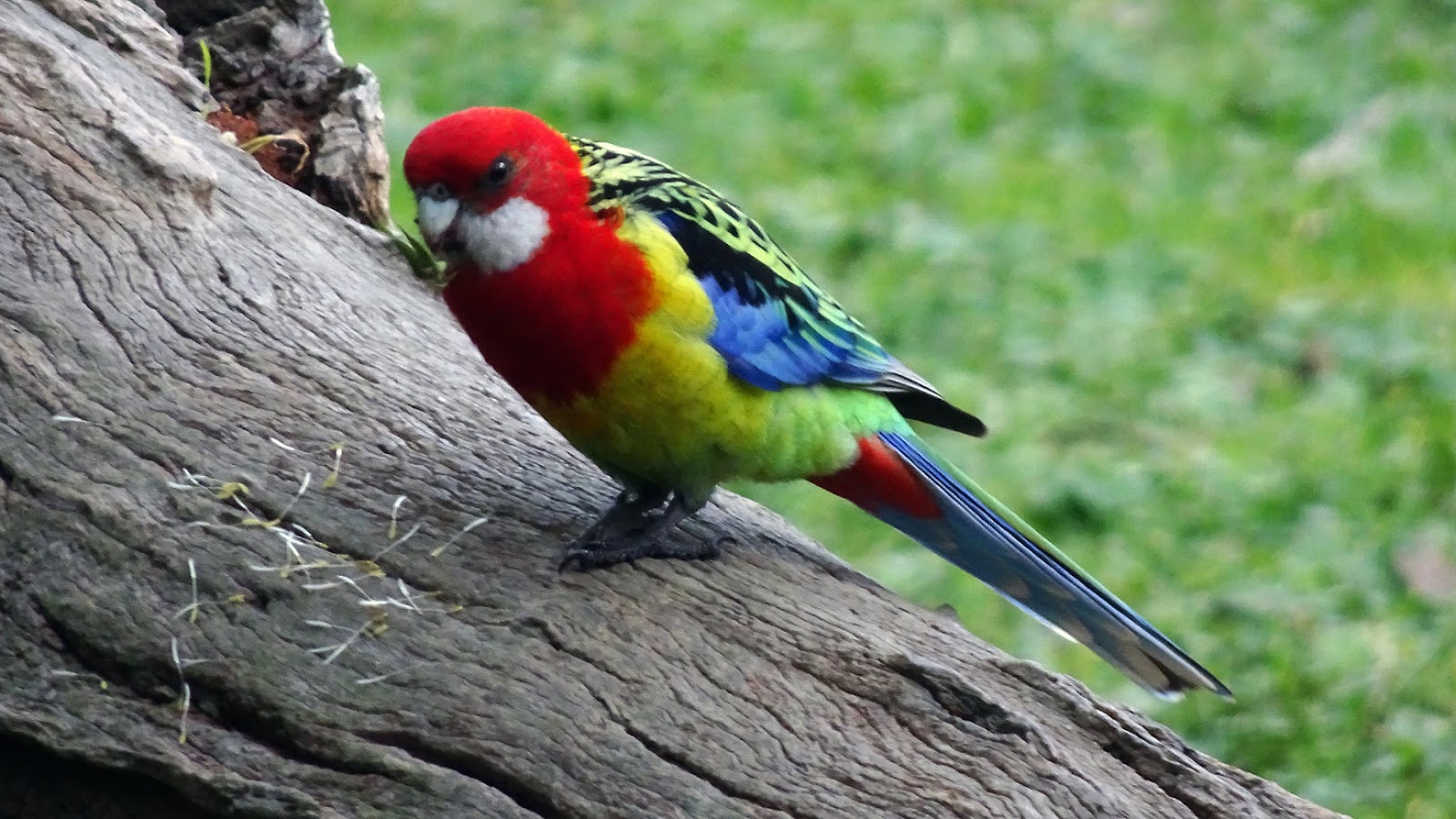
EASTERN ROSELLA
The eastern rosella (Platycercus eximius) is a rosella native to southeast of the Australian continent and to Tasmania. It has been introduced to New Zealand where feral populations are found in the North Island (notably in the northern half of the island and in the Hutt Valley) and in the hills around Dunedin in the South Island.
The eastern rosella is 30 cm long. It has a red head and white cheeks. The beak is white and the irises are brown. The upper breast is red and the lower breast is yellow fading to pale green over the abdomen. The feathers of the back and shoulders are black, and have yellowish or greenish margins giving rise to a scalloped appearance that varies slightly between the subspecies and the sexes. The wings and lateral tail feathers are bluish while the tail is dark green. The legs are grey. The female is similar to the male though duller in colouration and has an underwing stripe, which is not present in the adult male. Juveniles are duller than females and have an underwing stripe. The diet of eastern rosellas mainly consists of fruit, seeds, flowers and insects.
The eastern rosella is sometimes kept as a pet. These birds are desired for their beautifully coloured plumage. They are intelligent creatures, which can be trained to whistle a wide repertoire of tunes and may even learn to speak a few words or phrases. Rosellas can make good companion parrots; however, they require a great deal of attention and many toys to satisfy their need for social interaction and mental stimulation. These birds sometimes won't adapt to life as a family pet. Hand-raised birds can be fully domesticated, but usually they turn out still wild. Usually, this species doesn't like getting “petted” or “cuddled” and can bite in response to this type of handling. Many people believe that rosellas are best housed in large aviaries that enable them to fly freely with minimal human socialization. Despite these difficulties, many people enjoy the eastern rosella as a beautiful but sometimes feisty pet bird.
This post is part of the Saturday Critters meme,
and also part of the Camera Critters meme.


Saturday, 20 July 2019
SEAGULLS
Gulls or seagulls are seabirds of the family Laridae in the suborder Lari. They are most closely related to the terns (family Sternidae) and only distantly related to auks, skimmers, and more distantly to the waders. Until the 21st century, most gulls were placed in the genus Larus, but this arrangement is now known to be polyphyletic, leading to the resurrection of several genera. An older name for gulls is mew, cognate with German Möwe, Danish måge, Dutch meeuw, and French mouette; this term can still be found in certain regional dialects.
Gulls are typically medium to large birds, usually grey or white, often with black markings on the head or wings. They typically have harsh wailing or squawking calls, stout, longish bills, and webbed feet. Most gulls, particularly Larus species, are ground-nesting carnivores, which take live food or scavenge opportunistically. Live food often includes crabs and small fish. Gulls have unhinging jaws which allow them to consume large prey.
Apart from the kittiwakes, gulls are typically coastal or inland species, rarely venturing far out to sea. The large species take up to four years to attain full adult plumage, but two years is typical for small gulls. Large white-headed gulls are typically long-lived birds, with a maximum age of 49 years recorded for the herring gull. Gulls nest in large, densely packed noisy colonies. They lay two or three speckled eggs in nests composed of vegetation. The young are precocial, being born with dark mottled down, and mobile upon hatching.
This post is part of the Weekend Reflections meme,
and also part of the Saturday Critters meme,
and also part of the Camera Critters meme.


Saturday, 13 July 2019
DOG WALK
Walking the dog along the Merri Creek track. Midwinter in Melbourne is quite tolerable, as Australian Winter is relatively mild as far as temperate climates go.
This post is part of the Saturday Critters meme,
and also part of the Camera Critters meme.

This post is part of the Saturday Critters meme,
and also part of the Camera Critters meme.

Subscribe to:
Posts (Atom)