Showing posts with label melbourne. Show all posts

Saturday, 1 August 2026

CATERPILLAR AND BUTTERFLY

Papilio anactus, the dainty swallowtail, dingy swallowtail or small citrus butterfly is a medium-sized butterfly from the family Papilionidae, that is endemic to Australia. For protection against predators, this non-poisonous butterfly mimics the poisonous male Cressida cressida, another swallowtail butterfly that obtains its toxic properties through its host plant, the Dutchman's pipe.

Papilio anactus is endemic to Australia. It was originally only present in New South Wales, Victoria and Queensland, but due to the growing of citrus, a larval food plant of this species, in orchards, the species spread to South Australia in the late 1920s. Papilio anactus is not present on Kangaroo Island or elsewhere in Australia, as there are currently too few citrus trees. Sadly this butterfly is much less common than it once used to be. Dingy Swallowtail It also occurs on New Caledonia. There, it may be an introduced species or a vagrant.

This post is part of the Saturday Critters meme


Wednesday, 17 September 2025

BOLTE BRIDGE, MELBOURNE

View of the Bolte Bridge in Melbourne, spanning the Yarra River and Victoria Harbour in the Docklands precinct to the west of the Melbourne CBD. Construction took three years from 1996 to 1999 and cost $75 million.

This post is part of the Roentare’s Water Meme
and also part of the Wordless Wednesday meme
and also part of the Nature Notes meme


Tuesday, 10 June 2025

LAKE MOUNTAIN

Lake Mountain is a 1,433-metre-high mountain peak on a plateau that hosts a cross-country ski resort that is known by the same name. It is located in Victoria, Australia, approximately 120 kilometres north-east of Melbourne.

The 1,483-metre-high Mount Bullfight, which is within the Mount Bullfight Nature Conservation Reserve, is the highest peak that can be reached by a cross-country ski trail from Lake Mountain. Access to Lake Mountain's summit is restricted to a snow shoe track in winter.

The Lake Mountain Alpine Resort, located near Lake Mountain, is the most popular ski resort in Australia when measured in terms of total visitor numbers, including sightseers, due to its proximity to Melbourne. The Lake Mountain Alpine Resort is surrounded by the Yarra Ranges National Park into which its ski trails lead.

The resort is an unincorporated area under the direct administration of the government of Victoria, and is surrounded to the west, north & east by the Shire of Murrindindi and Yarra Ranges Shire to the south.

There is no lake at Lake Mountain. It is claimed that the mountain was named after George Lake, who was the surveyor-general of the area. Contradicting this, VICNames says that it is named for the "tarns, ponds and bogs near the summit".

This post is part of the Travel Tuesday meme

Saturday, 5 October 2024

Saturday, 12 March 2022

MASKED LAPWING

 The Masked Lapwing (Vanellus miles), also known as the masked plover and often called the spur-winged plover or just plover in its native range, is a large, common and conspicuous bird native to Australia, particularly the northern and eastern parts of the continent, New Zealand and .New Guinea.

This post is part of the Saturday Critters meme


Tuesday, 30 November 2021

YARRA RIVER SUNRISE

The city is certainly more lively now that most of the COVID restrictions have been lifted. The Omicron strain is causing some worry and many people are reacting by doing very silly and risky things. My favourite time in the City is at sunrise. Quiet, with few people around and lovely light!

This post is part of the Our World Tuesday meme,
and also part of the Ruby Tuesday meme,
and also part of the Travel Tuesday meme,
and also part of the Wordless Wednesday meme.


Saturday, 19 December 2020

HERON

The white-faced heron (Egretta novaehollandiae) also known as the white-fronted heron,[2] and incorrectly as the grey heron, or blue crane. is a common bird throughout most of Australasia, including New Guinea, the islands of Torres Strait, Indonesia, New Zealand, and all but the driest areas of Australia. It is a medium-sized heron, pale, slightly bluish-grey, with yellow legs and white facial markings. It can be found almost anywhere near shallow water, fresh or salt, and although it is prompt to depart the scene on long, slow-beating wings if disturbed, it will boldly raid suburban fish ponds.

This post is part of the Saturday Critters meme.


Monday, 2 November 2020

MEET THE NEIGHBOURS

A few houses around the neighbourhood where I live in one of Melbourne's inner city suburbs.
 
This post is part of the Mosaic Monday meme,
and also part of the Blue Monday meme,
and also part of the Seasons meme.


Tuesday, 7 July 2020

WARRANDYTE

Warrandyte is a suburb of Melbourne, Victoria, Australia, 24 km north-east of Melbourne's Central Business District. Its local government area is the City of Manningham. At the 2011 Census, Warrandyte had a population of 5,520. Warrandyte is bounded in the west by the Mullum Mullum Creek and Target Road, in the north by the Yarra River, in the east by Jumping Creek and Anzac Road, and in the south by an irregular line from Reynolds Road, north of Donvale, Park Orchards and Warrandyte South.

Warrandyte was founded as a Victorian town, located in the once gold-rich rolling hills east of Melbourne, and is now on the north-eastern boundary of suburban Melbourne. Gold was first discovered in the town in 1851 and together, with towns like Bendigo and Ballarat, led the way in gold discoveries during the Victorian gold rush. Today Warrandyte retains much of its past in its surviving buildings of the Colonial period and remains a twin community with North Warrandyte, which borders the Yarra River to its north. The Warrandyte Road Bridge over the Yarra River connects Warrandyte with North Warrandyte. The first bridge was built in 1861, but after its demise, the current bridge was built in 1952.

This post is part of the Our World Tuesday meme,
and also part of the Ruby Tuesday meme,
and also part of the Travel Tuesday meme,
and also part of the Wordless Wednesday meme.


Saturday, 11 January 2020

GRASS PARROTS

The red-rumped parrot (Psephotus haematonotus), also known as the red-backed parrot or grass parrot, is a common bird of south-eastern Australia, particularly in the Murray-Darling Basin. Red-rumped parrots are slim, elegant, moderate-sized parrots approximately 28 cm in length. The male's plumage is a bright emerald-green with yellow underparts, a brick-red rump and blue highlights on the wings and upper back. The female's plumage is less vibrant, with pale olive underparts, dull green wings and back and blue-black wingtips. The characteristic red rump is only found in the male.

This post is part of the Saturday Critters meme.
Male bird (Left) and female bird (Right)


Male bird.

Saturday, 27 July 2019

EASTERN ROSELLA

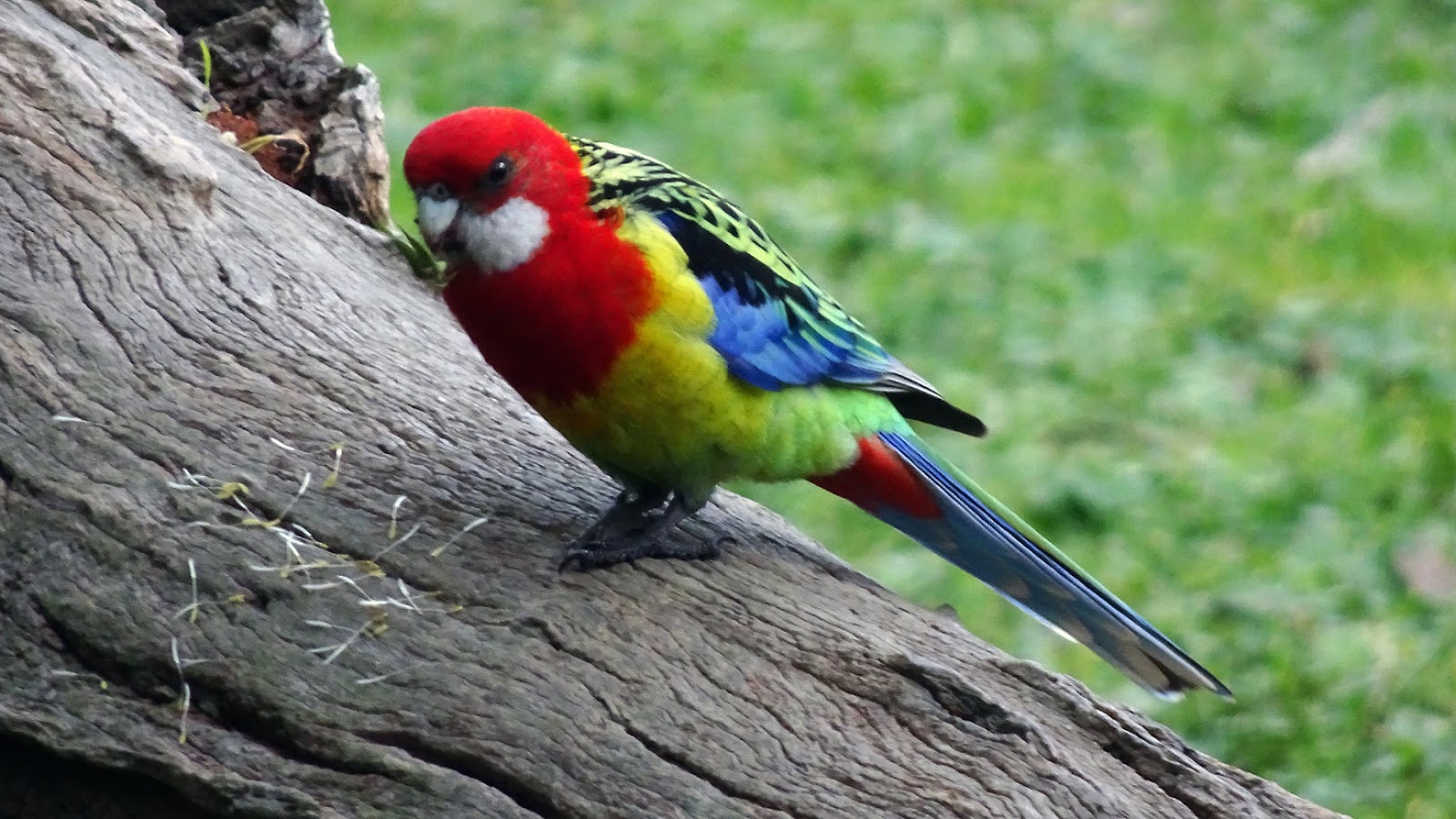
The eastern rosella (Platycercus eximius) is a rosella native to southeast of the Australian continent and to Tasmania. It has been introduced to New Zealand where feral populations are found in the North Island (notably in the northern half of the island and in the Hutt Valley) and in the hills around Dunedin in the South Island.

The eastern rosella is 30 cm long. It has a red head and white cheeks. The beak is white and the irises are brown. The upper breast is red and the lower breast is yellow fading to pale green over the abdomen. The feathers of the back and shoulders are black, and have yellowish or greenish margins giving rise to a scalloped appearance that varies slightly between the subspecies and the sexes. The wings and lateral tail feathers are bluish while the tail is dark green. The legs are grey. The female is similar to the male though duller in colouration and has an underwing stripe, which is not present in the adult male. Juveniles are duller than females and have an underwing stripe. The diet of eastern rosellas mainly consists of fruit, seeds, flowers and insects.

The eastern rosella is sometimes kept as a pet. These birds are desired for their beautifully coloured plumage. They are intelligent creatures, which can be trained to whistle a wide repertoire of tunes and may even learn to speak a few words or phrases. Rosellas can make good companion parrots; however, they require a great deal of attention and many toys to satisfy their need for social interaction and mental stimulation. These birds sometimes won't adapt to life as a family pet. Hand-raised birds can be fully domesticated, but usually they turn out still wild. Usually, this species doesn't like getting “petted” or “cuddled” and can bite in response to this type of handling. Many people believe that rosellas are best housed in large aviaries that enable them to fly freely with minimal human socialization. Despite these difficulties, many people enjoy the eastern rosella as a beautiful but sometimes feisty pet bird.

This post is part of the Saturday Critters meme,
and also part of the Camera Critters meme.


Saturday, 22 June 2019

WOOD DUCKS

The Australian wood duck, maned duck or maned goose (Chenonetta jubata) is a dabbling duck found throughout much of Australia. It is the only living species in the genus Chenonetta. Traditionally placed in the subfamily Anatinae (dabbling ducks), it might belong to the subfamily Tadorninae (shelducks); the ringed teal may be its closest living relative.

This 45–51 cm duck looks like a small goose, and feeds mostly by grazing in flocks. The male is grey with a dark brown head and mottled breast. The female has white stripes above and below the eye and mottled underparts. Both sexes have grey wings with black primaries and a white speculum. Juveniles are similar to adult females, but lighter and with a more streaky breast.

The Australian wood duck is widespread in Australia, including Tasmania. The Australian wood duck is found in grasslands, open woodlands, wetlands, flooded pastures and along the coast in inlets and bays. It is also common on farmland with dams, as well as around rice fields, sewage ponds and in urban parks. It will often be found around deeper lakes that may be unsuitable for other waterbirds' foraging, as it prefers to forage on land. It is classified as a game bird, and killed by licensed hunters. This species is not threatened, and numbers are stable.

Australian wood duck nests in cavities in trees or in nest-boxes above or near water. Nests are made with a pile of down. This duck nests in a tree cavity laying 9–11 cream-white eggs, similar to the Mandarin ducks. The female incubates them while the male stands guard. Once the ducklings are ready to leave the nest, the female flies to the ground and the duckling will leap to the ground and follow their parents. Like Mandarin drakes, the males also secure their ducklings closely along with the females.

This post is part of the Saturday Critters meme,
and also part of the Camera Critters meme.

Saturday, 11 May 2019

FOX

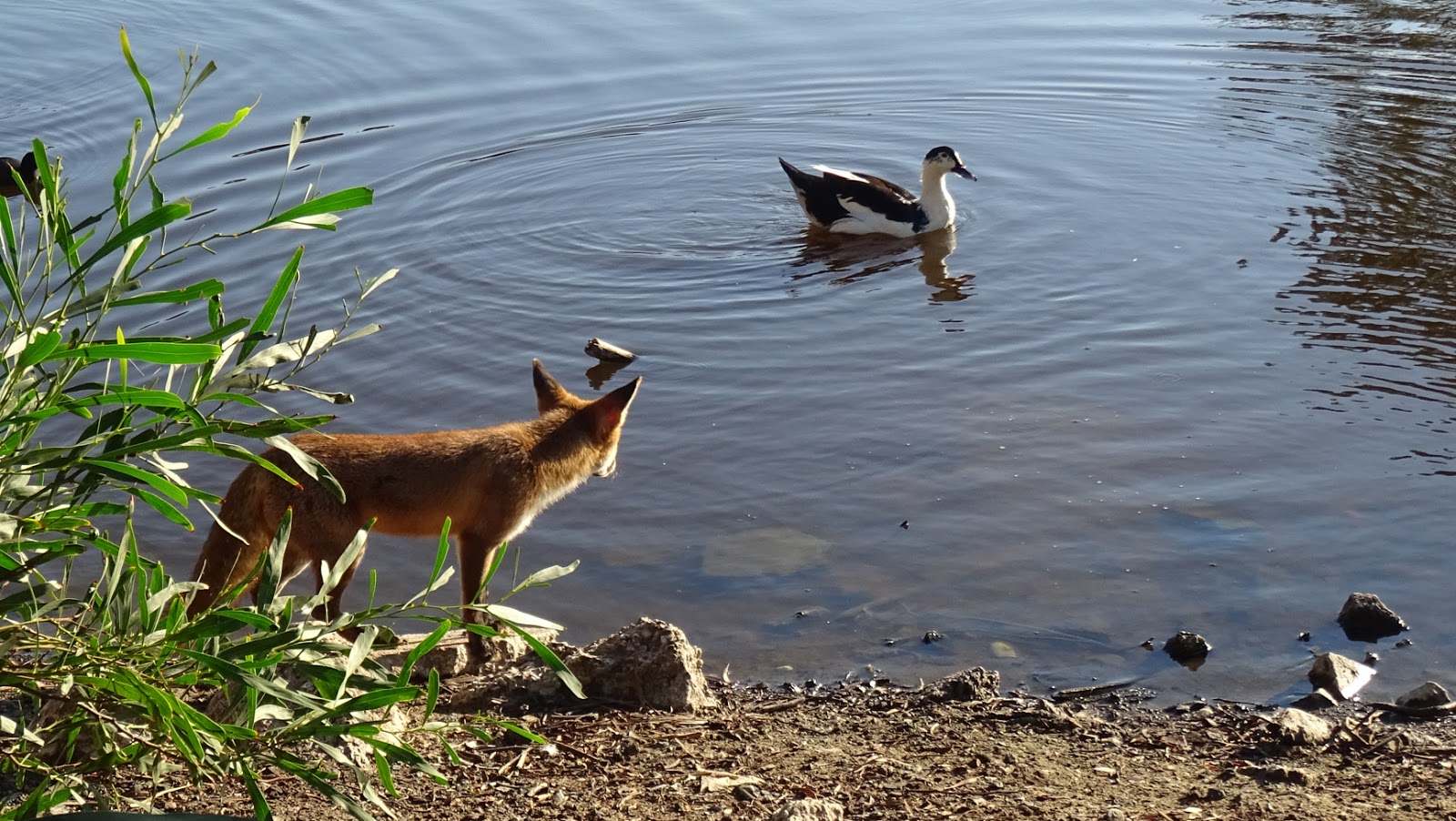
European foxes can be found on most of the Australian continent where they represent a very successful invasive species. Foxes were introduced to Australia in the mid-1800s for sport hunting and in about 100 years spread to most of the continent. Recently, foxes have also been introduced into Tasmania but efforts are already underway to eliminate foxes from this island.

Foxes have had a major impact on the Australian fauna, predating on ground nesting birds, mammals and reptiles. Moreover foxes compete with Australian native animals for food and habitat and can act as a reservoir of disease for wildlife and domestic animals. They are very common in Melbourne, but are seldom seen as they are shy, nocturnal and prefer areas with low human disturbance and buildings without domestic dogs.

Foxes select areas infested with exotic weeds (fennel, blackberry and African thistle) as shelter during the daytime and these also have low human disturbance. The Darebin Parklands in Melbourne are an ideal habitat for them and this specimen was quite tame and seemed unwary of me snapping away at him.

This post is part of the Saturday Critters meme,
and also part of the Camera Critters meme.


Friday, 10 May 2019

RAINY

We've had a few good falls of rain in Melbourne after a rather dry start to the year (with only 7mm grand total for the month of April). This total was easily surpassed in one day with the rain gauge recording up to 20 or so mm...

This post is part of the Skywatch Friday meme,
and also part of the Friday Photo Journal meme