Showing posts with label blue. Show all posts

Thursday, 11 June 2026

JACOB'S LADDER

Attractive, dense ferny foliage makes Polemonium pulcherrimum 'Blue Dove' (also known as Jacob's ladder) a valuable plant for all year round interest in the garden. As an added bonus loose sprays of open bell shaped flowers in a soft shade of blue can appear from spring right through to and including autumn. Its 'lacy' appearance makes it a useful plant for softening hard lines and edges created by rocks, garden edging or paving.

Polemonium is a genus comprising of around 30 species of mostly perennial herbs which are native to regions of North and Central America, Europe and Asia. An excellent plant for general garden use and suitable for most colour schemes. 'Blue Dove' looks particularly at home in woodland type settings or in the cottage garden.

It may be grown in semi shade although this may decrease flower production. This, however, is not necessarily a reason to avoid planting it in such locations as the attractive foliage alone will lend a visual appeal to these often difficult landscaping zones. To accent the foliage further create a foil of foliage behind it using larger, broader leafed plants or those with tall slender foliage such as that of Irises.

This post is part of the Floral Friday Fotos meme


Thursday, 12 March 2026

MORNING GLORY

Ipomoea is the largest genus in the flowering plant family Convolvulaceae, with over 500 species. Most of these are called morning glories, but this can also refer to related genera. Those formerly separated in Calonyction (Greek καλός, kalos, good and νύκτα, nycta, night) are called moonflowers. The generic name is derived from the Greek words ιπς (ips) or ιπος (ipos), meaning "worm" or "bindweed," and όμοιος (homoios), meaning "resembling". It refers to their twining habit.

The genus occurs throughout the tropical and subtropical regions of the world, and comprises annual and perennial herbaceous plants, lianas, shrubs and small trees; most of the species are twining climbing plants. Ipomoea nil is a species of Ipomoea morning glory known by several common names, including picotee morning glory, ivy morning glory, and Japanese morning glory. It is native to most of the tropical world, and has been introduced widely. It is cultivated as an attractive ornamental plant in many places, and the descendants of garden escapees now grow wild, in some situations regarded as a weed.

This is a climbing annual herb with three-pointed leaves 3 to 8 centimeters long. The flowers are several centimeters wide and appear in various shades of blue, pink or rose, often with white stripes or edges or blends of colors. Common cultivars include 'Scarlet O'Hara', 'Early Call', and 'Rose Silk'.

This post is part of the Floral Friday Fotos meme


Thursday, 24 April 2025

GERANIUM 'ROZANNE'

Geranium 'Rozanne' Pbr (Geranium wallichianum x himalayense 'Rozanne' PBR) is an extremely popular cultivar with bright violet-blue flowers, each with a white central eye. Delicate red veins radiate outward into each petal. Come early spring, beautiful lobed foliage emerges, forming a neat low mound. Flowers are soon produced and will extend throughout autumn after a light trim in summer. A perfect choice for planting with roses.

This post is part of the Floral Friday Fotos meme

Thursday, 31 October 2024

CAMPANULA

A self-seeded Campanula seedling growing and flowering amongst stones and rocks.

"One who gains strength by overcoming obstacles possesses the only strength which can overcome adversity." - Albert Schweitzer

This post is part of the Floral Friday Fotos meme


Monday, 22 January 2024

IN SUMMER

This post is part of the Mosaic Monday meme,
and also part of the Seasons meme.

It seems that I cannot comment on some blogs. I have alerted Blogspot at Google about it, as the instructions they give aren't helping. Please accept my thanks for hosting and for commenting on my blog (if you too aren't having a similar issue!)

Thursday, 24 November 2022

DELPHINIUM

The deep blue flowers of Delphinium chinense 'Blue Butterfly' begin appearing in spring and continue throughout the season. This unusual dwarf delphinium grows just 30-40 cm tall and is ideal as a colourful low hedge or the front of a border. Blooms best in full to part sun. Great cut flower.

This post is part of the Floral Friday Fotos meme


Thursday, 19 May 2022

PLUMBAGO

Plumbago is a genus of 10–20 species of flowering plants in the family Plumbaginaceae, native to warm temperate to tropical regions of the world. Common names include plumbago and leadwort (names which are also shared by the genus Ceratostigma).

The species include herbaceous plants and shrubs growing to 0.5–2 m tall. The leaves are spirally arranged, simple, entire, 0.5–12 cm  long, with a tapered base and often with a hairy margin. The flowers are white, blue, purple, red, or pink, with a tubular corolla with five petal-like lobes; they are produced in racemes.

The flower calyx has glandular trichomes (hairs), which secrete a sticky mucilage that is capable of trapping and killing insects; it is unclear what the purpose of these trichomes is; protection from pollination by way of "crawlers" (ants and other insects that typically do not transfer pollen between individual plants), or possible protocarnivory.

Mature plumbago leaves often have a whitish residue on their undersides, a feature that can confuse gardeners. While this white material resembles a powdery mildew disease or a chemical spray deposit, it is actually a natural exudate from "chalk" glands that are found on the Plumbago species.

This post is part of the Floral Friday Fotos meme


Thursday, 3 March 2022

HYDRANGEA 'FOREVER'

Hydrangea macrophylla 'Forever' (Youme) has lovely double lacecap flowers in colours of either delicate pale pink or blue (depending on soil). Grows very well in a pot or tub – this enables you to control the ph of the soil and maintain the beautiful colours.

This compact hydrangea has a strong rooting system and sturdy stems. Because of this, the abundantly blooming flower heads stand up straight.It is a Winter hardy hydrangea down to -22° Celsius. Plant in moist, well-drained soil in (full) sun or partial shade. Prune in spring and you’ll see its wonderful flowers appear once again.

The plants grow to 120 cm high and 80 cm wide. A perfect size for planting in a container on your terrace or balcony. This hydrangea is also very suitable for shrub borders, mass planting or combined with other plants.

This post is part of the Floral Friday Fotos meme.


Thursday, 6 January 2022

AUSTRALIAN BLUEBELL

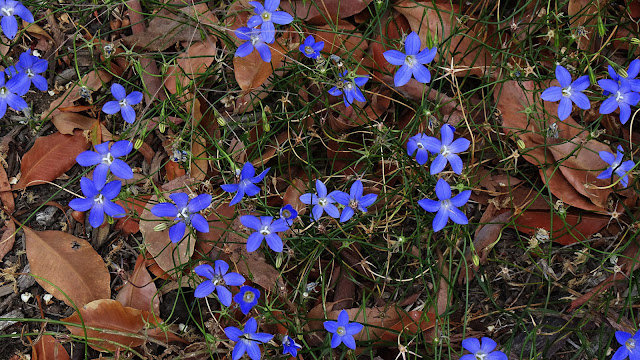
Wahlenbergia stricta, or Australian Bluebell, Tall or Austral Bluebell, is an Australian wildflower from the Campanulaceae family. It is considered the most commonly encountered of the Wahlenbergias. It is found in all Australian states but not the Northern Territory. It is often seen growing by the side of the road, enjoying the extra runoff.

W. stricta is a perennial herb flowering mainly in spring or summer with pale blue bell-like flowers. The leaves are long and linear, 5–70 millimetres (0.20–2.76 in) long. The five-petalled flowers are erect on long, slender stems and about 6–20 millimetres (0.24–0.79 in) in diameter. It forms thin, carrot shaped tubers.

Australian bluebells are generally easily propagated by division or root cutting. The seed is a very fine, black powder. It germinates readily in a few weeks and is best directly sown into tubes or cells as the seed and plant are very small and hard to separate and prick out.

There are a number of common cultivars, including various shades of blue from a saturated blue similar to #00f through to white. Various double forms are available. To maintain a cultivar propagation must be by vegetative means (division or cuttings). 

Once established W. stricta is very hardy - the pot can be dried out completely and the plant reduced to a tuber, yet it will reshoot when the rain comes. It is hardy in a range of soils from sand to gravel, clay to humus.

This post is part of the Floral Friday Fotos meme


Tuesday, 30 November 2021

YARRA RIVER SUNRISE

The city is certainly more lively now that most of the COVID restrictions have been lifted. The Omicron strain is causing some worry and many people are reacting by doing very silly and risky things. My favourite time in the City is at sunrise. Quiet, with few people around and lovely light!

This post is part of the Our World Tuesday meme,
and also part of the Ruby Tuesday meme,
and also part of the Travel Tuesday meme,
and also part of the Wordless Wednesday meme.


Friday, 15 October 2021

SPRING SKY

A change is coming, lots of rainy weather ahead, as gray clouds replace the white ones.

This post is part of the Skywatch Friday meme


Friday, 1 October 2021

FLYING

One from the archives, when to get on a plane and go wherever one liked when one liked was possible... Now that seems like quite an impossible thing to do! This is the northwest of Melbourne, approaching the airport at Tullamarine for a landing.

This post is part of the Skywatch Friday meme


Thursday, 30 September 2021

DIANELLA

Dianella caerulea, commonly known as the blue flax-lily, blueberry lily, or paroo lily, is a perennial herb of the family Asphodelaceae, subfamily Hemerocallidoideae, found across the eastern states of Australia and Tasmania. It is a herbaceous strappy perennial plant to a metre high, with dark green blade-like leaves to 70 cm long. Blue flowers in spring and summer are followed by indigo-coloured berries. It adapts readily to cultivation and is commonly seen in Australian gardens and amenities plantings.

This post is part of the Floral Friday Fotos meme

Thursday, 19 August 2021

BRUNNERA

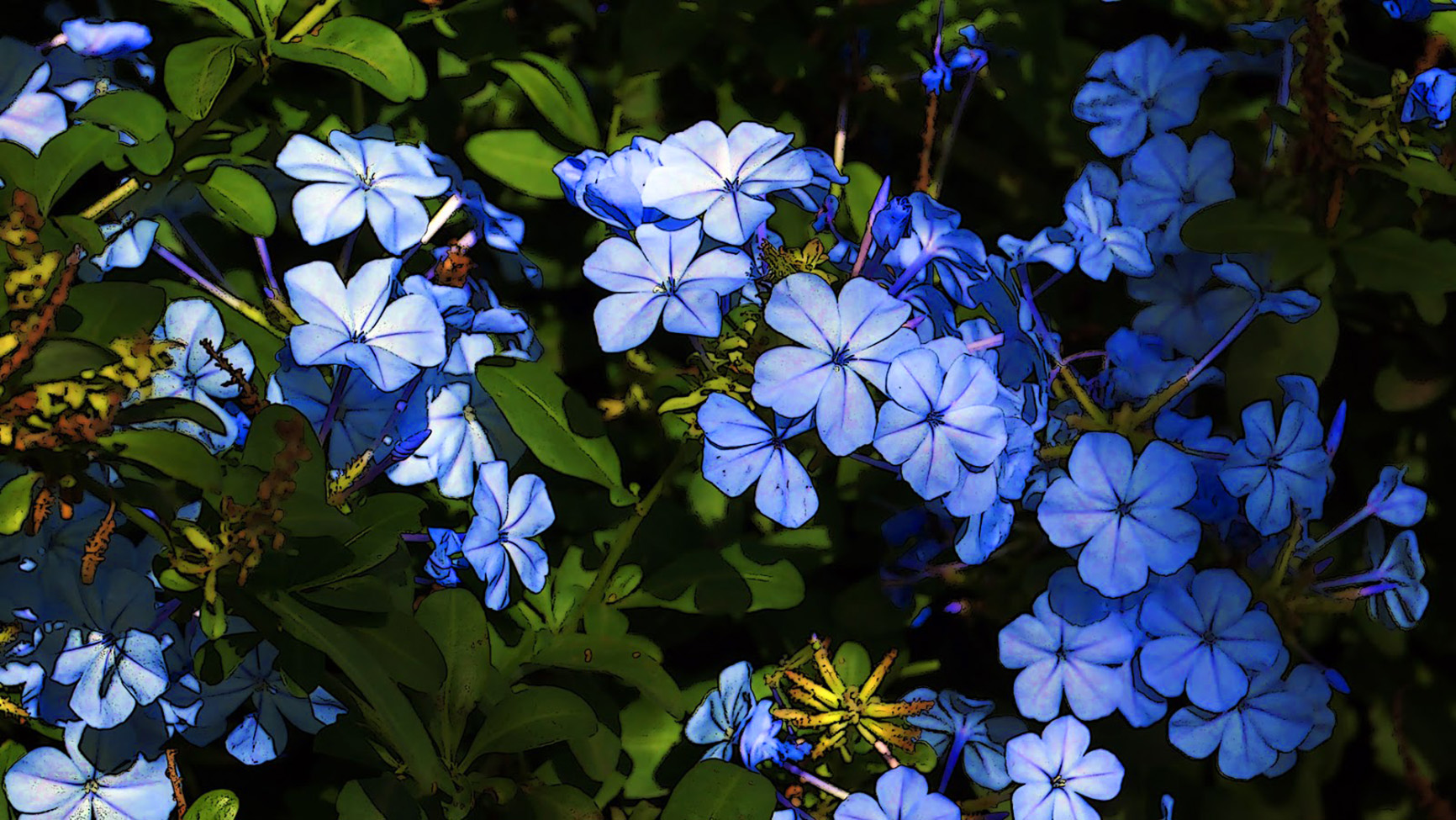
Brunnera is a genus of flowering plants in the family Boraginaceae. They are rhizomatous perennials, native to the woodlands of Eastern Europe and North West Asia. They have hairy leaves and sprays of blue flowers in spring. Numerous cultivars are available, which are valued as groundcover in dappled shade. Some possess variegated foliage, such as the  ‘Silver Heart’ hybrid shown here.

The best known species is Brunnera macrophylla, known as Siberian bugloss. It thrives in shade but also likes morning sunshine as long as it is in consistently moist, rich, organic soil. It does not tolerate dry conditions. It is often used in woodland gardens along streams of ponds and in naturalised areas as a specimen plant or clumped together as a border. Clumps slowly spread by both creeping rhizomes to form thick ground covers.

Brunnera macrophylla ‘Silver Heart’ (USDA Zone: 4-9) is a superb introduction, forming a clump of very thick, heart-shaped leaves that are silver with green edging and veining. Sprays of deep blue Forget-me-not-like flowers appear in spring. This is a choice collector’s plant, but also an easy-to-grow perennial that performs well in all but the driest of shady conditions. Excellent for the woodland garden. Provided there is sufficient moisture, plants can tolerate full sun; as the leaves are so thick, little or no scorching occurs. Bred by Spitsbergen-Willemsen of the Netherlands. USPP#24685: Unlicensed propagation prohibited.

This post is part of the Floral Friday Fotos meme.