Showing posts with label zoo. Show all posts

Saturday, 5 July 2025

NUMBAT

The numbat (Myrmecobius fasciatus), also known as the banded anteater, or walpurti, is a marsupial found in Western Australia. Its diet consists almost exclusively of termites. Once widespread across southern Australia, the range is now restricted to several small colonies and it is listed as an endangered species. The numbat is an emblem of Western Australia and protected by conservation programs.

This post is part of the Saturday Critters meme

Saturday, 8 January 2022

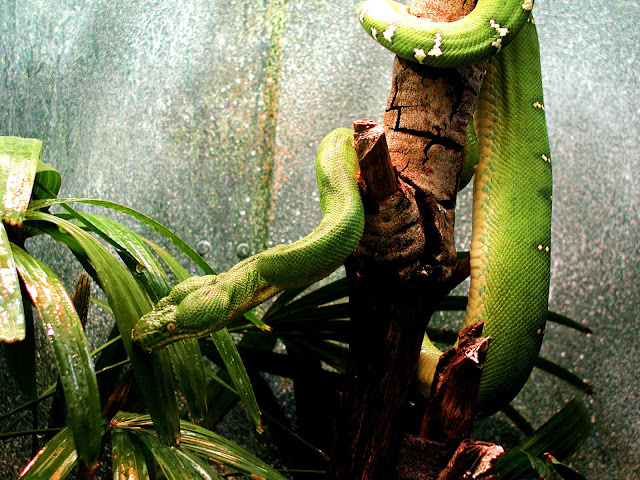
GREEN TREE PYTHON

Morelia viridis, commonly known as the green tree python, or as it is known in the herpetoculture hobby, 'chondro' (due to its former classification in the genus Chondropython) is a species of python found in New Guinea, islands in Indonesia, and Cape York Peninsula in Australia. The species usually reaches a total length of 150–180 cm, but large females may reach 200 cm. The size also varies depending on the region of origin.

The weight is highly dependent upon the nutritional status of the animal. Males can weigh about 1100-1400 g, females up to 1,600 g, although wild specimens are typically much lighter than this. Especially large specimens up to 2,200 g are invariably females, which like most snakes are slightly larger and heavier than males. Its main habitat is typically in or near rainforest, and is primarily arboreal, residing in trees, shrubs and bushes. Occasionally it is seen on the ground. This species is not currently thought to be threatened in its natural habitat, although it remains very popular in the pet trade. Some hunting for food is known to occur in New Guinea.

The diet of these pythons consists mostly of small mammals, such as rodents, and sometimes reptiles. Prey is captured by holding onto a branch using the prehensile tail and striking out from an s-shaped position and constricting the prey. Wild specimens have also been observed and photographed wrapped around the base of small tree trunks, facing down in an ambush position, presumably waiting for ground mammals to prey upon.

Morelia viridis is oviparous, laying 1-25 viable eggs per clutch. Breeding has never been reported from the wild, however in captivity eggs are incubated and protected by the female. Hatchlings are lemon-yellow with broken stripes and spots of purple and brown, or golden or orange-red. These snakes are often bred and kept in captivity, although they are usually considered an advanced species due to their specific care requirements; once these are met, they usually thrive in captivity.

This post is part of the Saturday Critters meme


Saturday, 14 December 2019

KOALA

The koala (Phascolarctos cinereus or, inaccurately, koala bear) is an arboreal herbivorous marsupial native to Australia. It is the only extant representative of the family Phascolarctidae, and its closest living relatives are the wombats. The koala is found in coastal areas of the mainland's eastern and southern regions, inhabiting Queensland, New South Wales, Victoria and South Australia. It is easily recognisable by its stout, tailless body; round, fluffy ears; and large, spoon-shaped nose. The koala has a body length of 60–85 cm and weighs 4–15 kg. Pelage colour ranges from silver grey to chocolate brown. Koalas from the northern populations are typically smaller and lighter in colour than their counterparts further south. It is possible that these populations are separate subspecies, but this is disputed.

Koalas typically inhabit open eucalypt woodlands, and the leaves of these trees make up most of their diet. Because this eucalypt diet has limited nutritional and caloric content, koalas are largely sedentary and sleep for up to 20 hours a day. They are asocial animals, and bonding exists only between mothers and dependent offspring. Adult males communicate with loud bellows that intimidate rivals and attract mates. Males mark their presence with secretions from scent glands located on their chests. Being marsupials, koalas give birth to underdeveloped young that crawl into their mothers' pouches, where they stay for the first six to seven months of their life. These young koalas are known as joeys, and are fully weaned at around a year. Koalas have few natural predators and parasites but are threatened by various pathogens, like Chlamydiaceae bacteria and the koala retrovirus, as well as by bushfires and droughts.

This post is part of the Saturday Critters meme.

Tuesday, 27 November 2018

ON A SAFARI IN WERRIBEE

Werribee Open Range Zoo is an African themed zoo in Werribee, about 32 kilometres south-west of Melbourne. It is part of the Zoological Parks and Gardens Board or 'Zoos Victoria' which also includes Melbourne Zoo and Healesville Sanctuary. It is situated on approximately 225 hectares (560 acres) and is located on the Werribee River in Werribee Park, adjacent to the Werribee Mansion. It was originally agistment land to the Melbourne Zoo.

Visitors to the zoo can take a bus tour, which normally lasts 35–40 minutes, multiple times a day, and takes up to 140 people per bus. The tour includes animals such as the hippo as well as animals of the grassland, such as zebra, waterbuck, giraffe, ostrich and rhinoceros, as well as the camel and the oryx. The zoo has a simulated African village, with educational and entertaining features, including a mock scenario of an African ranger and his adventures tracking lions, and an interactive soundscape walk with simulated lion sounds surrounding the walker.

There are two independent trails that visitors may follow: the Pula Reserve Walking Trail which focuses on African animals, including lions, vervet monkeys, cheetahs and meerkats, and the Australian Journey Walk, which focuses on Australian animals, like the koala, emu and kangaroo as well as the cassowary.

This post is part of the Our World Tuesday meme,
and also part of the Ruby Tuesday meme,
and also part of the Travel Tuesday meme,
and also part of the Wordless Wednesday meme.


Wednesday, 22 August 2018

GORILLA IN ZOO

The Royal Melbourne Zoological Gardens, commonly known as the Melbourne Zoo, contains more than 320 animal species from Australia and around the world. The zoo is 4 kilometres north of the centre of Melbourne. It is accessible via Royal Park station on the Upfield railway line, and is also accessible via tram routes 55 and 19, as well as by bicycle on the Capital City Trail. Bicycles are not allowed inside the zoo itself. The Royal Melbourne Zoological Gardens is a full institutional member of the Zoo and Aquarium Association (ZAA) and the World Association of Zoos and Aquariums.

Nobody misses a visit to meet the Western Lowland Gorillas at Melbourne Zoo. These fascinating creatures, which are from the same family as humans, Orang-utans and chimpanzees, share many features with us – they even giggle when amused! Melbourne Zoo is one of 150 zoological institutions worldwide participating in a survival breeding program for Western Lowland Gorillas. The population within these participating zoos totals 856 gorillas. 

This post is part of the Wordless Wednesday meme,
and also part of the ABC Wednesday meme,
and also part of the Nature Notes meme.


Wednesday, 9 July 2014

ZOO, MELBOURNE

The Royal Melbourne Zoological Gardens, commonly known as the Melbourne Zoo, contains more than 320 animal species from Australia and around the world. The zoo is 4 kilometres north of the centre of Melbourne. It is accessible via Royal Park station on the Upfield railway line, and is also accessible via tram routes 55 and 19, as well as by bicycle on the Capital City Trail. Bicycles are not allowed inside the zoo itself. The Royal Melbourne Zoological Gardens is a full institutional member of the Zoo and Aquarium Association (ZAA) and the World Association of Zoos and Aquariums.

This post is part of the Waterworld Wednesday meme,
and also part of the Outdoor Wednesday meme,
and also part of the Wordless Wednesday meme,
and also part of the ABC Wednesday meme.