Tuesday, 24 April 2012

THE ANZACS AT WHITTLESEA

Tomorrow, 25th April, is Anzac Day which is observed in Australia and New Zealand as a day of commemoration for those who died in the service of their country, and is a day for honouring returned servicemen and women, whichever battle or war they served in  The 25th day of April is the anniversary of the landing of the Australian and New Zealand Army Corps (ANZACs) at Gallipoli in 1915. On the first anniversary of that landing services were held throughout both countries in remembrance of the thousands of Australian and New Zealand soldiers who died during the eight-month Gallipoli Campaign.

Since 1916 Anzac Day has evolved to the observance we commemorate today. The day of observance begins before dawn with a march by returned and service personnel to the local war memorial, where they are joined by other members of the community for the Dawn Service. This is a solemn and grave ceremony which brings to mind the lives lost and the terrible futility of warfare, whether it happened in Gallipoli, in the Middle East, in America, in Vietnam, in Afghanistan, the Gulf or in Korea… You can read more about Melbourne's Shrine of Remembrance and look at my photos in this linked blog post.

The assault on the Gallipoli Peninsula began on the 25th April 1915, as an attempt by Allied Command to weaken the strategic position of Germany, Austro-Hungary and Turkey who were allied in the first world war. It was the Australasian Expeditionary Force’s first major engagement of the First World War after their training in Egypt. By the end of the first day of warfare on the Gallipoli peninsula, about 2,000 allied troops lay dead. The bloody fighting continued, and by the end of the first week more than 6500 ANZACs had been killed or wounded. Many thousands of Turks also died there.

Not all brave acts at Gallipoli met with success, however. The film “Gallipoli” tells the story of the 10th Light Horse Regiment from Western Australia and the brave but pointless attack at a place called The Nek. After several mistakes that gave the Turks time to prepare for an attack, the Australians fixed bayonets, leapt out of their trenches and charged the Turkish lines. In just 30 seconds, the first wave of men had all been killed or wounded. The Turks eventually stopped shooting and the battlefield fell silent.

After only two minutes, the second wave stormed from the trenches, into the wall of hot lead and steel. The final wave of ANZACs remained in the trench. They knew the attack was now pointless, and waited for the Generals down on the beach to order them to stop. But the only order they received was to attack. Brothers said goodbye to each other, and friends stood side by side. As they leapt out of the trench they jumped over the bodies of their friends who had been alive only minutes earlier, and knew they would soon join them. No ANZACs ever reached the Turkish trenches. In 1919, after the war was over, several ANZACs went back to Gallipoli to bury their dead properly. At the Nek, they found the bodies of more than 300 Australians in an area smaller than a tennis court.

After eight long months of bitter fighting, the British High Command decided that the war at Gallipoli was too costly when they were also fighting other battles in Europe. The ANZACs alone had lost 10,000 men, and so the order came for a withdrawal. Since the first anniversary of the Gallipoli landing in 1916, Anzac Day has evolved to acknowledge the sacrifice and service of subsequent wars and to encompass new understandings of the full impact of armed conflict on those who have served their country.

Gallipoli has marked indelibly the Australian psyche and there is nobody in Australia who does not know of the events in the first world war that led to such a terrible loss of young lives. All towns and cities in Australia have some sort of memorial to the Anzacs, and I give you here some photos from Whittlesea, a town in Melbourne, Victoria, Australia, 40 kilometres north-east from Melbourne's central business district. At the 2006 Census, Whittlesea had a population of 4,563.

The Anzac memorial in Whittlesea is one that is similar to many others in small towns in Australia, the statue of the digger surmounting a column on which names of the fallen are engraved. Furthermore, in this town plane trees have been planted in the main street, each one of them dedicated to a fallen digger, with a plaque commemorating the young life lost. I find this a particularly poignant memorial to these fallen heroes.


This post is part of Julie's Taphophile Tragics meme.


Monday, 23 April 2012

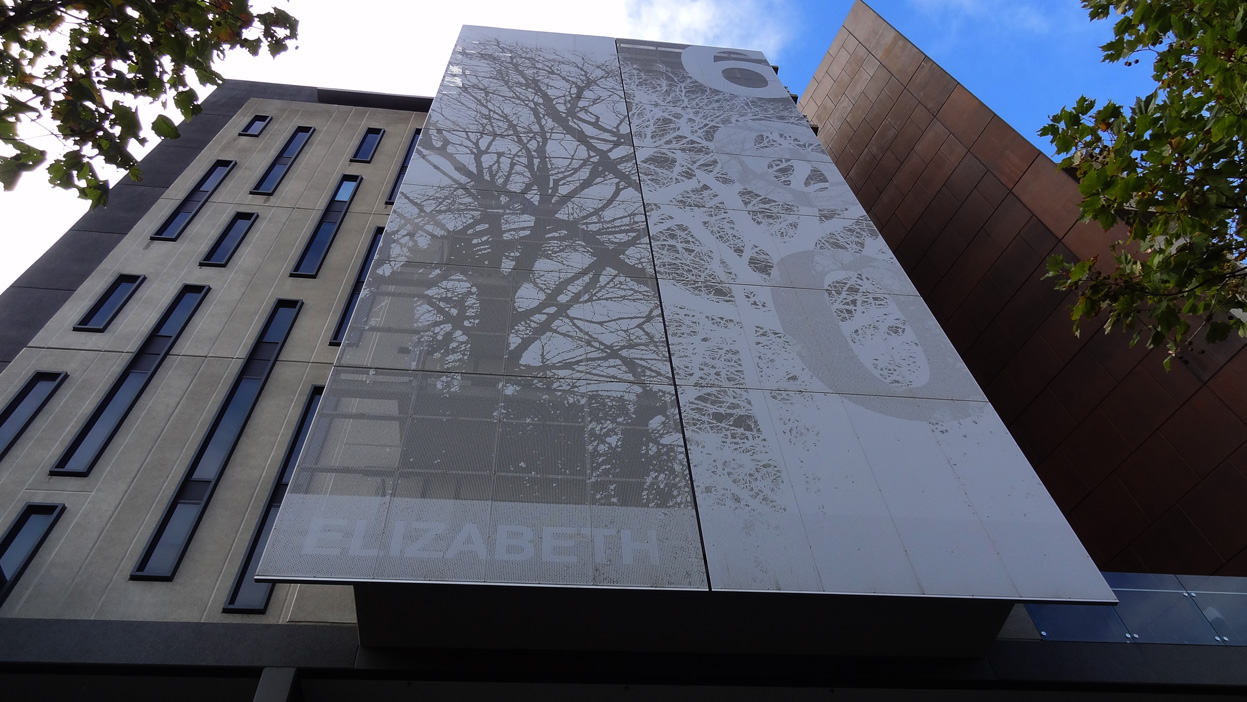
APARTMENTS IN ELIZABETH ST


660 Elizabeth St. is a new 10 level apartment building located in the heart of Melbourne. It is beautifully designed, provides high quality living spaces, has spectacular views and reflects current best practice in terms of environmental sustainability.

It provides much needed affordable rental housing for a mix of singles and families on low and moderate incomes. What makes this project particularly special is that it also aims to create a welcoming and supportive place for Victorians who have experienced long periods of homelessness.

Yarra Community Housing’s vision for 660 Elizabeth St. is to not only be a stunning new inner city apartment building, but to be a vibrant and exciting place where people from a diverse range of backgrounds can create a sense of home and community; and be inspired to realise their own hopes and dreams.

Yarra Community Housing is a non-profit, non-government affordable housing association with a long history of providing innovative models of housing and support for single persons who struggle to achieve stable housing - including many people who have experienced homelessness.

I may be stretching the definition of "mural" a little bit, but the patterned, temperature -regulating grill on the façade of the building, looks to me like a fine decorative mural, reflecting the magnificent street trees outside the building.


This post is part of the Monday Murals meme.


Sunday, 22 April 2012

WARBURTON, VICTORIA

Warburton is a town in Victoria, Australia, 72 km east from Melbourne's central business district. At the 2006 Census, Warburton had a population of 2288. The name “Warburton” has been shared between two townships over the years. The mining town of “Yankee Jims Creek” was located on the gold-bearing slopes of Mount Little Joe, and was renamed “Warburton” after the mining warden of the district, Charles Warburton Carr. Gold depletion caused a declining population in the 1880s, so the town was renamed “Old Warburton” and the town of “Upper Warburton” on the banks on the Yarra River was renamed “Warburton”.

The Post Office opened around 1884 though two earlier offices named Warburton were renamed as Launching Place and Hoddle's Creek. Warburton was connected to Lilydale by a Victorian Railways branch line which closed in 1965.The railway path is now used for the Lilydale to Warburton Rail Trail, a rail trail used by pedestrians, cyclists, and horse-riders. East of Warburton is a large water catchment area called Upper Yarra Dam designed to supply Melbourne with the required amount of water sourced from the Thomson catchment area.

The Yarra River passes through Warburton as it winds its way to Melbourne. The extensive reserves and parklands around the Yarra in and around the town provide ample opportunity for all sorts of leisure activities, as well as affording a beautiful location for walking and of course, photography!


This post is part of the Scenic Sunday meme.


Saturday, 21 April 2012

MELBOURNE NURSERIES

With the large number of homes in Melbourne that possess extensive gardens in the front and back yards, it is no surprise that there are hundreds of nurseries throughout the metropolitan area. These do a rollicking trade in plants, seedlings, garden tools, statuary, pots, soils, screenings and a host of other gardening supplies to keep the garden-mad Melburnians content.

In some of the outer suburbs nurseries can be very large and have extensive grounds where one may see samples of the plants on sale in a natural garden setting. Here is the ornamental lake from one of these large nurseries in Eltham, an outer Northeastern suburb.

This post is part of James' Weekend Reflections meme,
and also part of Louis' Sunday Bridges meme.


Friday, 20 April 2012

MELBOURNE STREET TREES 16

The pomegranate, Punica granatum, is a fruit-bearing deciduous shrub or small tree growing between five and eight meters tall. Native to the area of modern day Iran and Iraq, the pomegranate has been cultivated in the Caucasus since ancient times. From there it spread to Asian areas such as the Caucasus as well as the Himalayas in Northern India. Today, it is widely cultivated throughout Turkey, Iran, Syria, Azerbaijan, Armenia, Afghanistan, India, Pakistan, Bangladesh, Iraq, Lebanon, Egypt, China, Burma, Saudi Arabia, Israel, Jordan, the drier parts of southeast Asia, the Mediterranean region of Southern Europe, and tropical Africa.

Introduced into Latin America and California by Spanish settlers in 1769, pomegranate is also cultivated in parts of California and Arizona for juice production. In the Northern Hemisphere, the fruit is typically in season from September to February. In the Southern Hemisphere, the pomegranate is in season from March to May. Melbourne's mild climate is particularly well-suited to this tree and many fine specimens can be seen gracing the front and back yards of houses, especially those belonging to immigrants from the countries where the pomegranate is widespread.

The pomegranate has been mentioned in many ancient texts, notably the Book of Exodus, the Homeric Hymns and the Quran. In recent years, it has reached mainstream prominence in the commercial markets of North America and the Western Hemisphere. Its health benefits are numerous and it finds widespread culinary uses.

This post is part of the Floral Friday Fotos meme.


CLAYTON, MELBOURNE

Clayton is an outer suburb in Melbourne, Victoria, 19 km south-east from Melbourne's central business district. Its Local Government Area is the City of Monash. At the 2006 Census, Clayton had a population of 14,332. The main focus for the suburb of Clayton is the shopping strip that runs along Clayton Road. The local railway station, situated at the northern end of the shopping strip bears the name Clayton railway station.

The shopping strip is a vibrant, multicultural and rather old-fashioned place, where one may shop, people-watch, enjoy a cup of coffee or look at the buskers that frequent it.

This post is part of the Challenge Walk In The Street meme.


Thursday, 19 April 2012

SOUTH WHARF, MELBOURNE

South Wharf is a small inner suburb of Melbourne, Victoria. Its Local Government Area is the City of Melbourne and the City of Port Phillip. Its borders are the Yarra River to the north, Wurundjeri Way to the west, the West Gate Freeway and a small private car park bordering Ford Street and Munro Street which is part of the City of Port Phillip to the south, and the railway line and Clarendon Street to the east.

South Wharf is located on the southern bank of the Yarra River, bounded by Clarendon Street, Normanby Road, the West Gate Freeway and Docklands Highway. Gazetted in 2008, formerly part of the industrial and shipping area of Southbank, the renaming is part of a wider urban renewal strategy to link Southbank with Melbourne Docklands. South Wharf includes some of Melbourne's landmarks including the Melbourne Exhibition and Convention Centre and the Melbourne Maritime Museum with its heritage Polly Woodside. South Wharf is home to Shopping outlet Direct Factory Outlets and the Hilton Melbourne - "South Wharf".

This post is part of the Signs, Signs meme hosted by Lesley,
and also Things in a Row meme hosted by Pat.


Wednesday, 18 April 2012

DAYLESFORD, VICTORIA, AUSTRALIA

Daylesford is a town located in the Shire of Hepburn, Victoria, Australia, founded in 1852 with the finding of alluvial gold in areas now occupied by Lake Daylesford. It is about 115 km north-west of Melbourne, in the foothills of the Great Dividing Range. At the 2006 census, Daylesford had a population of 3,073. The Midland Highway runs through the town. The broader area around the town, including Hepburn Springs to the north, is renowned for its natural spring mineral spas where visitors can sample the mineral water. This together with its proximity to Melbourne make it a popular destination for tourists.

Lake Daylesford, originally an idea by a Norwegian, Christian Christensen, to provide hydro-electric power to the town, was finally brought to fruition in 1929 by Councilor Trembath, a descendant of a Cornish miner. The spa resorts declined in the 1930s, but were redeveloped in the 1970s. Since then, Daylesford and all of the eastern Shire of Hepburn has become a major alternative lifestyle centre, with such services as massages, reiki, shiatsu, acupuncture, aromatherapy, reflexology, spiritual healing, and tarot reading being found.

This post is part of the Water World Wednesday meme,
the Nature Footsteps Waters meme,
and the Outdoor Wednesday meme.


Tuesday, 17 April 2012

SAMUEL MAUGER & THE FIRE SERVICES MUSEUM

Samuel Mauger Jr (pronounced "Major" - 12 November 1857 – 26 June 1936) was an Australian social reformer, hat manufacturing unionist and a Protectionist politician. He was born in Geelong, Victoria, son of immigrants from Guernsey, Channel Islands, Samuel Mauger Senior and Caroline née Liz who migrated to Australia in the 1850s. Mauger junior was educated at the Geelong National School, but left school early to become an errand boy for a hat maker when his father contracted rheumatic fever. Mauger later owned the hat manufacturing business. Mauger was a Bible class teacher at St Mark's Church of England in Fitzroy. He later became the Sunday-school superintendent at St Paul's Congregational Church in North Fitzroy. On 13 May 1880, Mauger married Hanna Rice who he had metat St Mark's; they eventually had four sons and four daughters.

Mauger held various memberships to various organisations. He was a superintendent in the Fire Brigades' Association of Victoria and four times president of the Metropolitan Fire Brigades Board. Mauger was one of the founders and secretary of the Anti-Sweating League (against sweatshops in manufacturing) from 1895. Mauger was on the Board enquiry for unemployment in 1899 and involved in the royal commission of Victorian factories and shops law in 1900.

Being a devout Christian of the Australian Church, Mauger was president of the Young Men's Christian Association and president of the Melbourne Total Abstinence Society. Mauger attempted to run for politics in various State electorates before becoming a Member of Parliament. He stood for the seat of Fitzroy in 1892, South Melbourne in 1896 and Portland in 1897. In 1900, Mauger was elected to the Victorian Legislative Assembly to the seat of Footscray. He held the seat of Footscray until May 1901, where he resigned from State politics and ran for Federal politics. Mauger was the first member for Melbourne Ports in 1901 until his defeat to ALP candidate James Mathews in 1906. Mauger then shortly got elected to the Federal seat of Maribyrnong and became the electorate's first Federal Member of Parliament. He was a Minister without a Portfolio from 1906 until 1907 and then Postmaster-General until 1908.

Mauger lost his seat of Maribyrnong to ALP candidate James Fenton in 1910. Mauger ran for the Victorian Senate in 1913 and 1914, but failed to get elected. He was an ardent protectionist and was for some time honorary secretary of the protectionists' association of Victoria; he was for a time president of the Melbourne Total Abstinence Society, and chairman of the Indeterminate Sentences Board; and he presumably found some time for his business as a hatter and mercer. For about 50 years in every movement in Melbourne intended to better the conditions of the mass of the people, Mauger was to be found working incessantly and showing much organising ability.

In 1934 Mauger wrote a brochure on "The Rise and Progress of the Metropolitan Fire Brigade, Victoria, Australia", on page 29 some verses relating to the success of the staff fund illustrate his philosophy of life. Basically it was that if anything is brought forward for the good of humanity, difficulties will vanish if the problem is tackled with sufficient courage. Mauger died in Elsternwick, Victoria and is buried in the Melbourne General Cemetery. At his funeral, he was given a fire guard honour.

In East Melbourne, adjacent to the city on Victoria Parade, there is a monument to Mauger opposite the old Eastern Hill Fire Station, which is now the Fire Services Museum.

This post is part of the Taphophile tragics meme hosted by Julie,
and also part of the Our World Tuesday meme.
The central reserve of Victoria Parade in East Melbourne, along which the tram tracks run
The monument to Samuel Mauger in the central reserve of Victoria Parade, opposite the Eastern Hill Fire Station. In the background is St Vincent's Hospital
The inscription reads: "Erected by Commonwealth Admirers in Memory of Samuel Mauger, Born 1857 - Died 1936. Industrial, Prison, Temperance & Social Reformer. He Gave His Life to the Service of Mankind. This Memorial is Erected to Commemorate the Life and Achievement of one who Spent his Years in Seeking to Serve his Fellow-Men. 'Go Thou and Do Likewise'. 26th June 1937." 
The old Eastern Hill Fire Station, now the Fire Services Museum

The Board Room in the Museum. The figure on the left is Samuel Mauger, in his role as president of the Metropolitan Fire Brigades Board
Painting titled "1891-1991 Celebration of a Century" by R Horne (an ex-fireman), installed on 25th August 1992
The Fire Chief's Office
The first floor Watchroom
Fire Services Museum Victoria provides a home and focus for the history of fire fighting services in Victoria. The Museum includes a collection of over 10,000 fire related items, the largest collection in Australia, featuring fire brigades, fire appliances, personnel histories, memorabilia and associated items.
Part of the protective equipment display
The international fire services room
Country Fire Authority room - Large painting by Jamie Cooper titled: "Spirit of CFA"