Showing posts with label memorial. Show all posts

Friday, 26 June 2026

SUNSET WALK

A poignant photo for me this week. It is a repost, in fact, of a shot I took several years ago of three friends I was walking with at sunset all those years back. I turned to look at them after we parted and took this photo as they were walking away from me. I learned yesterday that one of them had died earlier this week. Vale, AH...

This post is part of the Skywatch Friday meme


Wednesday, 14 February 2024

LINCOLN SQUARE

Lincoln Square, Swanston Street, Carlton provides a green space in the heart of the City. A central part of it is the Bali Memorial Fountain. This fountain and landscaped site memorialises those who lost their lives or were injured by the bomb blasts that devastated Kuta, Bali, on 12 October 2002, and honours those who helped in the aftermath. It has been conceived as a place of comfort, the seating offering a place for quiet contemplation.

The memorial’s centrepiece is a low concrete platform in which two rectangular pools are sunk. These house 91 jets, representing the Australians who perished in the bombing; the names of the 22 Victorians killed are recorded on the sides of the fountain. The fountain’s 202 lights represent all who died that night. A plaque on the eastern side of the memorial lists the names of the Australians who lost their lives. On each anniversary of the bombing, the fountain recedes to become a reflection pool. 

This memorial rejuvenated an existing water feature, built on the site in the 1960s. In 1961, the Melbourne City Council began work landscaping Lincoln Square, laying paths, stone terraces, flower beds and installing an ornamental spraying fountain. It was officially opened by Councillor Brens, Chairman of the Parks and Gardens Committee on the 23rd of July, 1965. The fountain was the first work to be designed financed and installed entirely by the Melbourne City Council, at a cost of 18,000 pounds. The City Architects designed a 40 foot square pool with 150 jets forming the water sculpture. The pool is capped with Sicilian marble and Harcourt granite.

This post is part of the Wordless Wednesday meme,
and also part of the Nature Notes meme.


Wednesday, 9 August 2017

EIRENIC ELTHAM MEDITATION

EIRENIC - adjective[formal] "Aiming or aimed at peace."

A serene sunset, away from the hustle and bustle of the City, but in direct view of it, at the Eltham War Memorial Park in Kangaroo Ground.

As the clouds of impending war seem to dull the horizons of our near future, it is worthwhile to reflect on all of the bloody conflicts of the past and do everything in our power in the present to prevent such horrors from recurring...

This post is part of the 
Wordless Wednesday meme,
and also part of the Outdoor Wednesday meme,
and also part of the ABC Wednesday meme.

Tuesday, 2 October 2012

CONSERVATORY, FITZROY GARDENS

One of Melbourne's favourite tourist attractions, the Conservatory opened on the 13th of March 1930, and has a history of over 70 years of providing spectacular floral displays. The Building copies the Spanish mission architectural style, measuring 30 x 15 metres and originally costing 4,000 pounds. The Conservatory is a vital part of the City's commitment to excellence in horticulture. There are five separate displays each year. It is used by tourists, schools, families and anyone who wants to capture a moment of floral beauty.

Display 1 - Hydrangea / Fuchsia: November - February
Display 2 - Tuberous Begonia / Gloxinia: February - April
Display 3 - Tropical / Pointsettia: April - July
Display 4 - Cineraria / Cyclamen: July - September
Display 5 - Schizanthus / Calceolaria: September - November

Also in the conservatory are two memorials. One dedicated to Mary Gilbert, the first migrant woman settler in the Port Phillip settlement that was to become Melbourne. A statue by Ailsa O'Connor adds to the tribute. However, for me even more poignant is a simple plaque that commemorates Wilma Saunders, Conservatory Attendant and Fitzroy Gardens Tour Guide between 1999 and 2009...

This post is part of the Taphophile Tragics meme,
and also part of the Our World Tuesday meme.


Tuesday, 18 September 2012

FLAGSTAFF GARDENS

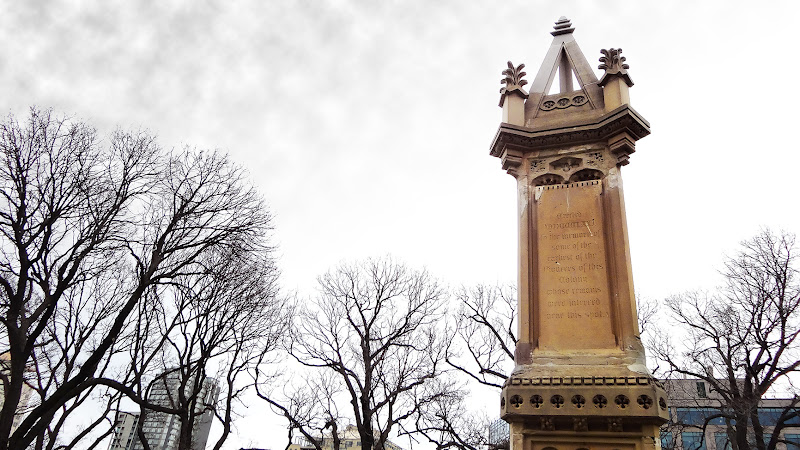
Flagstaff Gardens is the oldest park in Melbourne, first established in 1862. In 2005 it is one of the most visited and widely used parks in the city by nearby office workers and tourists. The gardens are notable for their archeological, horticultural, historical and social significance to the history of Melbourne.

The gardens are 7.2 hectares (18 acres) of Crown Land bounded by William, La Trobe, King and Dudley streets, managed by the City of Melbourne. The park contains extensive lawns with a variety of mature trees, flowerbeds and native animals including possums. The southern end is characterised by deciduous trees, while the northern end contains mature eucalypts. Avenues of elms shade pathways along with several large Moreton Bay Fig trees. The north corner contains a bowling lawn, rose beds, flower and shrub beds. Along William Street there are tennis courts, which also double as volleyball, handball and netball courts. Electric barbecues nearby provides a popular site for office parties in December.

Scattered about the lawns and gardens are memorials and sculptures that illuminate some of the social significance of the area. Flagstaff Gardens have been classified by the National Trust of Australia (Victoria) and is listed by the Australian Heritage Commission and the Victorian Heritage Register. At the listing ceremony by the Victorian Heritage Council in April 2004, Council Chair Chris Gallagher said "This listing ensures the much loved trees, landscaping and other individual features are conserved and protected. But it also means the whole site is recognised as an important place for gaining an insight into our historical, archaeological, aesthetic, horticultural and social heritage."


With the establishment of Melbourne in 1835, the first deaths in the colony were buried on high ground between William and King Streets, in what was colloquially called Burial Hill. The hill had panoramic views of the small colony, the Yarra River and Port Phillip.

This post is part of the Taphophile Tragics meme,
and also part of the Our World Tuesday meme.


  • 1838 - Melbourne cemetery was marked out in what is now the Queen Victoria market, and burials continued at that location.
  • 1839 - Superintendent Charles La Trobe first included the site as part of the green belt encircling Melbourne which included Batman's Hill, Carlton Gardens, Fitzroy Gardens, Treasury Gardens and the Kings Domain.
  • 1840 - a flagstaff was erected on the hill as part of a signalling system between the town and ships in the Port of Melbourne. The flagstaff proved too small and the following year a fifty foot (15 m) flagstaff was erected.11 November
  • 1850: site of announcement of Victoria’s Separation from the Colony of New South Wales, resulting in celebrations with a huge bonfire with about 5,000 townspeople in attendance.
  • 1853- establishment of the Melbourne cemetery
  • 1857 - cutting excavated to ease the gradient of King Street. This created the bluestone retaining wall of the high bank along the western boundary.
  • 1857-1863 - A Magnetic Observatory and Weather Station was established by Georg von Neumayer on the hilltop. William John Wills worked here as an assistant before being appointed to the Burke and Wills expedition. The observatory moved to the Kings Domain when the Melbourne Observatory was established, as iron in the buildings surrounding Flagstaff Hill were affecting Neumayer's magnetic observations.1860s - the telegraph supersedes signalling by flags.
  • 1862 - West Melbourne residents petition the government to turn the hill into public gardens or recreation reserve. Clement Hodgkinson, the Deputy Surveyor-General in charge of city parks, prepared a plan for the gardens and directed its implementation.The Fitzroy and Treasury Gardens were also designed by him.
  • 1871 - Memorial to Melbourne’s pioneers erected.1873 - Gardens permanently reserved
  • 1880 - establishment of path network, lawns, trees and flowerbeds.October 9, 1917 - the City of Melbourne was appointed responsible for the Flagstaff Gardens.1918 - children’s playground established, one of the first in Melbourne.23 March 2004 - gardens formally added to the Victorian Heritage Register.

Thursday, 2 August 2012

MERCHANT NAVY MEMORIAL

South Wharf is a small inner suburb south west from Melbourne's CBD. Its borders are the Yarra River to the north, Wurundjeri Way to the west, the West Gate Freeway and a small private car park bordering Ford Street and Munro Street, which is part of the City of Port Phillip, to the south and the former Port Melbourne railway line and Clarendon Street to the east. Gazetted in 2008 and formerly part of the industrial and shipping area of Southbank, the renaming is part of a wider urban renewal strategy to link Southbank with the Melbourne Docklands.

This memorial to the Merchant Navy men and women lost at sea is found in the area close to the Polly Woodside maritime museum (more in a later post!).


This post is part of Lesley's Signs, Signs meme.


Tuesday, 24 April 2012

THE ANZACS AT WHITTLESEA

Tomorrow, 25th April, is Anzac Day which is observed in Australia and New Zealand as a day of commemoration for those who died in the service of their country, and is a day for honouring returned servicemen and women, whichever battle or war they served in  The 25th day of April is the anniversary of the landing of the Australian and New Zealand Army Corps (ANZACs) at Gallipoli in 1915. On the first anniversary of that landing services were held throughout both countries in remembrance of the thousands of Australian and New Zealand soldiers who died during the eight-month Gallipoli Campaign.

Since 1916 Anzac Day has evolved to the observance we commemorate today. The day of observance begins before dawn with a march by returned and service personnel to the local war memorial, where they are joined by other members of the community for the Dawn Service. This is a solemn and grave ceremony which brings to mind the lives lost and the terrible futility of warfare, whether it happened in Gallipoli, in the Middle East, in America, in Vietnam, in Afghanistan, the Gulf or in Korea… You can read more about Melbourne's Shrine of Remembrance and look at my photos in this linked blog post.

The assault on the Gallipoli Peninsula began on the 25th April 1915, as an attempt by Allied Command to weaken the strategic position of Germany, Austro-Hungary and Turkey who were allied in the first world war. It was the Australasian Expeditionary Force’s first major engagement of the First World War after their training in Egypt. By the end of the first day of warfare on the Gallipoli peninsula, about 2,000 allied troops lay dead. The bloody fighting continued, and by the end of the first week more than 6500 ANZACs had been killed or wounded. Many thousands of Turks also died there.

Not all brave acts at Gallipoli met with success, however. The film “Gallipoli” tells the story of the 10th Light Horse Regiment from Western Australia and the brave but pointless attack at a place called The Nek. After several mistakes that gave the Turks time to prepare for an attack, the Australians fixed bayonets, leapt out of their trenches and charged the Turkish lines. In just 30 seconds, the first wave of men had all been killed or wounded. The Turks eventually stopped shooting and the battlefield fell silent.

After only two minutes, the second wave stormed from the trenches, into the wall of hot lead and steel. The final wave of ANZACs remained in the trench. They knew the attack was now pointless, and waited for the Generals down on the beach to order them to stop. But the only order they received was to attack. Brothers said goodbye to each other, and friends stood side by side. As they leapt out of the trench they jumped over the bodies of their friends who had been alive only minutes earlier, and knew they would soon join them. No ANZACs ever reached the Turkish trenches. In 1919, after the war was over, several ANZACs went back to Gallipoli to bury their dead properly. At the Nek, they found the bodies of more than 300 Australians in an area smaller than a tennis court.

After eight long months of bitter fighting, the British High Command decided that the war at Gallipoli was too costly when they were also fighting other battles in Europe. The ANZACs alone had lost 10,000 men, and so the order came for a withdrawal. Since the first anniversary of the Gallipoli landing in 1916, Anzac Day has evolved to acknowledge the sacrifice and service of subsequent wars and to encompass new understandings of the full impact of armed conflict on those who have served their country.

Gallipoli has marked indelibly the Australian psyche and there is nobody in Australia who does not know of the events in the first world war that led to such a terrible loss of young lives. All towns and cities in Australia have some sort of memorial to the Anzacs, and I give you here some photos from Whittlesea, a town in Melbourne, Victoria, Australia, 40 kilometres north-east from Melbourne's central business district. At the 2006 Census, Whittlesea had a population of 4,563.

The Anzac memorial in Whittlesea is one that is similar to many others in small towns in Australia, the statue of the digger surmounting a column on which names of the fallen are engraved. Furthermore, in this town plane trees have been planted in the main street, each one of them dedicated to a fallen digger, with a plaque commemorating the young life lost. I find this a particularly poignant memorial to these fallen heroes.


This post is part of Julie's Taphophile Tragics meme.


Wednesday, 21 March 2012

TREASURY GARDENS - JFK MEMORIAL

The Treasury Gardens consist of 5.8 hectares (14.4 acres) on the south-eastern side of the Melbourne Central Business District, East Melbourne, Victoria, Australia. The gardens are bounded by Wellington Parade, Spring Street, Treasury Place, and by the Fitzroy Gardens across Lansdowne street to the west. They form part of a network of city gardens including Fitzroy Gardens, Carlton Gardens, Flagstaff Gardens and Kings Domain. The gardens are listed on the Victorian Heritage Register for their historical, archaeological, social, aesthetic and scientific (horticultural) importance for its outstanding nineteenth century design, path layout and planting.

The Gardens are a short walk from Victoria’s Parliament House and are overlooked by the old Treasury buildings, and State Offices. They create a landscaped setting for office workers to enjoy during lunch with large areas of lawn and walking paths lined with mature trees. Due to their central location close to the city, they are a popular spot as the starting or ending point for political rallies, demonstrations and festivals. The gardens are also enjoyed by business people and tourists staying at the Hilton Hotel on Wellington Parade, who are able to wander through on their way to the city.

The President John F. Kennedy Memorial, is located in the Gardens. The bronze bas-relief portrait is by sculptor Raymond B. Ewers. Erected in 1965 and located beside the specially landscaped pond and water fountain.

This post is part of the Watery Wednesday meme,
and also part of the Outdoor Wednesday meme.