

Showing posts with label cemetery. Show all posts
Showing posts with label cemetery. Show all posts
Friday, 28 January 2022

Friday, 2 October 2020

Tuesday, 17 March 2015
IN THE CEMETERY
John Batman bought the Northcote land from the Jaga Jaga tribe but the treaty was later declared invalid. The top half of Northcote was sold to speculators in 1839. Farmers along the more fertile upper reaches of the Merri Creek, Darebin Creek and the Yarra River supplied food for the growing city of Melbourne. The surveyed township of Northcote was laid out in 1853, when there were just a dozen houses in the area. By 1861 there were 170 houses. Mansions and larger homes were established on Northcote Hill by the wealthy classes; a series of shops and hotels were constructed on major routes; and industries such as the Northcote Brick Company established in the early 1880's developed in the area.
A number of German immigrants settled in Northcote in the early 1850's. Seven Germans bought blocks of land in Separation Street (named in honour of Victoria's independence from New South Wales), and they mostly settled on the flat land at the bottom of Northcote Hill. The Germans were a close-knit community who wanted to preserve their national identity in a new country. The 1901 census reveals that there were 77 German-born residents in Northcote.
The Old Cemetery is located in Separation Street and is now wedged between houses and the All Nations Park at the rear. The small rectangular cemetery is hidden away behind a one-metre red brick wall. Entry is through a wrought iron pedestrian gate and vehicle gates supported by brick pillars. This structure appears to have been erected in the 1960's. The layout is structured around a central drive which runs from the entrance in Separation Street. The records of initial burials are not available, but it would appear reasonable to that the earliest burials occurred in the 1860's. Many graves bear names like Müller and Schwaebsh, although other nationalities are represented.
The earliest receipt book for burial fees commences on 10 February 1899. The available records indicate fairly regular use of the cemetery up to about 1940. There have been approximately 200 burials. The cemetery has been closed since 1908, except for the holders of the right of burial. The last burial was in 1971. The Northcote City Council took-over the management of the cemetery in the 1920's, assuming all costs. Considerable works have made this cemetery a well-maintained and pleasant historic place.
This post is part of the Our World Tuesday meme,
and also part of the Ruby Tuesday meme,
and also part of the Wordless Wednesday meme.


A number of German immigrants settled in Northcote in the early 1850's. Seven Germans bought blocks of land in Separation Street (named in honour of Victoria's independence from New South Wales), and they mostly settled on the flat land at the bottom of Northcote Hill. The Germans were a close-knit community who wanted to preserve their national identity in a new country. The 1901 census reveals that there were 77 German-born residents in Northcote.
The Old Cemetery is located in Separation Street and is now wedged between houses and the All Nations Park at the rear. The small rectangular cemetery is hidden away behind a one-metre red brick wall. Entry is through a wrought iron pedestrian gate and vehicle gates supported by brick pillars. This structure appears to have been erected in the 1960's. The layout is structured around a central drive which runs from the entrance in Separation Street. The records of initial burials are not available, but it would appear reasonable to that the earliest burials occurred in the 1860's. Many graves bear names like Müller and Schwaebsh, although other nationalities are represented.
The earliest receipt book for burial fees commences on 10 February 1899. The available records indicate fairly regular use of the cemetery up to about 1940. There have been approximately 200 burials. The cemetery has been closed since 1908, except for the holders of the right of burial. The last burial was in 1971. The Northcote City Council took-over the management of the cemetery in the 1920's, assuming all costs. Considerable works have made this cemetery a well-maintained and pleasant historic place.
This post is part of the Our World Tuesday meme,
and also part of the Ruby Tuesday meme,
and also part of the Wordless Wednesday meme.
Tuesday, 18 September 2012
FLAGSTAFF GARDENS
Flagstaff Gardens is the oldest park in Melbourne, first established in 1862. In 2005 it is one of the most visited and widely used parks in the city by nearby office workers and tourists. The gardens are notable for their archeological, horticultural, historical and social significance to the history of Melbourne.
The gardens are 7.2 hectares (18 acres) of Crown Land bounded by William, La Trobe, King and Dudley streets, managed by the City of Melbourne. The park contains extensive lawns with a variety of mature trees, flowerbeds and native animals including possums. The southern end is characterised by deciduous trees, while the northern end contains mature eucalypts. Avenues of elms shade pathways along with several large Moreton Bay Fig trees. The north corner contains a bowling lawn, rose beds, flower and shrub beds. Along William Street there are tennis courts, which also double as volleyball, handball and netball courts. Electric barbecues nearby provides a popular site for office parties in December.
Scattered about the lawns and gardens are memorials and sculptures that illuminate some of the social significance of the area. Flagstaff Gardens have been classified by the National Trust of Australia (Victoria) and is listed by the Australian Heritage Commission and the Victorian Heritage Register. At the listing ceremony by the Victorian Heritage Council in April 2004, Council Chair Chris Gallagher said "This listing ensures the much loved trees, landscaping and other individual features are conserved and protected. But it also means the whole site is recognised as an important place for gaining an insight into our historical, archaeological, aesthetic, horticultural and social heritage."
With the establishment of Melbourne in 1835, the first deaths in the colony were buried on high ground between William and King Streets, in what was colloquially called Burial Hill. The hill had panoramic views of the small colony, the Yarra River and Port Phillip.
This post is part of the Taphophile Tragics meme,
and also part of the Our World Tuesday meme.


The gardens are 7.2 hectares (18 acres) of Crown Land bounded by William, La Trobe, King and Dudley streets, managed by the City of Melbourne. The park contains extensive lawns with a variety of mature trees, flowerbeds and native animals including possums. The southern end is characterised by deciduous trees, while the northern end contains mature eucalypts. Avenues of elms shade pathways along with several large Moreton Bay Fig trees. The north corner contains a bowling lawn, rose beds, flower and shrub beds. Along William Street there are tennis courts, which also double as volleyball, handball and netball courts. Electric barbecues nearby provides a popular site for office parties in December.
Scattered about the lawns and gardens are memorials and sculptures that illuminate some of the social significance of the area. Flagstaff Gardens have been classified by the National Trust of Australia (Victoria) and is listed by the Australian Heritage Commission and the Victorian Heritage Register. At the listing ceremony by the Victorian Heritage Council in April 2004, Council Chair Chris Gallagher said "This listing ensures the much loved trees, landscaping and other individual features are conserved and protected. But it also means the whole site is recognised as an important place for gaining an insight into our historical, archaeological, aesthetic, horticultural and social heritage."
With the establishment of Melbourne in 1835, the first deaths in the colony were buried on high ground between William and King Streets, in what was colloquially called Burial Hill. The hill had panoramic views of the small colony, the Yarra River and Port Phillip.
This post is part of the Taphophile Tragics meme,
and also part of the Our World Tuesday meme.
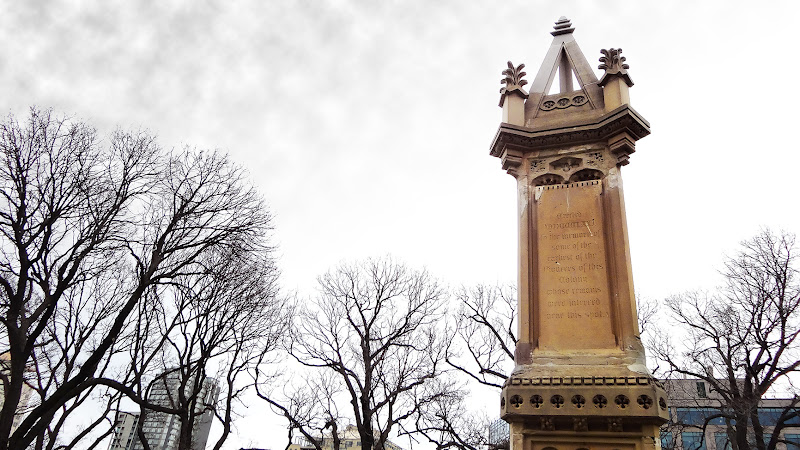


- 1838 - Melbourne cemetery was marked out in what is now the Queen Victoria market, and burials continued at that location.
- 1839 - Superintendent Charles La Trobe first included the site as part of the green belt encircling Melbourne which included Batman's Hill, Carlton Gardens, Fitzroy Gardens, Treasury Gardens and the Kings Domain.
- 1840 - a flagstaff was erected on the hill as part of a signalling system between the town and ships in the Port of Melbourne. The flagstaff proved too small and the following year a fifty foot (15 m) flagstaff was erected.11 November
- 1850: site of announcement of Victoria’s Separation from the Colony of New South Wales, resulting in celebrations with a huge bonfire with about 5,000 townspeople in attendance.
- 1853- establishment of the Melbourne cemetery
- 1857 - cutting excavated to ease the gradient of King Street. This created the bluestone retaining wall of the high bank along the western boundary.
- 1857-1863 - A Magnetic Observatory and Weather Station was established by Georg von Neumayer on the hilltop. William John Wills worked here as an assistant before being appointed to the Burke and Wills expedition. The observatory moved to the Kings Domain when the Melbourne Observatory was established, as iron in the buildings surrounding Flagstaff Hill were affecting Neumayer's magnetic observations.1860s - the telegraph supersedes signalling by flags.
- 1862 - West Melbourne residents petition the government to turn the hill into public gardens or recreation reserve. Clement Hodgkinson, the Deputy Surveyor-General in charge of city parks, prepared a plan for the gardens and directed its implementation.The Fitzroy and Treasury Gardens were also designed by him.
- 1871 - Memorial to Melbourne’s pioneers erected.1873 - Gardens permanently reserved
- 1880 - establishment of path network, lawns, trees and flowerbeds.October 9, 1917 - the City of Melbourne was appointed responsible for the Flagstaff Gardens.1918 - children’s playground established, one of the first in Melbourne.23 March 2004 - gardens formally added to the Victorian Heritage Register.
Tuesday, 17 July 2012
WALTER LINDRUM'S GRAVE
Walter Albert Lindrum, OBE (29 August 1898 – 30 July 1960), often known as Wally Lindrum, was an Australian professional player of English billiards who held the World Professional Billiards Championship from 1933 until his retirement in 1950. He was named Walter Albert to have the initials of the state where he was born - W.A. (Western Australia). He was one of the most successful players ever seen in billiards, with 57 world records to his credit, some of which still stand. Lindrum is also considered amongst Australia's all-time greatest sportspeople.
In 1981 Lindrum was honoured on a postage stamp issued by Australia Post, which featured a caricature of him by famed artist Tony Rafty. Lindrum was inducted into the Sport Australia Hall of Fame and the Western Australia Sporting Hall of Champions in 1985. His house in Melbourne at 158 Kerferd Road, Albert Park, is noted for its historical association with him by the Port Phillip Council.
In Melbourne, the Hotel Lindrum on Flinders Street has incorporated much memorabilia associated with Walter Lindrum. The building formerly housed the Lindrum's Billiard Centre run by Walter's niece, Dolly. One of the original tables from the Billiard Centre has been fully restored there by the original manufacturing company. In April 2009, the Hotel Lindrum hosted the Capital Cup, a billiards tournament that, on its 10th Anniversary, honoured the life and history of Walter Lindrum.
On 30 July 1960, at the age of 61, Walter Lindrum suddenly became ill and died while on holiday in Surfers Paradise, Queensland. The cause of death was officially listed as heart failure, but it has alternatively been suggested that he died as a result of food poisoning from a steak and kidney pie. His body was returned to Melbourne, and he was given a state funeral attended by 1,500 people. He was buried at Melbourne General Cemetery, with champion cyclist Sir Hubert Opperman raising the funds for a distinctive monument consisting of a billiards table, complete with balls and cue; more than fifty years after his death the site reportedly remains the most visited grave in this substantial cemetery.
It has been proposed to have a large collection of Lindrum memorabilia including personal and professional effects, newspaper clippings, diagrams of his shots, letters, and photographs moved to a special display in Australia's National Sports Museum.
This post is part of Julie's Taphophile Tragics meme.


In 1981 Lindrum was honoured on a postage stamp issued by Australia Post, which featured a caricature of him by famed artist Tony Rafty. Lindrum was inducted into the Sport Australia Hall of Fame and the Western Australia Sporting Hall of Champions in 1985. His house in Melbourne at 158 Kerferd Road, Albert Park, is noted for its historical association with him by the Port Phillip Council.
In Melbourne, the Hotel Lindrum on Flinders Street has incorporated much memorabilia associated with Walter Lindrum. The building formerly housed the Lindrum's Billiard Centre run by Walter's niece, Dolly. One of the original tables from the Billiard Centre has been fully restored there by the original manufacturing company. In April 2009, the Hotel Lindrum hosted the Capital Cup, a billiards tournament that, on its 10th Anniversary, honoured the life and history of Walter Lindrum.
On 30 July 1960, at the age of 61, Walter Lindrum suddenly became ill and died while on holiday in Surfers Paradise, Queensland. The cause of death was officially listed as heart failure, but it has alternatively been suggested that he died as a result of food poisoning from a steak and kidney pie. His body was returned to Melbourne, and he was given a state funeral attended by 1,500 people. He was buried at Melbourne General Cemetery, with champion cyclist Sir Hubert Opperman raising the funds for a distinctive monument consisting of a billiards table, complete with balls and cue; more than fifty years after his death the site reportedly remains the most visited grave in this substantial cemetery.
It has been proposed to have a large collection of Lindrum memorabilia including personal and professional effects, newspaper clippings, diagrams of his shots, letters, and photographs moved to a special display in Australia's National Sports Museum.
This post is part of Julie's Taphophile Tragics meme.


Tuesday, 19 June 2012
JOHN PASCOE FAWKNER'S GRAVE
John Pascoe Fawkner (20 October 1792 – 4 September 1869) was an early pioneer, businessman and politician of Melbourne, Victoria, Australia. In 1835 he financed a party of free settlers from Van Diemen's Land (now called Tasmania), to sail to the mainland in his ship, Enterprize. Fawkner's party sailed to Port Phillip and up the Yarra River to found a settlement which became the city of Melbourne.
When the Enterprize was ready to leave in August 1835, at the last moment creditors prevented Fawkner from joining the voyage. On board the Enterprize as it departed George Town, were Captain John Lancey, Master Mariner (Fawkner’s representative); George Evans, builder; William Jackson and Robert Marr, carpenters; Evan Evans, servant to George Evans; and Fawkner’s servants, Charles Wyse, ploughman, Thomas Morgan, general servant, James Gilbert, blacksmith and his pregnant wife, Mary, under Captain Peter Hunter. On 15 August 1835, Enterprize entered the Yarra River. After being hauled upstream, she moored at the foot of the present day William Street. On 30 August 1835 the settlers disembarked to build their store and clear land to grow vegetables. The Fawkners arrived in the Port Phillip District, on Friday, 16 October 1835, on the second trip of the Enterprize. Fawkner's diary reads: 'Warped up to the Basin, landed 2 cows, 2 calves and the 2 horses.'
Fawkner was keen to secure his place in history. He opened Melbourne's first hotel on the corner of William St and Flinders Lane. He published the Melbourne Advertiser on 1 January 1838 which was the district's first newspaper. The Advertiser's first nine or ten weekly editions were handwritten in ink. An old wood press and some type were eventually obtained from Launceston and the first printed edition appeared on 5 March 1838. It was to last for a further 17 editions when it was closed down on 23 April 1838 for want of a newspaper license from Sydney. The Port Phillip Patriot and Melbourne Advertiser was commenced on 6 February 1839 by newly licensed John Pascoe Fawkner. It was published daily commencing on 15 May 1845.
Fawkner acquired a property in 1839 as one of eleven lots in the subdivision of the Coburg district by the government surveyor, Robert Hoddle. The property was called Pascoeville, and was bounded approximately by the Moonee Ponds Creek, Gaffney Street, Northumberland Road and the western prolongation of Boundary Road. He lived at his farmhouse and at his townhouse in Collingwood between 1840 and 1855. In 1845 he served as a member of the Market Commission in the Town Council.
In 1851 Fawkner was elected to the first Legislative Council of the Port Phillip District (Talbot electorate), and in 1856 he was elected to the first Parliament of the self-governing colony of Victoria, as MLC for Central Province, the seat he held until his death on 4 September 1869. In Melbourne as in Launceston, he made many enemies, before dying as the grand old man of the colony on 4 September 1869 in Smith Street, Collingwood at the age of 77. At his funeral over 200 carriages were present, and 15,000 persons were reported to have lined the streets on his burial day, 8 September 1869. He was buried at the Melbourne General Cemetery. He and Eliza did not have any children.


This post is part of Julie's Taphophile Tragics meme.
When the Enterprize was ready to leave in August 1835, at the last moment creditors prevented Fawkner from joining the voyage. On board the Enterprize as it departed George Town, were Captain John Lancey, Master Mariner (Fawkner’s representative); George Evans, builder; William Jackson and Robert Marr, carpenters; Evan Evans, servant to George Evans; and Fawkner’s servants, Charles Wyse, ploughman, Thomas Morgan, general servant, James Gilbert, blacksmith and his pregnant wife, Mary, under Captain Peter Hunter. On 15 August 1835, Enterprize entered the Yarra River. After being hauled upstream, she moored at the foot of the present day William Street. On 30 August 1835 the settlers disembarked to build their store and clear land to grow vegetables. The Fawkners arrived in the Port Phillip District, on Friday, 16 October 1835, on the second trip of the Enterprize. Fawkner's diary reads: 'Warped up to the Basin, landed 2 cows, 2 calves and the 2 horses.'
Fawkner was keen to secure his place in history. He opened Melbourne's first hotel on the corner of William St and Flinders Lane. He published the Melbourne Advertiser on 1 January 1838 which was the district's first newspaper. The Advertiser's first nine or ten weekly editions were handwritten in ink. An old wood press and some type were eventually obtained from Launceston and the first printed edition appeared on 5 March 1838. It was to last for a further 17 editions when it was closed down on 23 April 1838 for want of a newspaper license from Sydney. The Port Phillip Patriot and Melbourne Advertiser was commenced on 6 February 1839 by newly licensed John Pascoe Fawkner. It was published daily commencing on 15 May 1845.
 |
| John Fawkner and Mrs Eliza Fawkner in 1856 as painted by William Strutt |
In 1851 Fawkner was elected to the first Legislative Council of the Port Phillip District (Talbot electorate), and in 1856 he was elected to the first Parliament of the self-governing colony of Victoria, as MLC for Central Province, the seat he held until his death on 4 September 1869. In Melbourne as in Launceston, he made many enemies, before dying as the grand old man of the colony on 4 September 1869 in Smith Street, Collingwood at the age of 77. At his funeral over 200 carriages were present, and 15,000 persons were reported to have lined the streets on his burial day, 8 September 1869. He was buried at the Melbourne General Cemetery. He and Eliza did not have any children.


 |
| Melbourne General Cemetery is quite enormous... |
 |
| So it is good to have these handy guides around the place! |
Tuesday, 29 May 2012
MELBOURNE CEMETERY IRONWORK
Wrought iron is an iron alloy with a very low carbon content (unlike the high carbon content of steel), and in addition has fibrous inclusions, known as slag. This is what gives it a "grain" resembling wood, which is visible when it is etched or bent to the point of failure. Wrought iron is tough, malleable, ductile and easily welded. Historically, it was known as "commercially pure iron". However, it no longer qualifies as such because current standards for commercially pure iron require a carbon content of less than 0.008 wt%.
Prior to the development of effective methods of steelmaking and the availability of large quantities of steel, wrought iron was the most common form of malleable iron. A modest amount of wrought iron was used as a raw material for manufacturing of steel, which was mainly used to produce swords, cutlery, chisels, axes and other edge tools as well as springs and files. Demand for wrought iron reached its peak in the 1860s with the adaptation of ironclad warships and railways, but then declined as mild steel became more available.
Before they came to be made of mild steel, items produced from wrought iron included rivets, nails, wire, chains, rails, railway couplings, water and steam pipes, nuts, bolts, horseshoes, handrails, straps for timber roof trusses, and ornamental ironwork. Wrought iron is no longer produced on a commercial scale. Many products described nowadays as 'wrought iron', such as guard rails, garden furniture and gates, are made of mild steel. They retain that description because they are wrought (worked) by hand.
In Victorian time ornamental wrought ironwork was an indispensable part of architectural ornament. This was very much the case not only in homes for this life, but also in the homes for the afterlife, i.e. graves! Melbourne Central Cemetery has a huge number of graves from the Victorian era, which have much wrought iron in the form of ornamental railings and little "fences" around the graves. The last photo amuses me as it is one of ornamental ironwork railings on a rooftop viewing platform, reminiscent of the railings around a grave. The little angels complete the funerary illusion.
This post is part of Julie's Taphophile Tragics meme.


Prior to the development of effective methods of steelmaking and the availability of large quantities of steel, wrought iron was the most common form of malleable iron. A modest amount of wrought iron was used as a raw material for manufacturing of steel, which was mainly used to produce swords, cutlery, chisels, axes and other edge tools as well as springs and files. Demand for wrought iron reached its peak in the 1860s with the adaptation of ironclad warships and railways, but then declined as mild steel became more available.
Before they came to be made of mild steel, items produced from wrought iron included rivets, nails, wire, chains, rails, railway couplings, water and steam pipes, nuts, bolts, horseshoes, handrails, straps for timber roof trusses, and ornamental ironwork. Wrought iron is no longer produced on a commercial scale. Many products described nowadays as 'wrought iron', such as guard rails, garden furniture and gates, are made of mild steel. They retain that description because they are wrought (worked) by hand.
In Victorian time ornamental wrought ironwork was an indispensable part of architectural ornament. This was very much the case not only in homes for this life, but also in the homes for the afterlife, i.e. graves! Melbourne Central Cemetery has a huge number of graves from the Victorian era, which have much wrought iron in the form of ornamental railings and little "fences" around the graves. The last photo amuses me as it is one of ornamental ironwork railings on a rooftop viewing platform, reminiscent of the railings around a grave. The little angels complete the funerary illusion.
This post is part of Julie's Taphophile Tragics meme.


Tuesday, 10 April 2012
MELBOURNE CEMETERY 3: JEWISH SECTION
The Jewish community in Melbourne is a strong, vibrant and flourishing part of the social fabric of our metropolis for many decades now. Currently Melbourne has about 50,000 Jewish inhabitants. It is not surprising that the Jewish section of the Melbourne General Cemetery is a large area in the Southern part, where many of our citizens have been buried, including some prominent ones.
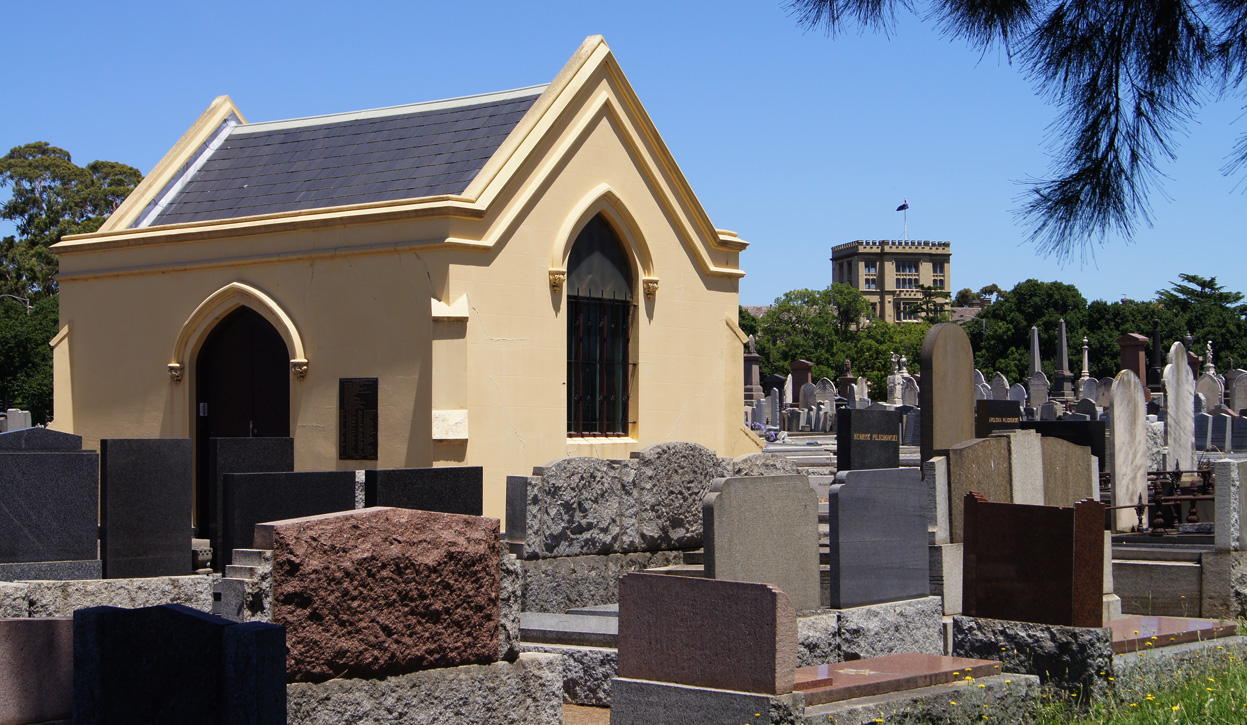
It is a very well maintained part of the cemetery, and most graves are simple and unostentatious. Some more monumental graves are to be found here and there, but even they are quite restrained. The inscriptions on the headstones are mostly bilingual (Hebrew/English) and the Star of David is to be found on nearly all grave markers. A historic Metahar House (Jewish Chapel) is found in this section of the cemetery. Also, a Holocaust Memorial is to be found there.
This part of Julie's Taphophile Tragics meme.


It is a very well maintained part of the cemetery, and most graves are simple and unostentatious. Some more monumental graves are to be found here and there, but even they are quite restrained. The inscriptions on the headstones are mostly bilingual (Hebrew/English) and the Star of David is to be found on nearly all grave markers. A historic Metahar House (Jewish Chapel) is found in this section of the cemetery. Also, a Holocaust Memorial is to be found there.
This part of Julie's Taphophile Tragics meme.




Tuesday, 3 April 2012
MELBOURNE CEMETERY MONUMENTS
The Melbourne General Cemetery is a large necropolis located 2 km north of the city of Melbourne in the suburb of Carlton North. The cemetery was opened on 1 June 1853, and the Old Melbourne Cemetery (on the site of what is now the Queen Victoria Market) was closed the next year. The Melbourne Cemetery has much history and home to more than half a million stories. This cemetery is full of fiery preachers, con men, courageous women, scandals, disasters and joyous occasions. Musicians, actors, scientists and ordinary people who have helped make Melbourne the metropolis it is now. A miscellany of photos today of monuments, statues, mausolea and graves.
This post is part of Julie's Taphophile Tragics meme.
This post is part of Julie's Taphophile Tragics meme.
 |
| This pavilion is for the rest and refreshment of cemetery visitors - much needed on a sunny, warm day like the day of our visit was |
 |
| The Elvis Presley memorial, which is a cenotaph (cenotaph = "empty grave" in Greek) |
 |
| One of the mausolea in the cemetery, which is reminiscent of a "kokh" - A kokh (plural: kokhim, Hebrew: כּוּךְ) is a type of tomb complex characterised by a series of long narrow shafts, in which the deceased were placed for burial, radiating from a central chamber. These tomb complexes were generally carved into a rock face, and were usually closed with a stone slab and had channels cut into the centre of the shaft to drain any water that seeped through the rock. |
 |
| There are several devotional chapels on the cemetery and this is one of the larger ones |
 |
| A rather magnificent and exuberant statue of Christ resurrected adorning one of the graves |
 |
| This delightful little angel was on top of a gravestone. It is obviously mass-produced as one may find numerous identical such statuettes on many a headstone, but nevertheless quite effective in its ingenuousness |
Monday, 19 March 2012
MELBOURNE CEMETERY: BURKE & WILLS MONUMENT
In 1860–61, Robert O'Hara Burke and William John Wills led an expedition of 19 men with the intention of crossing Australia from Melbourne in the south to the Gulf of Carpentaria in the north, a distance of around 3,250 kilometres (approximately 2,000 miles). At that time most of the inland of Australia had not been explored by non-indigenous people and was completely unknown to the European settlers. The south-north leg was successfully completed (except that they were stopped by swampland 5 kilometres (3.1 mi) from the northern coastline), but owing to poor leadership and bad luck, both of the expedition's leaders died on the return journey. Altogether, seven men lost their lives, and only one man, John King, crossed the continent with the expedition and returned alive to Melbourne.
The Victorian Government held a Commission of Enquiry into the deaths of Burke and Wills. Howitt was sent back to Cooper Creek to recover their bodies and the explorers were given a state funeral in Melbourne on Wednesday, 21 January 1863. The funeral car was modelled on the design used for the Duke of Wellington ten years earlier. There were reported to have been 40,000 spectators. Burke and Wills were then buried at the Melbourne General Cemetery.


The Victorian Government held a Commission of Enquiry into the deaths of Burke and Wills. Howitt was sent back to Cooper Creek to recover their bodies and the explorers were given a state funeral in Melbourne on Wednesday, 21 January 1863. The funeral car was modelled on the design used for the Duke of Wellington ten years earlier. There were reported to have been 40,000 spectators. Burke and Wills were then buried at the Melbourne General Cemetery.
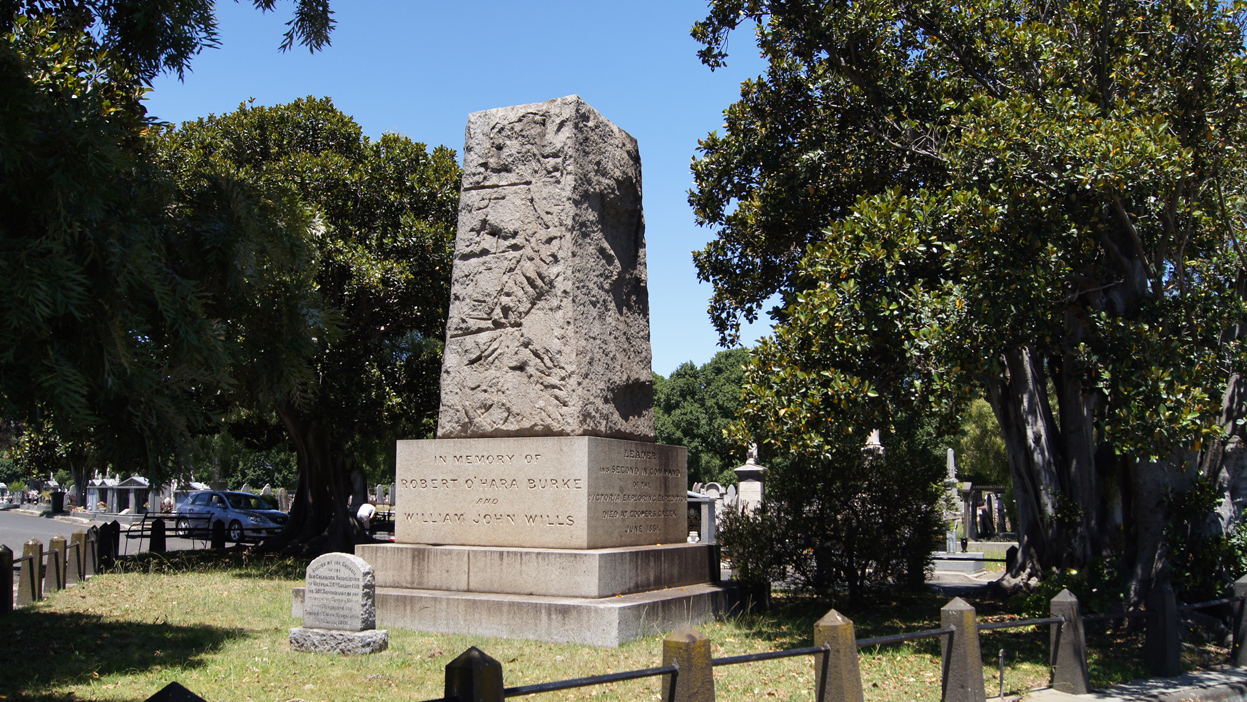
The memorial in Melbourne General Cemetery consists of a massive granite slab. Around the four sides of the base are the following inscriptions:
In memory of Robert O'Hara Burke and William John Wills leader and second in command of the Victorian exploring expedition died at Cooper’s Creek June 1861.
Comrades in a great achievement
companions in death
and
associates in renown. The first to cross
the continent of Australia
Burke Wills
Gray King survivor.In memory of Robert O'Hara Burke and William John Wills leader and second in command of the Victorian exploring expedition died at Cooper’s Creek June 1861.


 |
| Burke and Wills Statue (1865) by Charles Summers on the corner of Collins and Swanston Streets, Melbourne. Charles Summers was born in England in 1825. After gaining his early training with his stonemason father, he studied at London’s Royal Academy. Summers arrived in Australia in 1852, setting up his Melbourne studio three years later. He undertook many significant commissions around fledgling Melbourne, and designed one of the earliest sculptures erected in Fitzroy Gardens, River God Fountain |
 |
| Artist William Strutt (3 July 1825 - 3 January 1915) was only in Melbourne for a period of about twelve years. However the years from 1850 to 1862 were highly significant ones in the history of Melbourne, and Strutt, along with S.T. Gill left us some of our most enduring visual images of the period. Some of his works were painted in retrospect after returning to England. William Strutt's Burial of Burke is usually considered to be his finest painting and is on display at the State Library of Victoria. |
This post is part of Julie's Taphophile Tragics meme.
Subscribe to:
Posts (Atom)