Showing posts with label Casuarinaceae. Show all posts

Thursday, 15 June 2017

MELBOURNE STREET TREES 181 - CASUARINA

Casuarina is a genus of 17 tree species in the family Casuarinaceae, native to Australia, the Indian Subcontinent, southeast Asia, and islands of the western Pacific Ocean. It was once treated as the sole genus in the family, but has been split into three genera. They are evergreen shrubs and trees growing to 35 m tall. The foliage consists of slender, much-branched green to grey-green twigs bearing minute scale-leaves in whorls of 5–20.

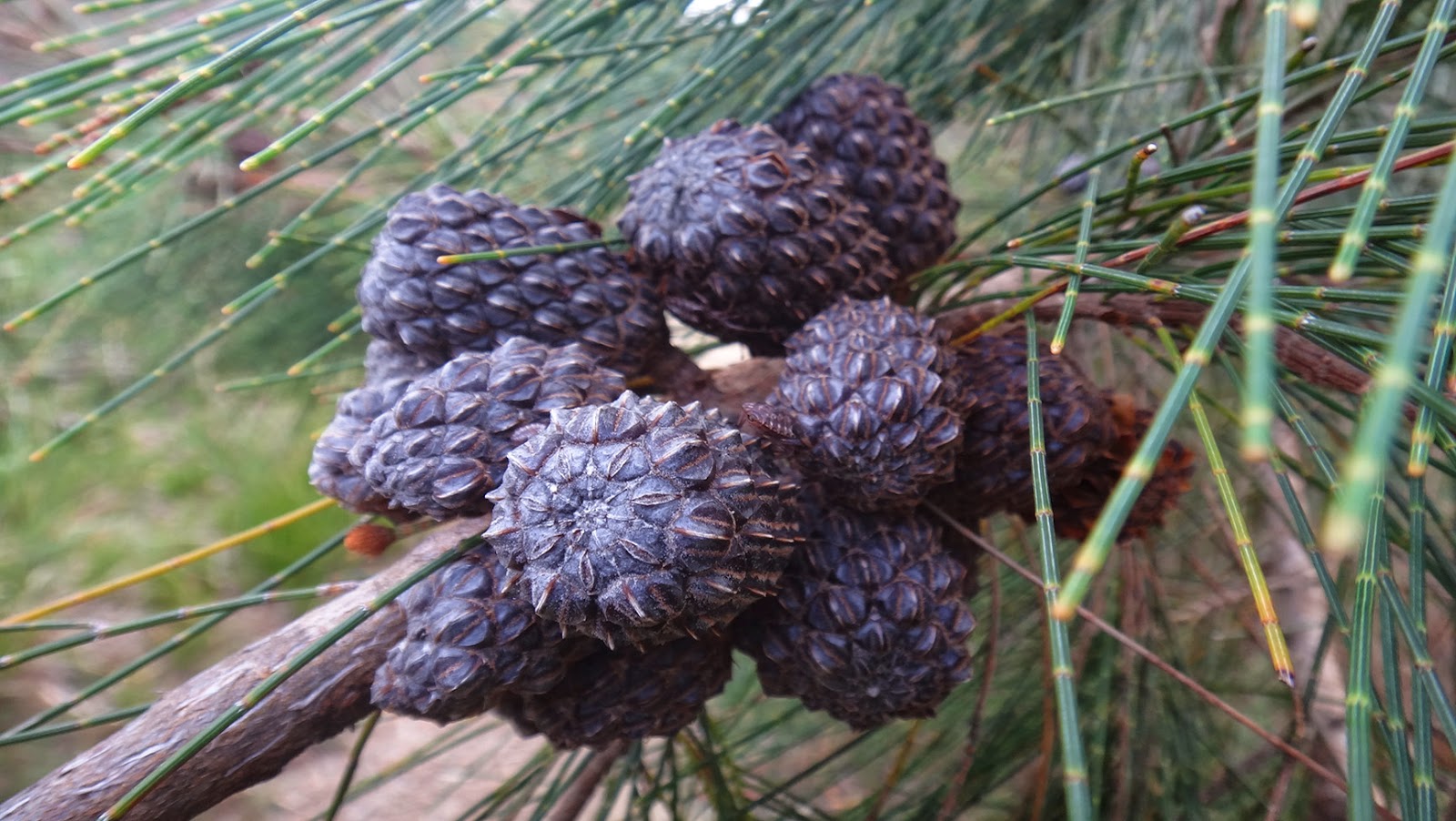
The apetalous flowers are produced in small catkin-like inflorescences. Most species are dioecious, but a few are monoecious. The fruit is a woody, oval structure superficially resembling a conifer cone, made up of numerous carpels, each containing a single seed with a small wing.

The generic name is derived from the Malay word for the cassowary, kasuari, alluding to the similarities between the bird's feathers and the plant's foliage, though the tree is called rhu in current standard Malay. Casuarina species are a food source of the larvae of hepialid moths.

Casuarina obesa (shown here), commonly known as Swamp She-oak or Swamp Oak, is a species of Casuarina that is closely related to C. glauca and C. cristata. The Noongar peoples know the plant as Goolee, Kweela, Kwerl and Quilinock. It is native to a broad area of south-western Australia, with a much more restricted occurrence in New South Wales and Victoria.

It is a small dioecious (male and female flowers on separate trees) tree, growing to 1.5 to 10 metres in height and capable of flowering at any time of year. It has male and female flowers on separate plants, the female plants produce woody cones in an indehiscent state, with crops from two seasons sometimes present. It is found in sand or clay soils, often in brackish or saline environments, along rivers, creeks and salt lakes. It is widely planted for agroforestry, particularly in salt-affected areas, and as a street tree.

This post is part of the Floral Friday Fotos meme.
Male tree

Female tree (note "cones")

Clusters of male flowers (staminate "catkins")

Clusters of male flowers (staminate "catkins")

Male flowers (staminate "catkins")

Buds of female flowers

Open female flowers (pistillate apetalous)

Open female flowers (pistillate apetalous)

Single open female flower

Fruits ("cones")

Fruits ("cones")

Thursday, 26 June 2014

MELBOURNE STREET TREES 79 - SHEOAK

Allocasuarina is a genus of trees in the flowering plant family Casuarinaceae. They are endemic to Australia, occurring primarily in the south. Like the closely related genus Casuarina, they are commonly called sheoaks or she-oaks, they are notable for their long, segmented branchlets that function as leaves. Formally termed cladodes, these branchlets somewhat resemble pine needles, although sheoaks are actually flowering plants. The leaves are reduced to minute scales encircling each joint. Fallen cladodes form a dense, soft mat beneath sheoaks, preventing the development of undergrowth and making sheoak woods remarkably quiet.

Another characteristic feature are the spiny "cones", about the size of an acorn but with a texture more resembling a conifer cone. However, sheoak "cones" are actually a woody fruit. Male specimens bear no fruit and are sometimes colloquially referred to as a "heoak". As with legumes, sheoak roots possess nodules containing symbiotic nitrogen fixing bacteria; together with their highly drought-adapted foliage, this enables sheoaks to thrive in very poor soil and semi-arid areas. However, sheoaks are much less bushfire-tolerant than eucalypts. Fossils of closely related species have been found dating back to the time of Gondwana.

This post is part of the Floral Friday Fotos meme.