Showing posts with label weeds. Show all posts

Saturday, 22 January 2022

HOVERFLY

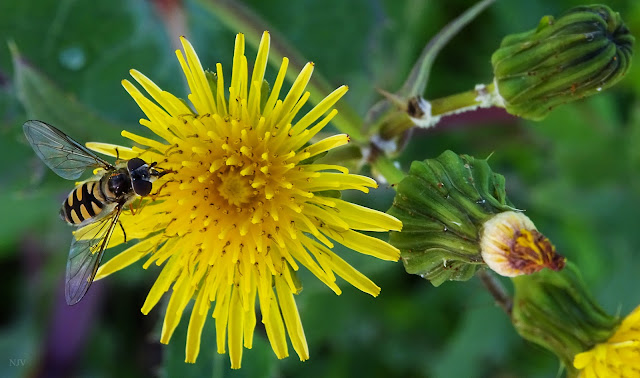
Hoverflies, sometimes called flower flies, or syrphid flies, make up the insect family Syrphidae. As their common name suggests, they are often seen hovering or nectaring at flowers; the adults of many species feed mainly on nectar and pollen, while the larvae (maggots) eat a wide range of foods. In some species, the larvae are saprotrophs, eating decaying plant and animal matter in the soil or in ponds and streams.

About 6,000 species in 200 genera have been described. Hoverflies are common throughout the world and can be found on all continents except Antarctica. Hoverflies are harmless to most other animals, despite their mimicry of more dangerous wasps and bees, which wards off predators.

Hieracium known by the common name hawkweed and classically as hierakion (from ancient Greek ιεράξ, hierax 'hawk'), is a genus of the sunflower family Asteraceae, and closely related to dandelion (Taraxacum), chicory (Cichorium), prickly lettuce (Lactuca) and sow thistle (Sonchus), which are part of the tribe Cichorieae. Hawkweeds, with their 10,000+ recorded species and subspecies, do their part to make Asteraceae the second largest family of flowers.

This post is part of the Saturday Critters meme

Thursday, 7 January 2021

QUEEN ANNE'S LACE

Daucus carota, whose common names include wild carrot, bird's nest, bishop's lace, and Queen Anne's lace (North America), is a white, flowering plant in the family Apiaceae, native to temperate regions of Europe and southwest Asia, and naturalised to North America and Australia. Domesticated carrots are cultivars of a subspecies, Daucus carota subsp. sativus.

This post is part of the Floral Friday Fotos meme.


Thursday, 29 November 2018

COUNTRYSIDE

A day trip to Gippsland and the lush springtime countryside is a wonderful sight. In the foreground, wild radish (Raphanus raphanistrum - white charlock or jointed charlock - is a flowering plant in the family Brassicaceae). To the right, the flowering shrub is hawthorn (Crataegus - May-tree - a large genus of shrubs and trees in the family Rosaceae, native to temperate regions of the Northern Hemisphere in Europe, Asia and North America).

Both of these are introduced species and classified as environmental weeds in many parts of Australia. However, they are a very pretty seasonal sight reminiscent of European meadows and hedgerows.

This post is part of the Floral Friday Fotos meme.

Thursday, 2 August 2018

MELBOURNE WEEDS 12 - WILD CLEMATIS

In the Parklands around suburban Melbourne the wild clematis is blooming. Clematis vitalba (also known as old man's beard and traveller's joy) is a climbing shrub of the Ranunculaceae family.

The plant has branched, grooved stems, deciduous leaves, and scented greeny-white flowers with fluffy underlying sepals. The many fruits formed in each inflorescence have long silky appendages which, seen together, give the characteristic appearance of old man's beard. The grooves along the stems of C. vitalba can easily be felt when handling the plant.

Due to its disseminatory reproductive system, vitality, and climbing behaviour, Clematis vitalba is an invasive plant in most places, including many in which it is native. Some new tree plantations can be suffocated by a thick layer of Clematis vitalba, if not checked.

This post is part of the Floral Friday Fotos meme.

Thursday, 10 August 2017

MELBOURNE WEEDS 5 - CANOLA

Rapeseed (Brassica napus), also known as rape, oilseed rape, rapa, rappi, rapaseed (and, in the case of one particular group of cultivars, canola), is a bright-yellow flowering member of the family Brassicaceae (mustard or cabbage family), cultivated mainly for its oil-rich seed. It is the third-largest source of vegetable oil in the world.

It is also consumed in China (油菜: Mandarin Pinyin yóucài; Cantonese:jau⁴coi³) and Southern Africa as a vegetable. The name derives from the Latin for turnip, rāpa or rāpum, and is first recorded in English at the end of the 14th century. Older writers usually distinguished the turnip and rape by the adjectives 'round' and 'long' (-'rooted'), respectively. Rutabagas, Brassica napobrassica, are sometimes considered a variety of B. napus. Some botanists also include the closely related B. rapa within B. napus.

Canola was developed through conventional plant breeding from rapeseed, an oilseed plant already used in ancient civilisation as a fuel. The change in name serves to distinguish it from natural rapeseed oil, which has much higher erucic acid content. In the 1970s, the Rapeseed Association of Canada chose the name "canola" to represent "Can" for Canada, and "ola" for oil. One dictionary purports that it stands for Can(ada) + o(il) + l(ow) + a(cid).

Canola oil is made at a processing facility by slightly heating and then crushing the seed.[Almost all commercial canola oil is then extracted using hexane solvent which is recovered at the end of processing. Finally, the canola oil is refined using water precipitation and organic acid to remove gums and free fatty acids, filtering to remove colour, and deodorising using steam distillation.

Throughout Melbourne, canola plants can be found as escapers from cultivation. These are considered weeds, although the leaves, seeds, and stems of this mustard variety are edible. The plant appears in some form in African, Pakistani, Bangladeshi, Italian, Indian, Chinese, Japanese, Korean, and African-American (soul food) cuisines. In Greece the young flower-bud shoots are collected, boiled and served with an oil and lemon juice dressing as salad greens (one of the greens collectively known as "horta").

This post is part of the Floral Friday Fotos meme,
and also part of the Food Friday meme.


Thursday, 29 June 2017

MELBOURNE WEEDS 4 - FUMITORY

Fumaria (fumitory or fumewort, from Latin fūmus terrae, "smoke of the earth") is a genus of about 60 species of annual flowering plants in the family Papaveraceae. Fumaria species are important plants used as a herbal medicine. The genus is native to Europe, Africa and Asia, most diverse in the Mediterranean region, and introduced to North and South America and Australia. Fumaria indica contains the alkaloids fuyuziphine and alpha-hydrastine. Fumaria indica may have anti-inflammatory and analgesic potential.

Fumaria officinalis (common fumitory, drug fumitory or earth smoke) is a herbaceous annual flowering plant and the most common species of the genus Fumaria in Western and Central Europe. It has been introduced into and grows successfully in the New World and Oceania, becoming in many cases a rampant weed.

It is a herbaceous annual plant, which grows weakly erect and scrambling, with stalks about 10 to 50 cm long. Its 7 to 9 mm flowers appear from April to October in the northern hemisphere adn may be coloured pink or white with dark burgundy lips. They are two lipped and spurred, with sepals running a quarter the length of the petals. The fruit is an achene. It contains alkaloids, potassium salts, and tannins. It is also a major source of fumaric acid.

The "smoky" or "fumy" origin of its name comes from the translucent colour of its flowers, giving them the appearance of smoke or of hanging in smoke, and the slightly gray-blue haze colour of its foliage, also resembling smoke coming from the ground, especially after morning dew. The plant was already called fūmus terrae (smoke of the earth) in the early 13th century.

Two thousand years ago, Dioscorides wrote in De Materia Medica (Περὶ ὕλης ἰατρικῆς) and Pliny the Elder in Naturalis Historia that rubbing the eyes with the sap or latex of the plant causes tears, like acrid smoke (fūmus) does to the eyes. Its Greek name is kapnos (καπνός, for smoke) and the name fumewort now applies mostly to the genus Corydalis, especially the similar looking Corydalis solida (formerly Fumaria bulbosa), which was thought to belong to the same genus as fumitory.

It was traditionally thought to be good for the eyes, and to remove skin blemishes. In modern times herbalists use it to treat skin diseases, and conjunctivitis; as well as to cleanse the kidneys. However, it should be remembered that fumitory is poisonous and should only be used under the direction of a medical herbalist.

The plant contains isoquinoline alkaloids protopine and allocryptopine. Both protopine and allocryptopine increased CYP1A1 and CYP1A2 mRNA levels in human hepatocyte cells. The use of products containing protopine and/or allocryptopine may be considered safe in terms of possible induction of CYP1A enzymes.

In the language of flowers, fumitory signifies anger and the message it gives a recipient is: ‘I have expelled you from my thoughts.’ Sending fumitory foliage to someone means: ‘I do not wish to talk with you further at this time’.

This post is part of the Floral Friday Fotos meme.


Thursday, 18 May 2017

MELBOURNE WEEDS 1 - REDSHANK

Persicaria maculosa (syn. Polygonum persicaria) is an annual plant in the buckwheat family, Polygonaceae. Common names include lady's thumb, spotted lady's thumb, Jesusplant, and redshank. It is widespread across Eurasia from Iceland south to Portugal and east to Japan. It is also present as an introduced and invasive species in North America, where it was first noted in the Great Lakes region in 1843 and has now spread through most of the continent.

The oldest name available for this species is Polygonum persicaria, coined by Carl Linnaeus in 1753. In transferring the species from Polygonum to Persicaria, the name Persicaria persicaria cannot be used because using the same word for both parts of the scientific name is prohibited by international agreement.

Persicaria maculosa is an annual herb up to 80 cm tall, with an erect rather floppy stem with swollen joints. The leaves are alternate and almost stalkless. The leaf blades often have a brown or black spot in the centre and are narrowly ovate and have entire margins. Each leaf base has stipules which are fused into a stem-enclosing sheath that is loose and fringed with long hairs at the upper end.

The inflorescence is a dense spike. The perianth of each tiny pink flower consists of four or five lobes, fused near the base. There are six stamens, two fused carpels and two styles. The fruit is a shiny black, three-edged achene. This plant flowers from July to September in the temperate Northern Hemisphere.

Persicaria maculosa is native to Europe and Asia, where it can be mistaken for Polygonum minus. The latter has narrower leaves, usually less than 1 cm wide. It has been introduced to North America and is naturalised throughout the mainland continent, growing along roadsides, riverbanks, and on fallow ground. In the United States, it is very similar to Pennsylvania smartweed, but redshank has a fringe of hairs at the top of the ochrea, something which Pennsylvania smartweed lacks. The species has also been found in New Zealand and Australia as an introduced weed.

Persicaria maculosa contains persicarin and tannins. In medicine, redshank is used against diarrhoea and infections. The leaves and young shoots may be eaten as a palatable and nutritious leaf vegetable. It is often seen as a weed and rarely cultivated. A yellow dye can be produced from this plant with alum used as a mordant.

This post is part of the Floral Friday Fotos meme,
and also part of the Weekend Green meme.


Thursday, 6 April 2017

VERVAIN BY THE CREEK

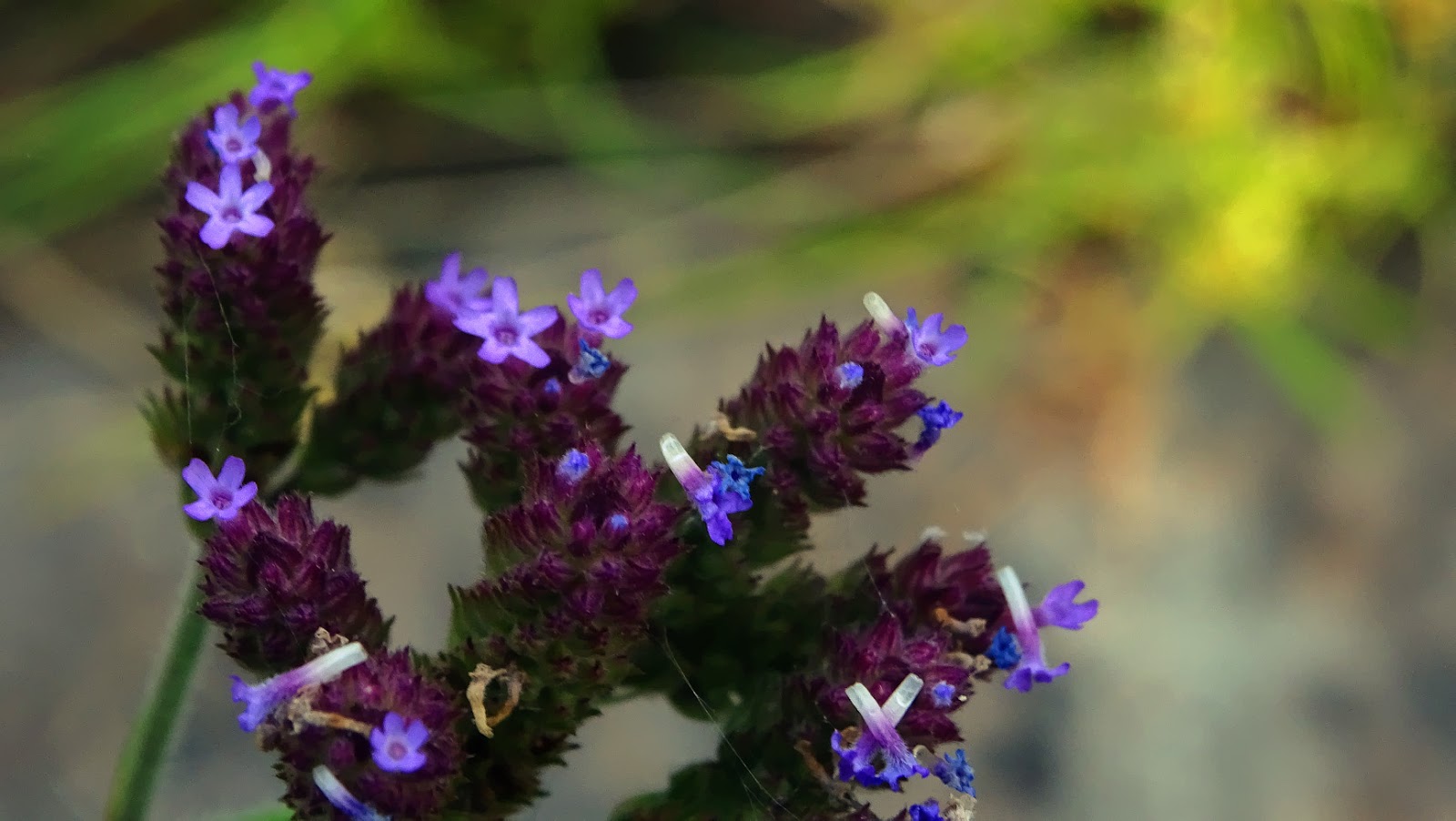
Verbena bonariensis (purpletop vervain, clustertop vervain, Argentinian vervain , tall verbena, or pretty verbena) is a member of the Verbenaceae family cultivated as a flowering annual or herbaceous perennial plant. In USA horticulture, it is also known by the ambiguous names "purpletop" (also used for the grass Tridens flavus) and "South American vervain" (which can mean any of the numerous species in the genus Verbena occurring in that continent). It is native to tropical South America where it grows throughout most of the warm regions, from Colombia and Brazil to Argentina and Chile.

Verbena bonariensis is a tall and slender-stemmed perennial. It can grow to 120 cm tall and can spread to 90 cm wide. At maturity, it will develop a woody base. Fragrant lavender to rose-purple flowers are in tight clusters located on terminal and axillary stems, blooming from mid-summer until Autumn frosts. The stem is square with very long internodes. Leaves are ovate to ovate-lanceolate with a toothed margin and grow up to 10 cm long.

V. bonariensis self-seeds readily. This ability has raised concerns that it may become an invasive species and noxious weed in favourable habitats. It has naturalised in a number of southern United States. Presently, the plant is on the invasive species watchlist for Washington state, naturalised in tropical and southern Africa, temperate Asia, Australia, New Zealand, the United States (including Hawaii), the West Indies, Macaronesia and the Mascarene Islands. According to Pacific Island Ecosystems at Risk, it is considered a weed in Fiji, New Guinea and other South Pacific islands.

Here it is growing as a weed by the Darebin Creek in Preston, in suburban Melbourne. It is very commonly encountered, but is not considered a noxious weed at the present time.

This post is part of the Floral Friday Fotos meme.


Thursday, 12 January 2017

A NOXIOUS WEED

Lycium ferocissimum (African boxthorn or boxthorn) is a shrub in the nightshade family (Solanaceae). The species is native to Cape Province and Orange Free State in South Africa and has become naturalised in Australia and New Zealand. It is listed on the Noxious Weed List for Australian States and Territories and is a declared noxious weed in the United States.

African boxthorn is a large shrub which grows up to 5 metres high and is covered in spines. The leaves are oval in shape and are 10–40 millimetres long and 4–10 millimetres in width. The solitary flowers emerge from the leaf axils and are purplish. The species was first formally described in 1854 by British botanist John Miers in the Annals and Magazine of Natural History. His description was based on plant material collected from Uitenhage in South Africa.

African boxthorn is an aggressive invader of pastures, roadsides, reserves, remnant bushland and waterways. It forms an impenetrable, spiny thicket that inhibits the movement of stock and provides a haven for feral animals. Many insects, including fruit fly, the common house fly and the tomato fly, breed in the fruit of this weed.

This plant is toxic to humans and will cause discomfort and irritation, but is not life-threatening. The berries, leaves, stems and roots are all poisonous, and can cause nausea, vomiting, breathing difficulties and unconsciousness. Get the person to an emergency department of a hospital ASAP, especially so if they are unconscious.

This post is part of the Floral Friday Fotos meme,
and also part of the Friday Greens meme.


Friday, 8 April 2016

WERRIBEE RIVER

The Werribee River is a perennial river of the Port Phillip catchment that is located on the plain west of Melbourne, Victoria, Australia. The headwaters of a tributary, the Lerderderg River, are north of Ballan near Daylesford and it flows across the basalt plain, through the suburb of Werribee to enter Port Phillip. A linear park follows the Werribee River along much of its course. In total the Werribee River completes a journey of approximately 110 kilometres.

The river flows through the Werribee Gorge State Park before being utilised for irrigation of market gardens at Bacchus Marsh, then through Werribee where it is crossed by the Maltby By-pass. It then flows through the Werribee Open Range Zoo in Werribee Park, and finally the small coastal settlement of Werribee South before entering Port Phillip. The Western Treatment Plant, a sewage treatment site, is located near the mouth of the river, and supplies irrigation needs to the zoo.

The weeds shown here are, in the second photo, Rumex obtusifolius (Polygonaceae) - Common dock (round-leaved dock), which produces large spreading leaves about 30 cm long, the whole plant reaching  60 to 90 cm in height. In the third and fourth photo, Lady's Thumb Persicaria maculosa (Polygonaceae), an annual herb up to 80 cm (31 in) tall, with an erect rather floppy stem with swollen joints. The leaves are alternate and almost stalkless. The leaf blades often have a brown or black spot in the centre and are narrowly ovate and have entire margins. Each leaf base has stipules which are fused into a stem-enclosing sheath that is loose and fringed with long hairs at the upper end. The inflorescence is a dense spike. The perianth of each tiny pink flower consists of four or five lobes, fused near the base.

This post is part of the Friday Greens meme,
and also part of the Floral Friday Fotos meme.


Thursday, 2 April 2015

PATERSON'S CURSE IN LEONGATHA

Leongatha is a town in the foothills of the Strzelecki Ranges, South Gippsland Shire, Victoria, Australia, located 135 kilometres south-east of Melbourne. The town is the civic, commercial, industrial, religious, educational and sporting centre of the region. At the 2006 census, Leongatha had a population of 6,860. The Murray Goulburn Co-operative Co. Limited, is a farmers' co-operative which trades in Australia under the Devondale label, and has a dairy processing plant just north of the town producing milk-based products for Australian and overseas markets.

Paterson's Curse (Echium plantagineum) is an invasive plant species in Australia. The name "Salvation Jane" originated from, and is mostly used in South Australia, due to its use as a source of food for grazing animals when the less drought tolerant grazing pastures die off. Other names are Blueweed, Lady Campbell Weed, Riverina Bluebell, and Purple Viper's Bugloss.

Three other Echium species have been introduced and are of concern; Viper's Bugloss (Echium vulgare) is the most common of them. Viper's Bugloss is biennial, with a single unbranched flowering stem and smaller, more blue flowers, but is otherwise similar. This species is also useful for honey production. Paterson's Curse has positive uses — it is the source for a particularly fine grade of honey. As a fodder plant, with proper handling, it can be valuable fodder over summer for cattle and sheep, but not livestock without ruminant digestive systems.

In the 1880s it was introduced to Australia, probably both as an accidental contaminate of pasture seed and as an ornamental plant. It is said that both names for the plant derive from Jane Paterson or Patterson, an early settler of the country near Albury. She brought the first seeds from Europe to beautify a garden, and then could only watch helplessly as the weed infested previously productive pastures for many miles around. Paterson's Curse is now a dominant broadleaf pasture weed through much of New South Wales, the Australian Capital Territory, Victoria, South Australia and Tasmania and also infests native grasslands, heathlands and woodlands.

Echium plantagineum contains pyrrolizidine alkaloids and is poisonous. When eaten in large quantities, it causes reduced livestock weight or even (in severe cases) death. Paterson's Curse can kill horses and irritate the udders of dairy cows and the skin of humans. After the 2003 Canberra bushfires over 40 recorded horses were put down after eating the weed.

This post is part of the Floral Friday Fotos meme.