Thursday, 24 November 2016

MELBOURNE STREET TREES 173 - FEIJOA

Acca sellowiana, a species of flowering plant in the myrtle family, Myrtaceae, is native to the highlands of southern Brazil, eastern Paraguay, Uruguay, northern Argentina, and Colombia. It is widely cultivated as a garden plant and fruiting tree in New Zealand, and can be found as a garden plant elsewhere such as in Armenia, Australia, Azerbaijan, western Georgia and southern Russia. Common names include feijoa, pineapple guava and guavasteen, although it is not a true guava.

It is an evergreen, perennial shrub or small tree, 1–7 metres in height, widely cultivated as an ornamental tree and for its fruit. The German botanist Otto Karl Berg named feijoa after João da Silva Feijó, a Portuguese botanist born in the colony of Brazil. The fruit, maturing in autumn, is green, ellipsoid, and about the size of a chicken egg. It has a sweet, aromatic flavour, which tastes like pineapple, apple and mint. The flesh is juicy and is divided into a clear, gelatinous seed pulp and a firmer, slightly granular, opaque flesh nearer the skin.

The fruit falls to the ground when ripe and at its fullest flavour, but it may be picked from the tree prior to falling to prevent bruising. Feijoa fruit has a distinctive, potent smell that resembles that of a perfume. The aroma is due to the ester methyl benzoate and related compounds that exist in the fruit. Personally, it reminds me of oil of wintergreen (often used in sprain ointments or even some toothpastes), a smell I do not like, hence it ruins the fruit for me...

This post is part of the Floral Friday Fotos meme,
and also part of the Friday Greens meme.


Wednesday, 23 November 2016

TREES AT DAREBIN PARKLANDS

Many native trees are found in the Darebin Parklands, including River Red Gum (Eucalyptus camaldulensis); Manna Gum (Eucalyptus viminalis); Yellow Box (Eucalyptus melliodora); Lightwood (Acacia implexa); Blackwood (Acacia melanoxylon); Silver Wattle (Acacia dealbata); Black Wattle (Acacia mearnsii); Golden Wattle (Acacia pycnantha); Drooping Sheoke (Allocasuarina verticillata); Kangaroo Apple (Solanum laciniatum); Swamp Paperbark (Melaleuca ericofolia).

This post is part of the Outdoor Wednesday meme,
and also part of the Wordless Wednesday meme,
and also part of the ABC Wednesday meme.


Tuesday, 22 November 2016

UNIVERSITY OF MELBOURNE

The University of Melbourne (informally Melbourne University, Melbourne Uni or simply Melbourne) is an Australian public research university located in Melbourne, Victoria. Founded in 1853, it is Australia's second oldest university and the oldest in Victoria.

Times Higher Education ranks Melbourne as 33rd in the world, while the QS World University Rankings places Melbourne 31st in the world. According to QS World University Subject Rankings 2015, the University of Melbourne is ranked 5th in the world for education, 8th in law, 13th in computer science and IT, 13th in arts and humanities, 14th in accounting and finance, 14th in dentistry and 18th in medicine.

Melbourne's main campus is located in Parkville, an inner suburb north of the Melbourne central business district, with several other campuses located across Victoria. Melbourne is a sandstone university and a member of the Group of Eight, Universitas 21 and the Association of Pacific Rim Universities. Since 1872 various residential colleges have become affiliated with the university. There are 12 colleges located on the main campus and in nearby suburbs offering academic, sporting and cultural programs alongside accommodation for Melbourne students and faculty.

Melbourne comprises 11 separate academic units and is associated with numerous institutes and research centres, including the Walter and Eliza Hall Institute of Medical Research, Florey Institute of Neuroscience and Mental Health, the Melbourne Institute of Applied Economic and Social Research and the Grattan Institute. Amongst Melbourne's 15 graduate schools the Melbourne Business School, the Melbourne Law School and the Melbourne Medical School are particularly well regarded.

Four Australian prime ministers and five governors-general have graduated from Melbourne. Seven Nobel laureates have been students or faculty, the most of any Australian university.

This post is part of the Our World Tuesday meme,
and also part of the Ruby Tuesday meme,
and also part of the Travel Tuesday meme,
and also part of the Wordless Wednesday meme.


Monday, 21 November 2016

ROSETIME IN THE SUBURBS

A fine old Edwardian house in Fairfield, an inner Melbourne suburb. Sitting on a sizeable block of land, enough for a decent front and back garden, this type of house is under threat of development... Many such houses have been demolished and in their place anything between 4-6 units have been built, overcrowding the neighbourhoods, increasing noise levels, traffic congestion, pollution and placing increasing demands on already heavily utilised infrastructure.

Let's stop and smell the roses while we still can... These beauties are Hybrid Tea, Rosa 'Pink Peace'. Very fragrant and perfect for cut flowers, as well as being a vigorous and heat resistant garden favourite. Hybridised by Meilland in 1959, an oldie but a goody!

This post is part of the Blue Monday meme,
and also part of the Macro Monday meme,
and also part of the Through my Lens meme,
and also part of the Seasons meme.


Sunday, 20 November 2016

PARKLANDS REFLECTIONS

Darebin Parklands is one of Darebin Council’s premier conservation parks sited along the Darebin Creek. The park is managed by the Darebin Creek Management Committee which the Cities of Darebin and Banyule are members. Darebin Parklands is a wonderful setting for walks and escaping into the natural environment, and is located only 5 km from Melbourne's CBD. The park has a full time Ranger coordinating the Education Centre which details the parks rich history and commitment to conservation and environmental sustainability. The Darebin Creek Trail runs through the centre of the park and provides shared trail access through to Bundoora Park 10km to the north.

Darebin Parklands comprises an area of approximately 40 hectares of urban bushland, between the suburbs of Ivanhoe and Alphington. The park is highly accessible being both on a bus route and adjacent to the Hurstbridge railway line. We always enjoy visiting this as it is only about 10 minutes walk from our house.


This post is part of the Weekend Reflections meme,
and also part of the Scenic Weekends meme,
and also part of the My Sunday Photo meme,
and also part of the Saturday Critters meme,
and also part of the Camera Critters meme.


Saturday, 19 November 2016

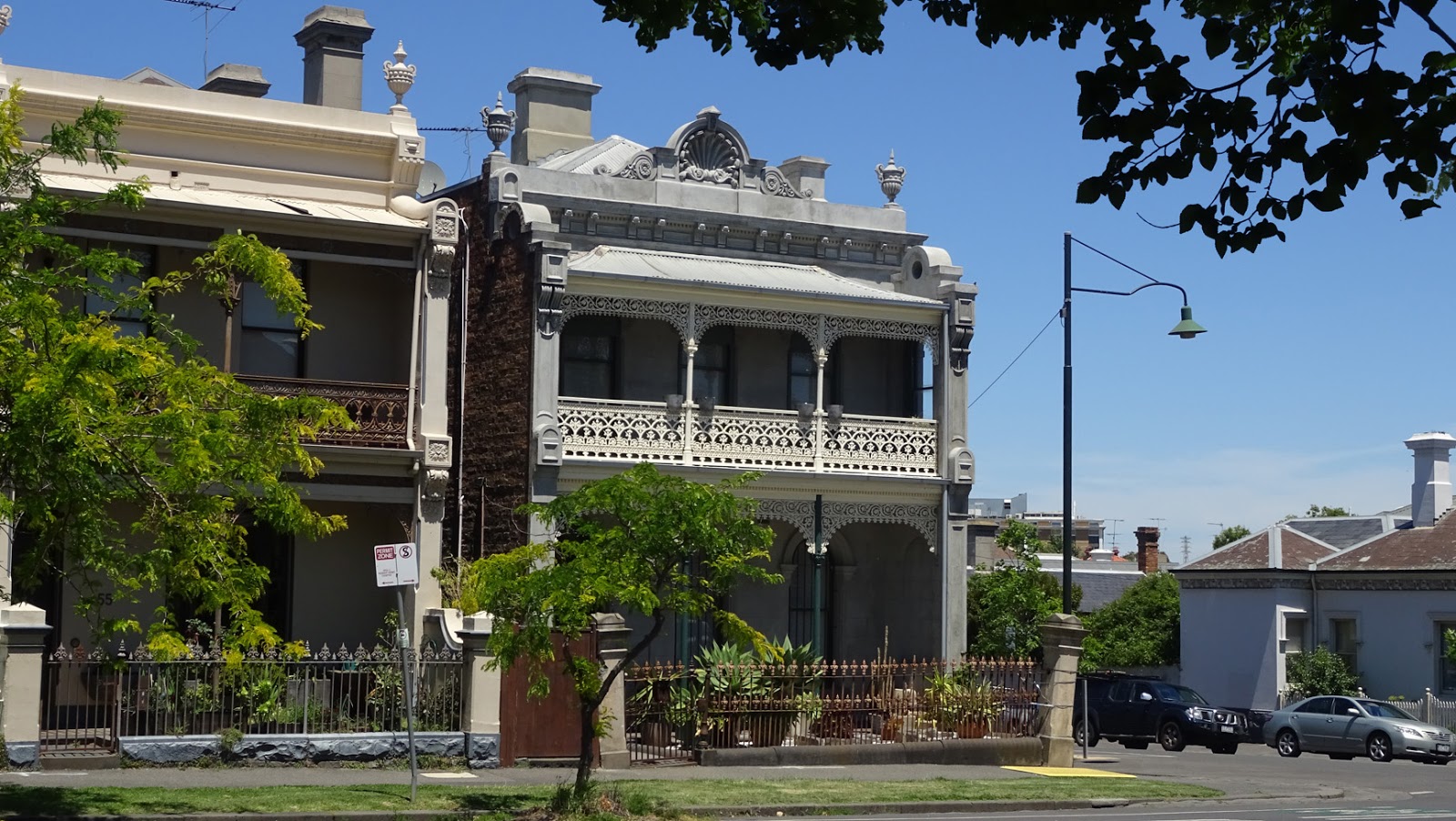
PARKVILLE TERRACES

Terraced houses in Australia refers almost exclusively to Victorian and Edwardian era terraced houses or replicas, almost always found in the older, inner city areas of the major cities, mainly Sydney and Melbourne. Terraced housing was introduced to Australia in the 19th century. Their architectural work was based on those in London and Paris, which had the style a century earlier.

Large numbers of terraced houses were built in the inner suburbs of large Australian cities, particularly Sydney and Melbourne, mainly between the 1850s and the 1890s. The beginning of this period coincided with a population boom caused by the Victorian and New South Wales Gold Rushes of the 1850s and finished with an economic depression in the early 1890s. Detached housing became the popular style of housing in Australia following Federation in 1901.

Melbourne's flat terrain has produced regular terraced house patterns. The wealth of the gold rush fuelled speculative housing development and also ensured that many terraces were built with ornate and elaborate details in a generally Italianate style, reaching its zenith in the 1880s with what is often referred to as "boom" style. The generic Melbourne style of terrace is distinguishable from other regional variations.

The majority of designers of Victorian terraces in Melbourne made a deliberate effort to hide roof elements with the use of a decorative parapet, often combined with the use balustrades above a subtle but clearly defined eave cornice and a frieze, which was either plain or decorated with a row of brackets (and sometimes additional patterned bas-relief). Chimneys were often tall, visible above the parapet and elaborately Italianate in style.

Individual terraces were designed to be appreciated on their own as much as part of a row. Symmetry was achieved through a central classical inspired pediment or similar architectural feature, balanced by a pair of architectural finial or urns on either side (though these details were subsequently removed on many terraces). The party walls were almost always decorated with corbels (which sometimes depicted heads), and the large wooden entry doors were decorated with stained or etched glass surrounds.

The Melbourne style often incorporated polychrome brickwork and decorative cast iron balconies (of the filigree style). The demand for imported cast iron eventually led to the establishment of local foundries. As a result, Melbourne has more decorative cast iron than any other city in the world. Melbourne style terraces were often set back from the street rather than built to the property line, providing a small front yard. Decorative cast-iron fencing, regularly dispersed with rendered brick piers, was typically used, and the party wall of the end terraces would sometimes, but not always, extend to the property line to join the fence.

This post is part of the Friday Greens meme,
and also part of the Saturday Silhouettes meme.


Friday, 18 November 2016

YARRA, AS THE CROW FLIES

Hunting in my archives I found some photos from last year, which were taken from the Rialto Building in the City. There are some quite nice views of the Yarra River and its bridges looking towards the East, South and Southwest.

This post is part of the Skywatch Friday meme,
and also part of the Friday Greens meme,
and also part of the Scenic Weekends meme.


Thursday, 17 November 2016

FIRST TASTE OF SUMMER

It is late Spring here in Melbourne and after much unsettled weather, unseasonal cold and rain during most of this year's Spring, today we had a wonderful summery day with fine, sunny weather, blue skies and temperature maxima in the low 30˚C range. It felt quite warm, but after the cool wet and grey weather we had been having, everybody who could get out and enjoy the sunshine did!  Here are some of the Spring flowers that I saw during my walk around the neighbourhood.

This post is part of the Skywatch Friday meme,
and also part of the Floral Friday Fotos meme,
and also part of the Friday Greens meme.
A hybrid crimson bottlebrush (Callistemon citrinus)
Dracaena marginata (dragon tree) in flower


Chinaberry tree (Melia azedarach)

Oyster plant (Acanthus mollis)

Hybrid tea roses (yellow Rosa 'Aperitif'; apricot Rosa 'Just Joey')

Sweet pea (Lathyrus odoratus)

A hybrid amaryllis (Hippeastrum spp) growing happily in a garden bed

Wednesday, 16 November 2016

BY THE YARRA

Ambling along the banks of the Yarra River on the South side, looking out towards the North. Picnicking, walking, boating, photographing, canoeing, or just having a lazy afternoon relaxing on the lawn, which is disrupted every now and then by the squawking seagulls... 

Deborah Halpern's mosaic sculpture "Angel" is prominent on the banks of the river. Deborah Halpern is one of Australia's most celebrated sculptors, known for her wildly colourful mosaic work. "Angel" stood in the moat of the National Gallery of Victoria for many years before it was moved to its current location at Birrarung Marr.

This post is part of the Wednesday Waters meme,
and also part of the Outdoor Wednesday meme,
and also part of the Wordless Wednesday meme,
and also part of the ABC Wednesday meme.


Tuesday, 15 November 2016

WARRANDYTE

Warrandyte is a suburb of Melbourne, Victoria, Australia, 24 km north-east of Melbourne's Central Business District. Its local government area is the City of Manningham. At the 2011 census, Warrandyte had a population of 5,520.

Warrandyte was founded as a Victorian town, located in the once gold-rich rolling hills east of Melbourne, and is now on the north-eastern boundary of suburban Melbourne. Gold was first discovered in the town in 1851 and together, with towns like Bendigo and Ballarat, led the way in gold discoveries during the Victorian gold rush.

Today Warrandyte retains much of its past in its surviving buildings of the Colonial period and remains a twin community with North Warrandyte, which borders the Yarra River to its north. The Yarra River is a prominent feature of the town and the lush vegetation on its banks provides ample opportunity for pleasant walks and leisure activities.

This post is part of the Our World Tuesday meme,
and also part of the Ruby Tuesday meme,
and also part of the Travel Tuesday meme,
and also part of the Wordless Wednesday meme.