Showing posts with label history. Show all posts

Tuesday, 30 June 2026

TRAIN STATION

In inner suburban Melbourne, Fairfield Railway Station is a well-preserved Federation Style station. The station features large timber weatherboard buildings on both platforms, constructed in the early 1910s (specifically 1911). These buildings exhibit Arts and Crafts architectural motifs. A notable feature visible in the background is the wooden pedestrian footbridge, which opened in March 1914.

This post is part of the Travel Tuesday meme


Tuesday, 23 June 2026

AT THE UNIVERSITY OF MELBOURNE

The University of Melbourne’s Old Quad features iconic, sandstone-arched cloisters. Located at the heart of the Parkville campus, these 19th-century cloisters form the perimeter of the university's oldest courtyard. The picturesque, Tudor-style spaces are a central hub for student life, cultural exhibitions, and campus ceremonies.

This post is part of the Travel Tuesday meme


Tuesday, 16 June 2026

GARFIELD

Garfield is a town in Victoria, Australia, 79 km south-east of Melbourne's Central Business District, located within the Shire of Cardinia local government area. Garfield recorded a population of 2,114 at the 2021 census. The area was originally called Cannibal Creek, but was renamed to Garfield in memory of the U.S. President James A. Garfield, who was murdered in July, 1881.

Garfield is also home to the Garfield Picture Theatre, Cardinia Shire’s first cinema in the region and one of the few remaining picture theatres in the Shire. The theatre was built in 1924, and was the town’s first source of electricity.

The Garfield Picture Theatre located in the heart of Garfield is where live music, tribute shows and community spirit meet in a lovingly restored 1920s picture house. Since first opening its doors in 1924, the theatre has been a place for people to come together, laugh, sing along and make memories.

It is located at 47-51 Nar Nar Goon-Longwarry Rd, Garfield VIC 3814. Comfortable one and two bedroom cabin style accommodation is available right on the Main Street of Garfield and can be booked via the Garfield Theatre's site.

This post is part of the Travel Tuesday meme

Tuesday, 3 March 2026

FITZROY

Fitzroy is an inner-city suburb in Melbourne, Victoria, Australia, three kilometres northeast of the Melbourne central business district, located within the City of Yarra local government area. Fitzroy recorded a population of 10,431 at the 2021 census.

Planned as Melbourne's first suburb in 1839, it later became one of the city's first areas to gain municipal status, in 1858, then known as Fitz Roy. It occupies Melbourne's smallest and most densely populated area outside the CBD, just 100 ha. 

Fitzroy is known as a cultural hub, particularly for its live music scene and street art, and is the main home of the Melbourne Fringe Festival. Its commercial heart is Brunswick Street, one of Melbourne's major retail, culinary strips. the intersection of Smith and Gertrude street has become a nightlife hub, especially for queer venues and events.

This post is part of the Travel Tuesday meme


Tuesday, 24 February 2026

BRUNSWICK STREET

Brunswick Street is a street in inner northern Melbourne, known for cafés, live music venues and alternative fashion shops. Brunswick Street runs north–south through the inner northern Melbourne suburbs of Fitzroy and Fitzroy North, from Victoria Parade at its southernmost end, crossing Gertrude Street and Alexandra Parade through Fitzroy, and north continuing until it reaches St Georges Road in Fitzroy North, near the Edinburgh Gardens. Tram route 11 (West Preston to Victoria Harbour) runs along the entire length of Brunswick Street.

It is a renowned bohemian strip and a premier destination for vibrant nightlife, eclectic fashion boutiques, vintage shopping, and diverse, often casual dining. It features iconic pubs, live music venues, street art, and a bustling café culture. Many fine Victorian era buildings ar e lined along its length. Landmarks include the Atherton Gardens housing estate, St Vincent's Private Hospital, and the Australian Catholic University.

This post is part of the Travel Tuesday meme


Tuesday, 10 February 2026

NORTHCOTE THEATRE

Built on the corner of High Street and Bastings Street in June 1912 by the Northcote Picture Theatre Company, it was opened on 27 June 1912  by Robert McLeish who remained its general manager while he became as well, the President of the Cinematograph Exhibitors' Association and Chairman of the Hoyts Victorian Executive.

It was designed by local architect, Edward Twentyman, jnr. and remains perhaps the earliest surviving picture theatre designed in Victoria. It possessed a balcony, stalls, its own electricity generator and a stage which was adaptable for vaudeville. It was the first building to be lighted by electricity. Amalgamated Pictures Ltd supplied the theatre with its silent cinema and the Northcote Mayoral ball was held there in late 1912.

It later became part of the Hoyts' chain of cinemas. While it was operating as a cinema, it was used as the setting for the film 'Night Club' in 1952. The cinema closed in 1960. Having been used as a dance studio, it is now used as a Reception Centre, and was used as a pilot for Darebin Council's façade restoration program in 1996. It had been extensively restored inside by the owners and refurbishments strictly considered original character.

This post is part of the Travel Tuesday meme


Tuesday, 23 December 2025

KEW BOATHOUSE

Historic Studley Park Boathouse, Kew, is only 10 minutes from the city centre and offers visitors the opportunity to dine in the restaurant, relax over a lighter meal in the indoor/outdoor café, or have a light snack from the kiosk while enjoying sweeping views of the Yarra River and natural bushland. You can also hire row boats, canoes and kayaks from the oldest operating boathouse in Australia. Open every day of the year except Christmas Day. Kids love the place as there are activities, animals and wide open spaces to play in.

This post is part of the Travel Tuesday meme
and also part of the Roentare’s Water Meme


Tuesday, 9 December 2025

BRUNSWICK TOWN HALL

Brunswick was declared a municipality in 1857, after residents petitioned for municipal government. The first municipal chambers were erected in 1859 on Sydney Road at Lobb's Hill, between Stewart and Albion streets. The present Town Hall began with the construction of what is now the central section in 1877, designed in Renaissance Revival style by Evander McIvor, consisting of three bays, with arched windows, rustication at the ground level, and paired pilasters above.

In 1888 a competition was held for a new structure, won by architect Sydney H Wilson, with a very grand scheme with a central clocktower, similar in style and elaboration to the just completed Collingwood Town Hall. The project however did not proceed, and instead an addition to the north in matching style was built in 1908, the same year Brunswick became a City.

In 1926 it was decided to finally complete the building, and include a smaller and larger hall, as well as offices for the Council. Sydney H Wilson was again the architect, along with Charles R Heath. The design incorporated the 1908 wing, with new sections to the south matching in detail, as part of an imposing building in Victorian Second Empire style, with a taller central section, mansard roofs, and a porte-cochere. The completed building, without the planned finials and cresting, opened in August 1927 with a 'brilliant spectacle'.

This post is part of the Travel Tuesday meme


Tuesday, 2 December 2025

MELBOURNE IMMIGRATION MUSEUM

The Immigration Museum focuses on Melbourne and Victoria’s immigration history. First opened in 1998 as a division of Museums Victoria, Immigration Museum is located at the restored Old Customs House Building on Flinders Street in Melbourne, Victoria.

The architects of Customs House were Peter Kerr, with additional input by J.J. Clark and Arthur Ebden Johnson. Constructed between 1855 and 1876, its creation was a reflection of vastly expanded trade and soaring revenue from the goldrush, resulting in one of Melbourne's grand buildings. The museum's most important space, the Long Room, is a notable piece of Renaissance Revival architecture. The site was listed in 1948 as one of the key sites for the modernisation of Melbourne. An 11 storey £750,000 Customs House office tower was proposed, which however, did not proceed.

This post is part of the Travel Tuesday meme


Tuesday, 11 November 2025

REMEMBRANCE DAY AT THE SHRINE

Armistice Day, later known as Remembrance Day in the Commonwealth and Veterans Day in the United States, is commemorated every year on 11 November to mark the armistice signed between the Allies of World War I and Germany at Compiègne, France, at 5:45 am for the cessation of hostilities on the Western Front of World War I, which took effect at 11:00 am—the "eleventh hour of the eleventh day of the eleventh month" of 1918—although, according to Thomas R. Gowenlock, an intelligence officer with the U.S. First Division, shelling from both sides continued for the rest of the day, ending only at nightfall. The armistice initially expired after a period of 36 days and had to be extended several times. A formal peace agreement was reached only when the Treaty of Versailles was signed the following year.

The Shrine of Remembrance (commonly referred to as 'The Shrine') is a war memorial in Melbourne, Victoria, Australia, located in Kings Domain on St Kilda Road. It was built to honour the men and women of Victoria who served in World War I, but now functions as a memorial to all Australians who have served in any war. It is a site of annual observances for Anzac Day (25 April) and Remembrance Day (11 November), and is one of the largest war memorials in Australia.

Designed by architects Phillip Hudson and James Wardrop, both World War I veterans, the Shrine is in classical style, based on the Tomb of Mausolus at Halicarnassus and the Parthenon in Athens, Greece. The crowning element at the top of the ziggurat roof references the Choragic Monument of Lysicrates. Built from Tynong granite, the Shrine originally consisted only of the central sanctuary surrounded by the ambulatory. The sanctuary contains the marble Stone of Remembrance, upon which is engraved the words "Greater love hath no man" (John 15:13); once per year, on 11 November at 11 a.m. (Remembrance Day), a ray of sunlight shines through an aperture in the roof to light up the word "Love" in the inscription. Beneath the sanctuary lies the crypt, which contains a bronze statue of a soldier father and son, and panels listing every unit of the Australian Imperial Force.

This post is part of the Travel Tuesday meme


Friday, 25 July 2025

STATE LIBRARY VICTORIA

State Library Victoria (SLV) is the state library of Victoria, Australia. Located in Melbourne, it was established in 1854 as the Melbourne Public Library, making it Australia's oldest public library and one of the first free libraries in the world. It is also Australia's busiest public library and, as of 2023, the third busiest library globally.

The library's first stage (the central part of the Swanston Street wing) opened on 11 February 1856, with a collection of 3,800 books chosen by Mr Justice Barry, the President of Trustees. The library has remained on the same site in the central business district since it was established fronting Swanston Street, and over time has expanded to cover a block bounded also by La Trobe, Russell, and Little Lonsdale streets.

The library's collection consists of over five million items, which in addition to books includes manuscripts, paintings, maps, photographs and newspapers, with a special focus on material from Victoria, including the diaries of the European founders of present-day Melbourne John Batman and John Pascoe Fawkner, the folios of colonial explorer James Cook, and items related to Ned Kelly, notably his armour and the original Jerilderie Letter.

This post is part of the Skywatch Friday meme


Tuesday, 1 July 2025

MONTSALVAT

Montsalvat is an artists' colony in Melbourne's Northeaster outer suburb, Eltham, established in 1934, and home to over a dozen buildings set amongst verdant established gardens. The colony of Montsalvat has a detailed history that reflects the life of Justus Jörgensen and his friends and family. Its buildings and gardens are steeped in the art and culture of Melbourne and its surroundings.

Architecturally Montsalvat has much in common with a simple French village in Provence, with a mix of rustic architectural styles. Justus Jörgensen was an architect and as a former student of Max Meldrum had spent many happy hours painting around Eltham. In 1934 Jörgensen purchased land and with his friends and students commenced the buildings that became Montsalvat, 26kms from Melbourne.

The grounds and buildings are currently used for exhibitions, performances, conferences, seminars, weddings and receptions; however, artists working in a variety of mediums continue to reside in Montsalvat. Several classes on various disciplines of art are offered year round by the resident artists. Today Montsalvat is a popular tourist attraction and the entire complex is listed on the Victorian Heritage Register.

This post is part of the Travel Tuesday meme


Sunday, 25 May 2025

MALDON

Maldon is a town in Victoria, Australia, in the Shire of Mount Alexander local government area. It has been designated "Australia's first notable town" and is notable for its 19th-century appearance, maintained since gold-rush days. At the 2021 census, Maldon had a population of 1,665.

This post is part of the Travel Tuesday meme

Sunday, 11 May 2025

PORSCHE TRACTOR

Porsche Junior is a tractor that was manufactured by Porsche-Diesel from 1952 to 1963. It is powered by an air-cooled 14 hp 822 cc, single-cylinder diesel engine. This one is on display in the window o fa retailer in my neighbourhood.

This post is part of the My Sunday Best meme

Tuesday, 29 April 2025

"CESTRIA" MANSION

"Cestria" is a Victorian mansion in Hawthorn, is one of the first and arguably the greatest American Romanesque Revival houses in Australia. It is of architectural significance for the survival of many interior features, especially the woodwork of the entrance/stair hall with its mahogany and American walnut staircase. The large west dining-room is also substantially intact with wallpapers and decoration from the time of the first owner.

"Cestria" was built for the wealthy biscuit manufacturer Thomas B Guest in 1891. Architect EG Kilburn of the partnership Ellerker and Kilburn signed the drawings. Kilburn had recently visited America, and the buildings he saw during his stay undoubtedly influenced the final design. "Cestria" followed close on the heels of Kilburn's American Romanesque design for an extension at the Priory Ladies School, St Kilda, which was finished in July 1890.

"Cestria" is architecturally significant as the greatest domestic example of the American Romanesque style of architecture in Victoria. Cestria is particularly significant as a reaction against the prevailing popularity of the Italianate style, which was characterised by cement rendered walls, parapets teetering with urns and other decorative features, and by cast iron. Cestria is significant for the part it played in the debate about an appropriate national style of architecture. It was hailed in contemporary building journals as being eminently suited to the Australian climate. The emergence of the American Romanesque and other red brick styles was central to the question of adapting an existing style to Australian requirements rather than creating a new one.

"Cestria" is located in a neighbourhood which contains a number of outstanding examples of Victorian and early Federation-style villas, combined with a series of well-designed and visually striking interwar houses and flats. Anchored by the visually prominent boulevard-like stretch of Glenferrie Road climbing past Scotch College, the place is representative of the changing patterns of development from the second half of the nineteenth century through to the interwar period.

This post is part of the Travel Tuesday meme.


Tuesday, 15 April 2025

SPENCER ST

The West End of the City, looking up Spencer St. The old whitish building on the southeast corner of Spencer and Flinders Streets in Melbourne is the Sir Charles Hotham Hotel, also known as the Hotham Hotel. It is a historic hotel, originally built in 1855. The hotel has been a hotel since the 1850s and has Edwardian Baroque style architecture and Art Nouveau features. The site is listed on the Victorian Heritage Inventory for its potential to contain historical archaeological remains.

This post is part of the Travel Tuesday meme

Tuesday, 25 February 2025

COUNTRYSIDE IDYLL

A bucolic landscape in Central Gippsland, with a view towards the south. The Strzelecki Ranges are seen and are a set of low mountain ridges located in the West Gippsland and South Gippsland regions of the Australian state of Victoria. The Ranges are named after Paweł Edmund Strzelecki, a Polish explorer, who with the assistance of Charley Tarra the small party's Aboriginal guide, led an expedition through this region in 1840.

This post is part of the Travel Tuesday meme


Tuesday, 12 November 2024

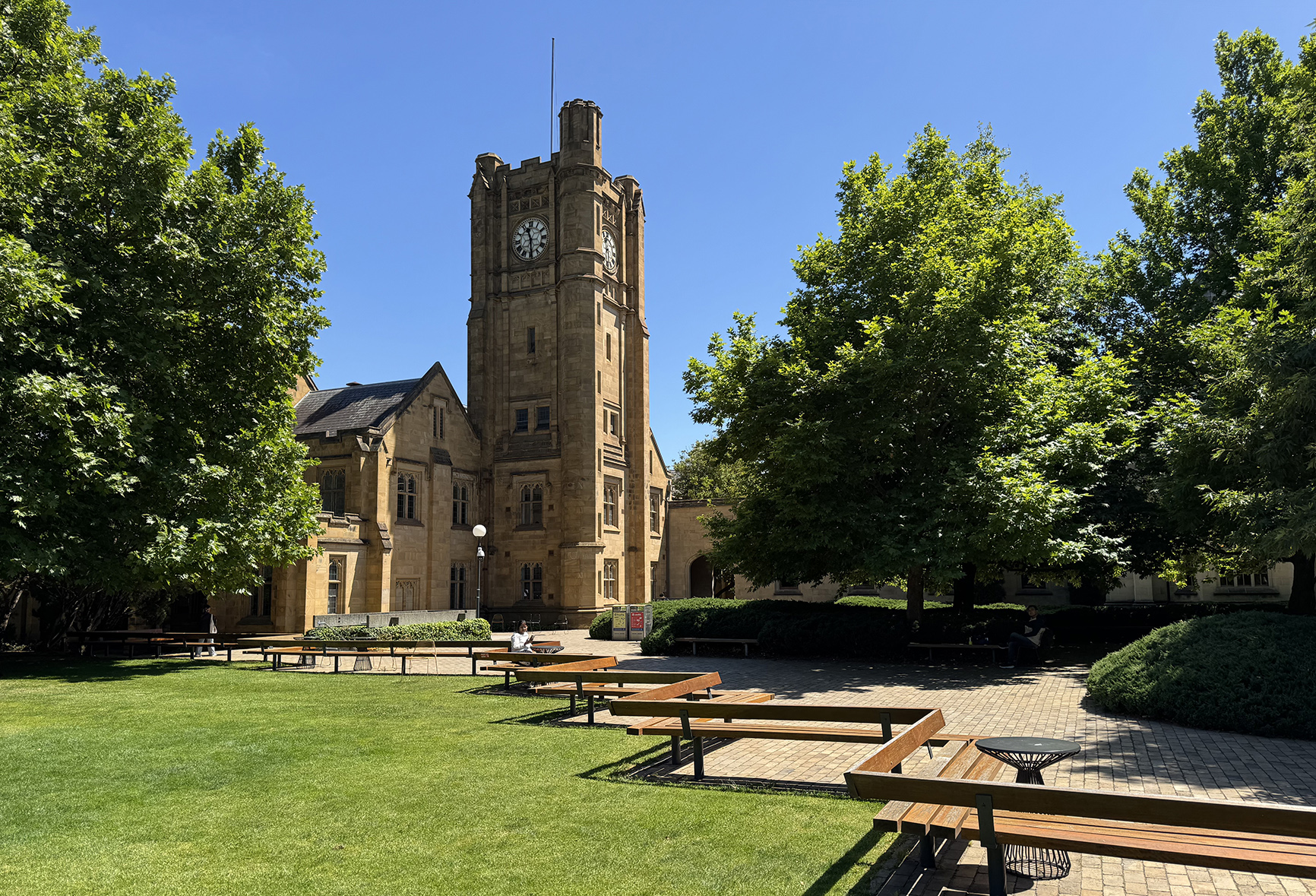
AT THE UNIVERSITY

The University of Melbourne (colloquially known as Melbourne University) is a public research university located in Melbourne, Australia. Founded in 1853, it is Australia's second oldest university and the oldest in Victoria. Its main campus is located in Parkville, an inner suburb north of Melbourne's central business district, with several other campuses located across Victoria.

The university comprises ten separate academic units and is associated with numerous institutes and research centres, including the Walter and Eliza Hall Institute of Medical Research, Florey Institute of Neuroscience and Mental Health, the Melbourne Institute of Applied Economic and Social Research and the Grattan Institute. The university has fifteen graduate schools, including the Melbourne Business School, the Melbourne Law School, the Melbourne Veterinary School, and the Melbourne Medical School.

In the QS World University Rankings 2025, the University of Melbourne was ranked 13th (1st nationally). Times Higher Education ranked Melbourne 33rd globally (1st in Australia) in the 2021–2022 iteration of its annual World University Rankings. In 2022, it ranked 33rd among the universities around the world by SCImago Institutions Rankings. I am proud to call this University my Alma Mater (all photos are from the Parkville Campus).

This post is part of the Travel Tuesday meme


Tuesday, 10 September 2024

MELBOURNE EXHIBITION BUILDING

Originally designed for the Melbourne International Exhibition of 1880, the Exhibition buildings and the surrounding Carlton Gardens are now World Heritage listed. The Royal Exhibition Building is Australia's only World Heritage listed building. Completed in 1880 for Melbourne's first International Exhibition, it was the site of Australia's first Federal Parliament in 1901. With its meticulously restored interior, expansive galleries and soaring dome, it continues to offer a magnificent setting for trade shows, fairs and cultural events.

The Exhibition Fountain by Josef Hochgurtel is of Portland cement built in 1880. Josef Hochgurtel was born in Cologne, Germany, and trained under Herr Fuels, who modelled the Cologne Cathedral. In creating the Exhibition Fountain, he was assisted by August Saupe, who had worked on similar pieces in Berlin, Dresden and Copenhagen. The colossal fountain stands some 10 metres high on the south side of the Royal Exhibition Building, outside the Great Hall. It was constructed for the first of Melbourne’s two grand international world fairs. The fountain’s visual elements were designed to display the young colony’s confidence and advancement, simultaneously signalling the purpose of world fairs to display the produce and industry of nations.

Here it is hosting the Affordable Art Fair held in Melbourne recently.

This post is part of the Travel Tuesday meme


Tuesday, 27 August 2024

MALVERN TOWN HALL

Malvern Town Hall is the former town hall of the municipality of Malvern in the state of Victoria, Australia. It is the seat of the local government area of the City of Stonnington. The Second Empire and Italianate style Victorian era building is located on the northeast corner of Glenferrie Road and High Street, in Malvern.

The foundation stone of the Malvern Shire Hall was laid by the Hon. Alfred Deakin, the Minister of Public Works, on 22 September 1885. Heritage Victoria describes the Malvern Town Hall as aesthetically and historically significant. It is an extraordinary and essentially intact example of a building of its type, having two towers. The building demonstrates a changing sequence of styles from the Late Victorian Boom period to interwar Adamesque. The use of marble and terrazzo in the foyers and the plaster Adamesque ornamentation in the hall is of note.

This post is part of the Travel Tuesday meme