The System Garden was the creation of Frederick McCoy, the first professor of Natural Science at the University of Melbourne. Begun in 1856, it originally comprised a series of concentric garden beds, organised according to plant classification. The only remnant from that time is the tower which formed the centre of an octagonal glasshouse.
This post is part of the Our World Tuesday meme.
The renowned Spanish deli “Casa
Iberica”, which since 1975 has been a fixture of Melbourne’s “Spanish Quarter”
in Fitzroy, has opened a second store in
Melbourne’s north-eastern inner suburb of Alphington. Owners Paulo and Mericia
Da Silva are now supplying the locals with Spanish, Portuguese, Mexican and
South American products.
The shop’s tall shelves are
neatly stacked with jars of dulce de leche and pickled jalapenos, packets of
Mexican hot chocolate, tins of smoky Los Novios paprika and bottles of hot
sauce with labels alluding to their after-effects. Arepas (corn flatbread) and
tortillas, cheese, chorizo, jamon and salami fill the fridges, the smallgoods
packaged for self-service, rather than cut to order.
Street art with Iberian and Mexican themes brightens the
double-fronted façade of thenew premises, a combination of shop, smallgoods
kitchen and warehouse in a quiet back street of Alphington. Casa Iberica Deli, is
located at 154-156 Fulham Road, Alphington, is open 9.30am-4pm Tuesday to
Saturday. Tel 9497 2107.
This post is part of the Monday Murals meme,
Benalla is a small city located on the Broken River in the High Country north-eastern region of Victoria, Australia, about 188 kilometres north east of the state capital Melbourne. At the 2006 Census the population was 9,129. It is the administrative centre for the Rural City of Benalla local government area.
Prior to the European settlement of Australia, the Benalla region was populated by the Taungurong people people, an Indigenous Australian people. It was first sighted by Europeans during an expedition of Hamilton Hume and William Hovell in 1824, when the area, first named "Swampy" was noted that agricultural settlement. The expedition was followed by that of Major Thomas Mitchell in 1834.Reverend Joseph Docker settled in 1838 creating a pastoral run called Benalta Run, said to be from an Aboriginal word for Musk Duck.
An attack by indigenous people on the camp of sheep herders George and William Faithful became known as the Faithful Massacre; eight settlers were killed in the incident. Following the massacre in 1839 a police station was established and the name of the settlement became Broken River.The Post Office opened on 1 December 1844 originally named Broken River. A bridge was built over the Broken River in 1847 and the following year the town was surveyed. In 1861 it was proclaimed a town.It was proclaimed a city in 1965.
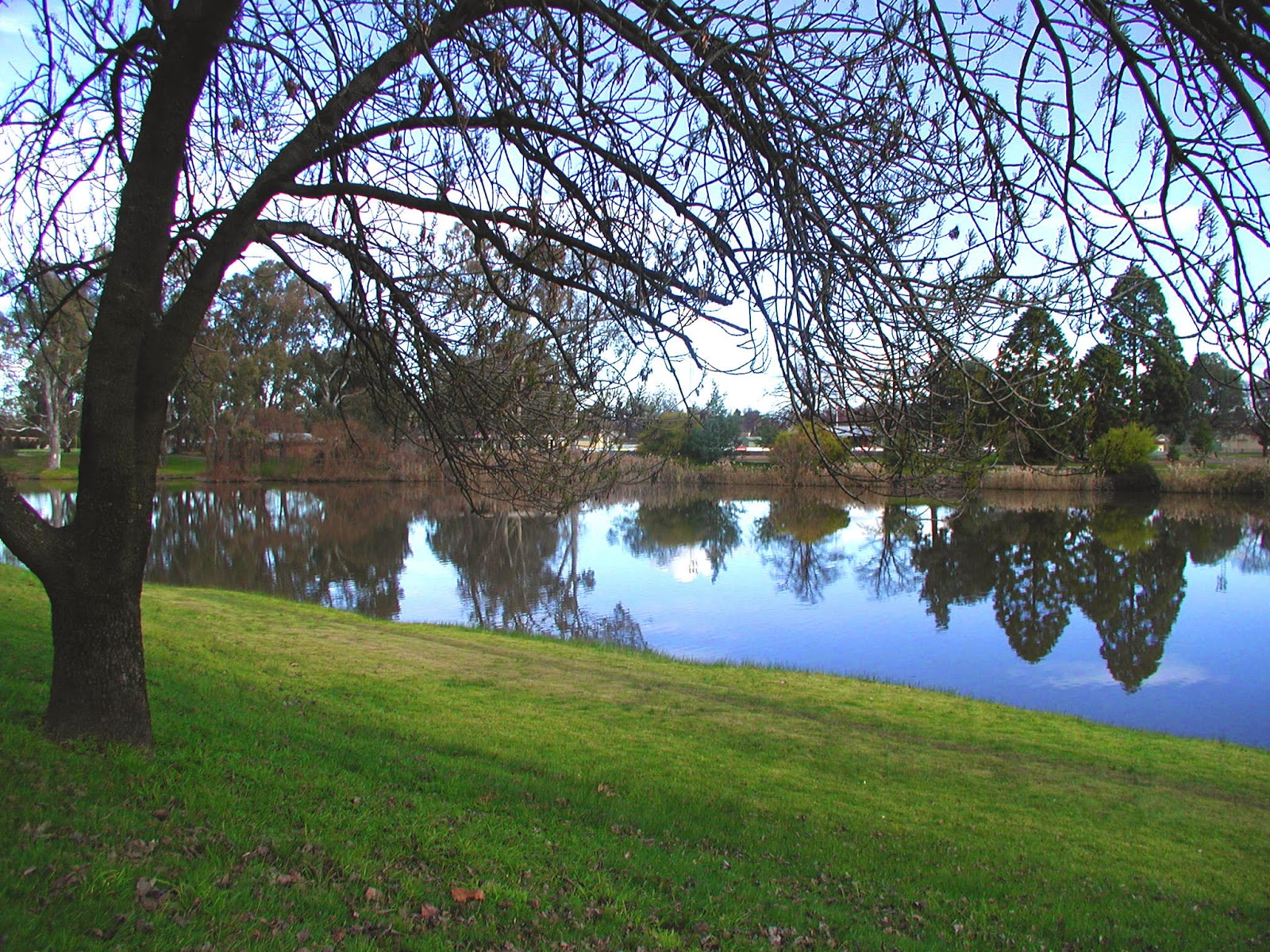
Benalla is situated on a mostly flat floodplain of the Broken River catchment situated directly to the north and west of the Great Dividing Range. Lake Benalla is an artificial lake created in 1973 from the Broken River as an ornamental feature for the centre of the city. Broken river forms a green belt along the north-south spine of the city. There are three major crossings of the river at Benalla. The main street in the Central Business District is Bridge Street East. Another large artificial lake, Lake Mokoan is 7 kilometres to the north east. To the south of the freeway is the heavily forested Reef Hills State Park.
This post is part of the Weekend Reflections meme,
and also part of the Scenic Weekends meme,
and also part of the Sunday Bridges meme.
Melbourne Airport, also known as Tullamarine Airport, is the primary airport serving the city of Melbourne, and the second busiest airport in Australia. It was opened in 1970 to replace the nearby Essendon Airport. Melbourne Airport is the sole international airport of the four airports serving the Melbourne metropolitan area.
The airport is 23 km from the city centre, and is adjacent to the suburb of Tullamarine. The Melbourne–Sydney air route is the third most-travelled passenger air route in the world and the third busiest in the Asia Pacific region. The airport features direct flights to 33 destinations in all states and territories of Australia in addition to numerous destinations in Oceania, Asia, Africa, Europe and North America. Melbourne is the most common destination for the airports of five of Australia's seven other capital cities.
Melbourne serves as a major hub for Qantas and Virgin Australia, while Jetstar Airways and Tiger Airways Australia utilise the airport as home base. Melbourne is the busiest airport for international export freight as of August 2011, while second busiest for import freight. Domestically, Melbourne serves as headquarters for Australian air Express and Toll Priority and handles more domestic freight than any other airport in the nation.
In 2003, Melbourne received the International Air Transport Association Eagle Award for service and two National Tourism Awards for tourism services. The airport comprises four terminals: One international terminal, two domestic terminals and one budget domestic terminal. Most recently Melbourne Airport was awarded by Skytrax for having the best Airport hotel in the Australia/Pacific in the World Airport Awards. Melbourne Airport was also ranked the 43rd best airport for 2012. Melbourne reached 30 million passengers for the first time in the 12 months ending July 2013.
This post is part of the Weekend Reflections meme,
Yesterday afternoon we had a hailstorm pass through Melbourne and our suburb experienced quite a heavy fall for about 10 minutes or so. Spring can be more than usually variable, weatherwise, in Melbourne and we often get quite a lot of fluctuation in daily maxima, rain, wind, hail as well as quite hot temperatures - sometimes all in one day!
This was the case yesterday with a sunny morning, albeit a little cool and then windy. The sky suddenly turned leaden and the hail fell, the stones about 1 cm in diameter. This was then to give way to quite a sunny afternoon. A cool, fine day today, with a very warm weekend forecast. Then cool temperatures and showers next week...
If you don't like the weather in Melbourne, wait 10 minutes - it will change!
This post is part of the Skywatch Friday meme.
Liriodendron tulipifera (known as the tulip tree, American tulip tree, tuliptree, tulip poplar, whitewood, fiddle-tree, and yellow poplar) is the Western Hemisphere representative of the two-species genus Liriodendron, and the tallest eastern hardwood. It is native to eastern North America from Southern Ontario and Illinois eastward across southern New England and south to central Florida and Louisiana.
It can grow to more than 50 m in virgin cove forests of the Appalachian Mountains, often with no limbs until it reaches 25–30 m in height, making it a very valuable timber tree. It is fast-growing, without the common problems of weak wood strength and short lifespan often seen in fast-growing species. April marks the start of the flowering period in the southern USA; trees at the northern limit of cultivation begin to flower in June. The flowers are pale green or yellow (rarely white), with an orange band on the tepals; they yield large quantities of nectar. The tulip tree is the state tree of Indiana, Kentucky, and Tennessee.
Tulip trees make magnificently shaped specimen trees, but are very large, growing to about 35 m in good soil. Liriodendron tulipifera has been introduced to many temperate parts of the world, at least as far north as Sykkylven, Norway. The magnificent specimen photographed here is growing outside the Heidelberg Town Hall in Melbourne. Surprisingly, the flower-bearing branches make good cut flower displays.
This post is part of the Floral Friday Fotos meme.