Monday, 20 May 2019

CURIO BOX

Cabinets of curiosities (also known in German loanwords as Kunstkabinett, Kunstkammer or Wunderkammer; also Cabinets of Wonder, and wonder-rooms) were notable collections of objects. The term cabinet originally described a room rather than a piece of furniture. Modern terminology would categorise the objects included as belonging to natural history (sometimes faked), geology, ethnography, archaeology, religious or historical relics, works of art (including cabinet paintings), and antiquities.

The classic cabinet of curiosities emerged in the sixteenth century, although more rudimentary collections had existed earlier. In addition to the most famous and best documented cabinets of rulers and aristocrats, members of the merchant class and early practitioners of science in Europe formed collections that were precursors to museums.

Here is my little version of a cabinet of curiosities, one of several curio boxes I have and in which I have various objects, some precious, others remarkable, yet others quite ordinary but connected with some event or person, and which therefore bring back some memory. In this one you can see a mosaic of all manner of things including: Antique miniature toys, tropical tree dried seeds, mineral specimens, carved oriental bone figures, cloisonné miniatures, fossils and shells.

This post is part of the Mosaic Monday meme,
and also part of the Through my Lens meme,
and also part of the Seasons meme,
and also part of the Blue Monday meme.

Sunday, 19 May 2019

YARRA RIVER VIEW

View of the Yarra River at Fairfield Park with the Pipe Bridge in the distance. A popular place for kayaking, walking and cycling. Oh, and photography!

This photo is part of the My Sunday Best meme,
and also part of the Weekend Reflections meme.

Saturday, 18 May 2019

Friday, 17 May 2019

BALLOONING AT SUNRISE

Funny sight when you draw the drapes in the morning and you see a hot air balloon just outside your window...

This post is part of the Skywatch Friday meme,
and also part of the Friday Photo Journal meme.

Thursday, 16 May 2019

JONQUIL

Narcissus jonquilla (Jonquil, Rush daffodil) is a bulbous flowering plant, a species of Narcissus (daffodil) that is native to southwestern Europe and northern Africa, but has naturalised throughout Europe and the United States. It bears long, narrow, rush-like leaves (hence the name "jonquil", Spanish junquillo, from the Latin juncus = "rush"). It is in the Amaryllidaceae family of plants.

In Spring it bears heads of up to 5 scented yellow or white flowers. It is a parent of numerous varieties within Division 7 of the horticultural classification. Division 7 in the Royal Horticultural Society classification of Narcissus includes N. jonquilla and N. apodanthus hybrids and cultivars that show clear characteristics of those two species.

N. jonquilla has been cultivated since the 18th century in France as the strongest of the Narcissus species used in Narcissus Oil, a component of many modern perfumes. Like other members of their family, narcissi produce a number of different alkaloids, which provide some protection for the plant, but may be poisonous if accidentally ingested. This property has been exploited for medicinal use in traditional healing and has resulted in the production of galantamine for the treatment of Alzheimer's dementia.

We have had the first jonquils blooming in our garden this week, which is very early (considering it is late Autumn here in Melbourne!).

This post is part of the Floral Friday Fotos meme.

Wednesday, 15 May 2019

S for SNAKE

Australia has nearly 200 known species of snake, only 25 of which are considered potentially deadly. Common snakes in the Melbourne area and surrounding suburbs include the Tiger Snake, Eastern Brown Snake, Copperhead Snake, White-Lipped Snake, Small-Eyed Snake and Red-Bellied Black Snake. There are over 27 types of snake in Victoria and a number of these are venomous, including the tiger snake, the copperhead, the brown snake and the red-bellied black snake.

Darebin Parklands being a nature reserve in the midst of inner suburban Melbourne, has a host of animal species, many of them native that live happily in its confines. These creatures of course include snakes. Numerous signs relating to snakes are found throughout the Parklands, reminding people to take care during the Summer between the months of October to April.

I have seen snakes a number of times, in the Parklands and elsewhere, but fortunately these encounters have been innocent enough. While seeing a snake may be an intimidating experience, they are typically shy creatures and most will try to avoid confrontation with humans and quickly slither away (how quickly they can move is indeed a sobering experience). My latest encounter was with a 1.2 m tiger snake that was crawling along the path, rushing to get to an area well-covered with grass and bushes. This was a couple of months ago and the day was very hot and the snake moved extremely quickly, rushing away from me towards cover. It was fortunate I had the camera in my hands and was able to take a few photos.

Tiger snakes, like this one, are a highly venomous snake species found in the southern regions of Australia, including its coastal islands, such as Tasmania. These snakes are highly variable in their colour, often banded like those on a tiger, and forms in their regional occurrences. All populations are in the genus Notechis, and their diverse characters have been described in further subdivisions of this group; they are sometimes described as distinct species and/or subspecies. Tiger snakes accounted for 17% of identified snakebite victims in Australia between 2005 and 2015, with four deaths recorded from 119 confirmed envenomations.

Tiger snake venoms possess potent neurotoxins, coagulants, haemolysins, and myotoxins. Symptoms of a bite include localised pain in the foot and neck region, tingling, numbness, and sweating, followed by a fairly rapid onset of breathing difficulties and paralysis. In a study, the mortality rate from untreated bites is reported to be between 40 and 60%. The risk of being bitten by a snake or dying from a snake bite is extremely low. While highly variable, it is estimated that no more than 100 or 200 people each year get bitten by snakes in Victoria. Despite this, on average only one person every 5 years dies of a snake bite. The last recorded fatal snake bite in Victoria was by a tiger snake in November 2014. To put the risk of dying from a snake bite in perspective, consider that each year in Victoria about 40 people die from drowning in waterways and about 250 people die in car accidents. 

Treatment is the same for all Australian venomous snakes. The pressure immobilisation method is used to inhibit the flow of venom through the lymphatic system. Broad, thick bandages are applied over the bite, then down and back along the limb to the armpit or groin. The affected limb is then immobilised with a splint. Identification of the venom is possible if traces are left near the wound. The availability of antivenom has greatly reduced the incidence of fatal tiger snake bites. Among the number of deaths caused by snakebite in Australia, those from tiger snakes are exceeded only by the brown snake. In most Australian states, tiger snakes are protected species, and to kill or injure one incurs a fine up to $7,500, as well as a jail sentence of 18 months in some states. It is also illegal to export a native Australian snake.

This post is part of the Wordless Wednesday meme,
and also part of the ABC Wednesday meme,
and also part of the Nature Notes meme.


Tuesday, 14 May 2019

FLINDERS ST STATION

Flinders Street Station is a railway station on the corner of Flinders and Swanston Streets in Melbourne, Australia. It serves the entire metropolitan rail network. Backing onto the city reach of the Yarra River in the heart of the city, the complex covers two whole city blocks and extends from Swanston Street to Queen Street. Flinders Street is served by Metro's suburban services, and V/Line regional services to Gippsland. It is the busiest station on Melbourne's metropolitan network, with some 92.6 million passenger movements recorded in 2011/12. It was the first railway station in an Australian city and the world's busiest passenger station in the late 1920s.

The main station building, completed in 1909, is a cultural icon of Melbourne, with its prominent dome, arched entrance, tower and clocks one of the city's most recognisable landmarks. It is listed on the Victorian Heritage Register. The Melburnian idiom "I'll meet you under the clocks" refers to the row of clocks above the main entrance, which indicate the time-tabled time of departure for trains on each line; another idiom, "I'll meet you on the steps", refers to the wide staircase underneath these clocks. Flinders Street Station is responsible for two of Melbourne's busiest pedestrian crossings, both across Flinders Street, including one of Melbourne's few pedestrian scrambles.

The ladies in red are volunteer tourist helpers, willing to smile and lend a hand to "lost souls"! Volunteers play a vital role in the City of Melbourne’s tourism services. ​Volunteers provide information on Melbourne to around two million visitors each year. Their love and knowledge of the city and regional Victoria adds to Melbourne's reputation as a friendly, welcoming and culturally vibrant city.

This post is part of the Our World Tuesday meme,
and also part of the Ruby Tuesday meme,
and also part of the Travel Tuesday meme,
and also part of the Wordless Wednesday meme.

Monday, 13 May 2019

HELLO AUTUMN

Our trees are showing beautiful Autumn colours and the weather has been wet, cool and crisp. Read the sign...

This post is part of the Mosaic Monday meme,
and also part of the Macro Monday meme,
and also part of the Through my Lens meme,
and also part of the Seasons meme.

Sunday, 12 May 2019

ON THE YARRA

Rowers on the Yarra River in Suburban Melbourne.

This post is part of the My Sunday Best meme.

Saturday, 11 May 2019

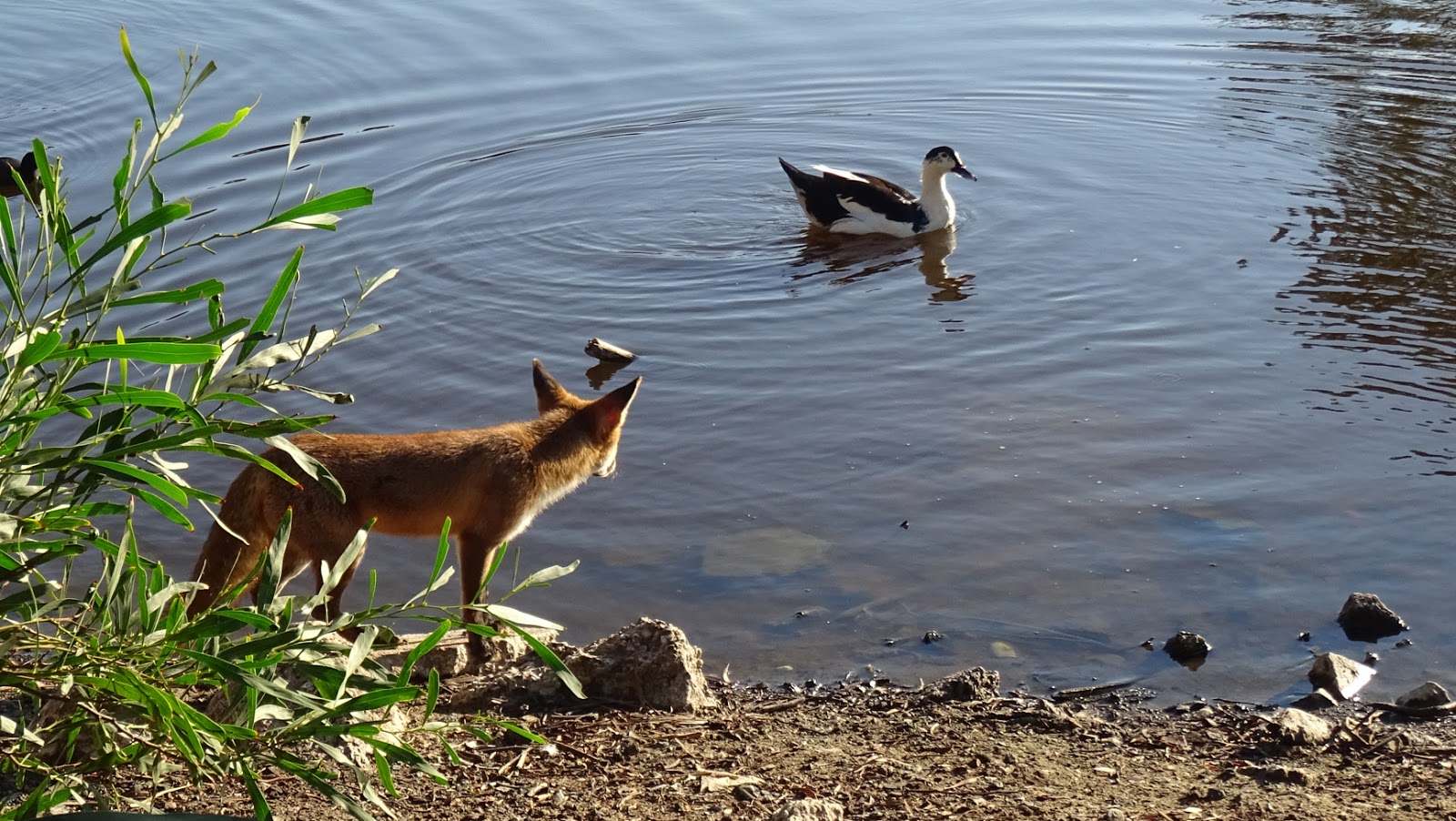
FOX

European foxes can be found on most of the Australian continent where they represent a very successful invasive species. Foxes were introduced to Australia in the mid-1800s for sport hunting and in about 100 years spread to most of the continent. Recently, foxes have also been introduced into Tasmania but efforts are already underway to eliminate foxes from this island.

Foxes have had a major impact on the Australian fauna, predating on ground nesting birds, mammals and reptiles. Moreover foxes compete with Australian native animals for food and habitat and can act as a reservoir of disease for wildlife and domestic animals. They are very common in Melbourne, but are seldom seen as they are shy, nocturnal and prefer areas with low human disturbance and buildings without domestic dogs.

Foxes select areas infested with exotic weeds (fennel, blackberry and African thistle) as shelter during the daytime and these also have low human disturbance. The Darebin Parklands in Melbourne are an ideal habitat for them and this specimen was quite tame and seemed unwary of me snapping away at him.

This post is part of the Saturday Critters meme,
and also part of the Camera Critters meme.