Melbourne has a moderate oceanic climate (Köppen climate classification Cfb) and is well known for its changeable weather conditions. This is mainly due to Melbourne's location situated on the boundary of the very hot inland areas and the cold southern ocean. This temperature differential is most pronounced in the Spring and Summer months and can cause very strong cold fronts to form. These cold fronts can be responsible for all sorts of severe weather from gales to severe thunderstorms and hail, large temperature drops, and heavy rain. One advantage of the Spring showers is that we have delightful flowers in our gardens.
This post is part of the Weekend Reflections meme.
One of the advantages of being a 'morning person' is enjoying the sunrise, the quiet streets and commuting in uncrowded public transport. Here is a sunrise I enjoyed recently in my home suburb of Fairfield, an inner northeastern suburb of Melbourne.
This post is part of the Skywatch Friday meme.
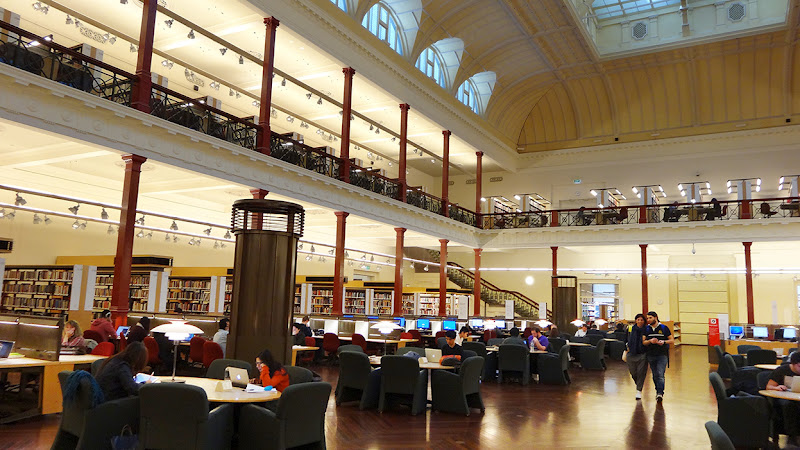
The State Library of Victoria is the central library of the state of Victoria, Australia, located in Melbourne. It is on the block bounded by Swanston, La Trobe, Russell, and Little Lonsdale streets, in the northern centre of the central business district. The library holds over 2 million books and 16,000 serials, including the diaries of the city's founders, John Batman and John Pascoe Fawkner, and the folios of Captain James Cook, R.N.. It also houses the original armour of Ned Kelly.
This post is part of the Things in a Row meme
and also part of the Signs, Signs meme.
Darebin Parklands is one of Darebin’s premier conservation parks sited along the Darebin Creek. The park is managed by the Darebin Creek Management Committee which the Cities of Darebin and Banyule are members.
Darebin Parklands is a wonderful setting for walks and escaping into the natural environment, and is located only 5km from Melbourne's CBD. The park has a full time Ranger coordinating the Education Centre which details the parks rich history and committment to conservation and environmental sustainability. The Darebin Creek Trail runs through the centre of the park and provides shared trail access through to Bundoora Park 10km to the north.
This post is part of the Water World Wednesday meme,
and also part of the Outdoor Wednesday meme,
and also part of the Nature Footsteps Waters meme.
Flagstaff Gardens is the oldest park in Melbourne, first established in 1862. In 2005 it is one of the most visited and widely used parks in the city by nearby office workers and tourists. The gardens are notable for their archeological, horticultural, historical and social significance to the history of Melbourne.
The gardens are 7.2 hectares (18 acres) of Crown Land bounded by William, La Trobe, King and Dudley streets, managed by the City of Melbourne. The park contains extensive lawns with a variety of mature trees, flowerbeds and native animals including possums. The southern end is characterised by deciduous trees, while the northern end contains mature eucalypts. Avenues of elms shade pathways along with several large Moreton Bay Fig trees. The north corner contains a bowling lawn, rose beds, flower and shrub beds. Along William Street there are tennis courts, which also double as volleyball, handball and netball courts. Electric barbecues nearby provides a popular site for office parties in December.
Scattered about the lawns and gardens are memorials and sculptures that illuminate some of the social significance of the area. Flagstaff Gardens have been classified by the National Trust of Australia (Victoria) and is listed by the Australian Heritage Commission and the Victorian Heritage Register. At the listing ceremony by the Victorian Heritage Council in April 2004, Council Chair Chris Gallagher said "This listing ensures the much loved trees, landscaping and other individual features are conserved and protected. But it also means the whole site is recognised as an important place for gaining an insight into our historical, archaeological, aesthetic, horticultural and social heritage."
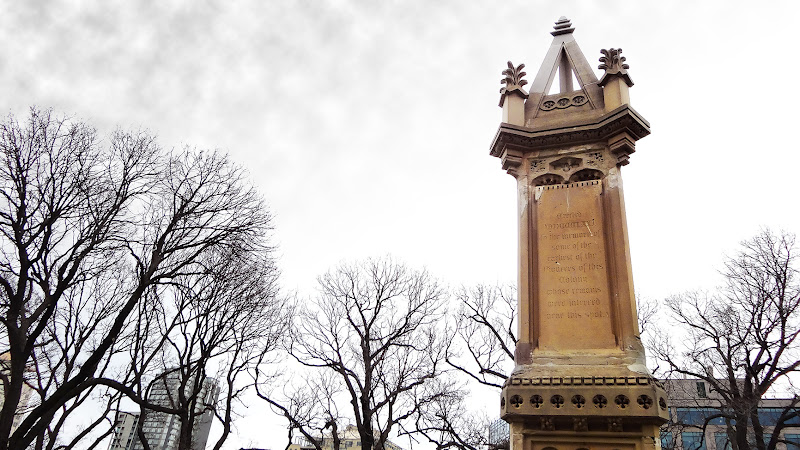
With the establishment of Melbourne in 1835, the first deaths in the colony were buried on high ground between William and King Streets, in what was colloquially called Burial Hill. The hill had panoramic views of the small colony, the Yarra River and Port Phillip.
This post is part of the Taphophile Tragics meme,
and also part of the Our World Tuesday meme.


- 1838 - Melbourne cemetery was marked out in what is now the Queen Victoria market, and burials continued at that location.
- 1839 - Superintendent Charles La Trobe first included the site as part of the green belt encircling Melbourne which included Batman's Hill, Carlton Gardens, Fitzroy Gardens, Treasury Gardens and the Kings Domain.
- 1840 - a flagstaff was erected on the hill as part of a signalling system between the town and ships in the Port of Melbourne. The flagstaff proved too small and the following year a fifty foot (15 m) flagstaff was erected.11 November
- 1850: site of announcement of Victoria’s Separation from the Colony of New South Wales, resulting in celebrations with a huge bonfire with about 5,000 townspeople in attendance.
- 1853- establishment of the Melbourne cemetery
- 1857 - cutting excavated to ease the gradient of King Street. This created the bluestone retaining wall of the high bank along the western boundary.
- 1857-1863 - A Magnetic Observatory and Weather Station was established by Georg von Neumayer on the hilltop. William John Wills worked here as an assistant before being appointed to the Burke and Wills expedition. The observatory moved to the Kings Domain when the Melbourne Observatory was established, as iron in the buildings surrounding Flagstaff Hill were affecting Neumayer's magnetic observations.1860s - the telegraph supersedes signalling by flags.
- 1862 - West Melbourne residents petition the government to turn the hill into public gardens or recreation reserve. Clement Hodgkinson, the Deputy Surveyor-General in charge of city parks, prepared a plan for the gardens and directed its implementation.The Fitzroy and Treasury Gardens were also designed by him.
- 1871 - Memorial to Melbourne’s pioneers erected.1873 - Gardens permanently reserved
- 1880 - establishment of path network, lawns, trees and flowerbeds.October 9, 1917 - the City of Melbourne was appointed responsible for the Flagstaff Gardens.1918 - children’s playground established, one of the first in Melbourne.23 March 2004 - gardens formally added to the Victorian Heritage Register.
I spotted this while walking up to the Royal Children's Hospital form the City. The elephant is part of the 50 decorated elephants project currently running in Melbourne. The Melbourne Zoo celebrates 150 years and got together 50 artist-designed elephants throughout the Melbourne CBD. The elephants stay in the Melbourne city from the 10th August 2012 to September 21st. I'll post some more of these elephants up at a later date.
The mural brightens up the old market shed and it's quite amazing that it has all been done on the corrugated iron panels of the walls. I thought the abstract design was pretty neat, but then I saw the portrait on the other side! I couldn't find the name of the artist, but the "Stringbean Alley" on the mural refers to the little lane that runs down the side.
This post is part of the Monday Murals meme,
And also part of the Mellow Yellow Monday meme,
And also part of the Blue Monday meme
The Monash Religious Centre, designed by John Mockridge of the Melbourne architectural firm Mockridge Stahle & Mitchell, was built in 1967-8 at the new Monash University. The university opened in 1961, and the Religious Centre was planned by the Christian and Jewish communities of Melbourne as a space that could be used by all religious groups. The funds were raised by the different groups and the building was then presented to the university, to dissociate it from any one religious tradition.
The Religious Centre was seen at the time as an important ecumenical exercise and part of the process of reassessment and reform within the churches, including moves towards liturgical experimentation, greater social relevance and greater interaction with other religious traditions. Mockridge Stahle & Mitchell, with John Mockridge as the principal designer, was a prominent architectural firm established in Melbourne in 1948, and was particularly well-known for its designs for school and university buildings and churches.
Mockridge chose the circular form of the building as a symbol of unity, eternity and ecumenical feeling. With the growth of a significant non-Western student population, the Centre has been increasingly used by other religious groups, particularly Muslims, Buddhists and Hindus. The building is used for Christian and Jewish services, Muslim prayers, Bible studies, Catholic confession, meetings of the religious societies, discussion groups and social gatherings, as well as joint ceremonies by representatives of the different users.
The organ, made by Ronald Sharp of Sydney, was installed in 1978 in the Large Chapel, which is also used for organ practice, choir rehearsals, concerts, weddings and funerals.
In these troubled times, worldwide, it is important to remember the ecumenical spirituality that all great religions share and that if all the faithful, whatever their faith chose to follow their religious principles, there would be little place for violence in the world.
This post is part of the Spiritual Sunday meme,
And here is Joseph Haydn's setting of Psalm 19:1 from the Creation, sung in German: "Die Himmel erzählen die Ehre Gottes".