Showing posts with label Campanulaceae. Show all posts

Thursday, 31 October 2024

CAMPANULA

A self-seeded Campanula seedling growing and flowering amongst stones and rocks.

"One who gains strength by overcoming obstacles possesses the only strength which can overcome adversity." - Albert Schweitzer

This post is part of the Floral Friday Fotos meme


Thursday, 6 January 2022

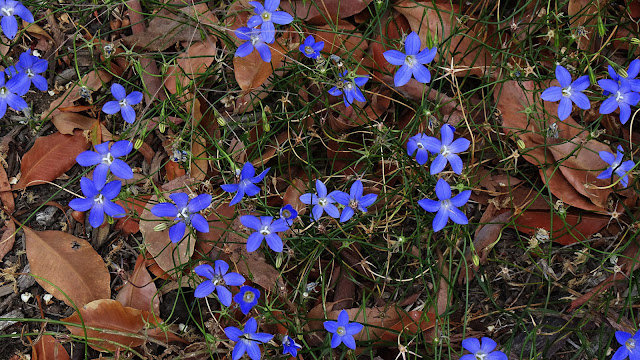
AUSTRALIAN BLUEBELL

Wahlenbergia stricta, or Australian Bluebell, Tall or Austral Bluebell, is an Australian wildflower from the Campanulaceae family. It is considered the most commonly encountered of the Wahlenbergias. It is found in all Australian states but not the Northern Territory. It is often seen growing by the side of the road, enjoying the extra runoff.

W. stricta is a perennial herb flowering mainly in spring or summer with pale blue bell-like flowers. The leaves are long and linear, 5–70 millimetres (0.20–2.76 in) long. The five-petalled flowers are erect on long, slender stems and about 6–20 millimetres (0.24–0.79 in) in diameter. It forms thin, carrot shaped tubers.

Australian bluebells are generally easily propagated by division or root cutting. The seed is a very fine, black powder. It germinates readily in a few weeks and is best directly sown into tubes or cells as the seed and plant are very small and hard to separate and prick out.

There are a number of common cultivars, including various shades of blue from a saturated blue similar to #00f through to white. Various double forms are available. To maintain a cultivar propagation must be by vegetative means (division or cuttings). 

Once established W. stricta is very hardy - the pot can be dried out completely and the plant reduced to a tuber, yet it will reshoot when the rain comes. It is hardy in a range of soils from sand to gravel, clay to humus.

This post is part of the Floral Friday Fotos meme


Thursday, 10 December 2020

LAURENTIA

Isotoma axillaris is a heat-loving plant native to Australia that is hardy in zones 7-10 but is easily grown as an annual in colder climates. The common name laurentia comes from its previous classification as Laurentia axillaris; that name, as well as another synonym, Solenopsis axillaris, is still often used in the nursery industry. This species in the bellflower family (Campanulaceae) has other common names including blue star or star flower.

A profusion of star-shaped flowers are produced just above the foliage throughout the season until frost. The fragrant, 3cm wide flowers are produced in shades of blue, pink or white. The plants shed spent flowers on their own so do not need deadheading, although shearing in midseason will encourage more flowers on a more compact plant.

Grow laurentia in full sun to partial shade. Purchase plants in spring or grow from seed or cuttings. Seeds should be sown indoors very early Spring or late Winter as it takes about 4 months for the plants to come into flower. Place plants in the garden after the last frost. This plant has few pests, although it can be attacked by mealybugs, and is not favoured by deer or rabbits.

The cultivar illustrated here is "Pop-n-Fizz Glowing Purple".

This post is part of the Floral Friday Fotos meme.