

Showing posts with label wildflower. Show all posts
Showing posts with label wildflower. Show all posts
Thursday, 20 August 2026

Thursday, 8 August 2024
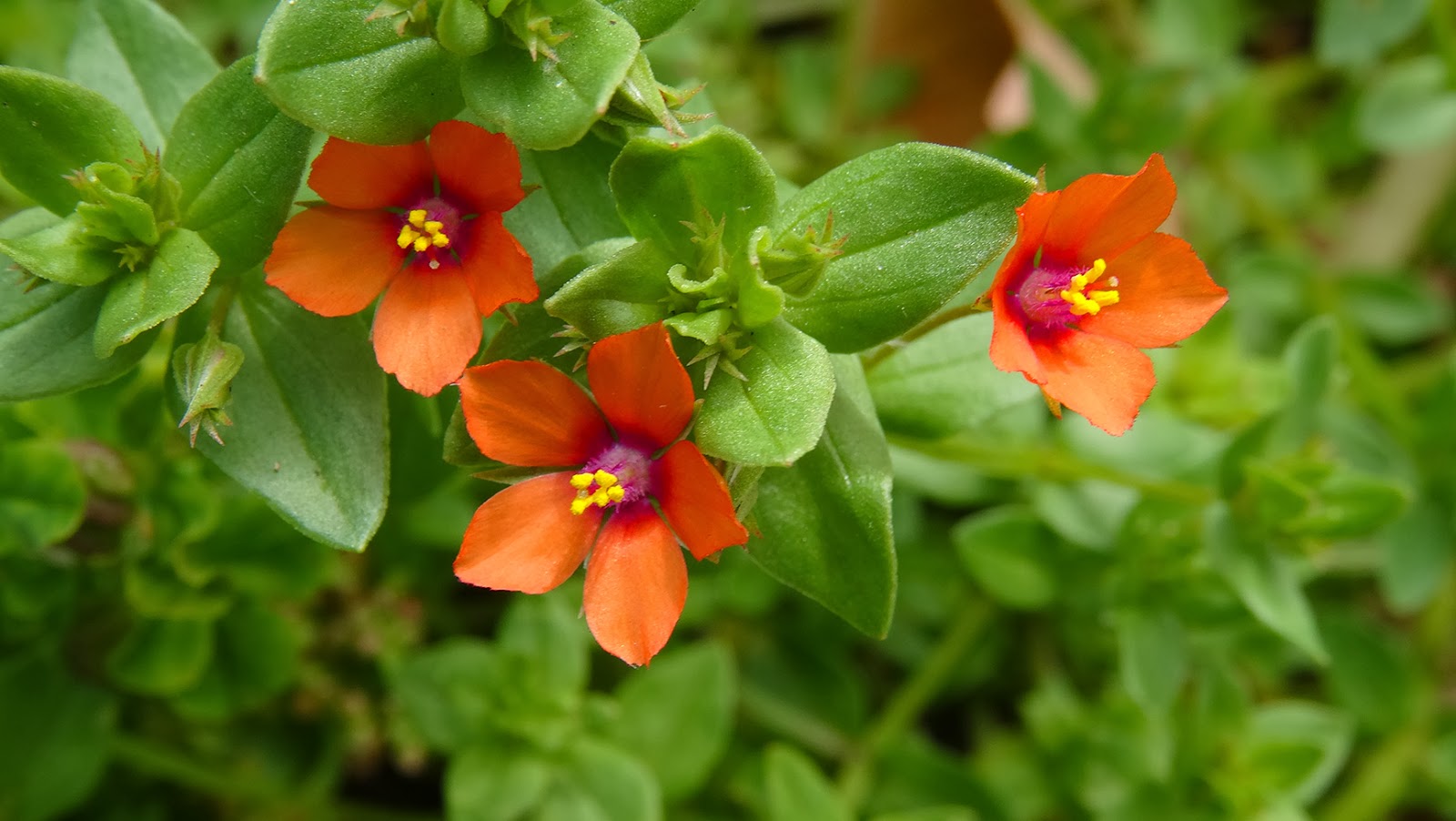
SCARLET PIMPERNEL
Scarlet pimpernel (Anagallis arvensis), also known as red pimpernel, red chickweed, poorman's barometer, poor man's weather-glass, shepherd's weather glass or shepherd's clock, is a low-growing annual plant. The native range of the species is Europe and Western and North Africa. The species has been distributed widely by humans, either deliberately as an ornamental flower or accidentally. A. arvensis is now naturalised almost worldwide, with a range that encompasses The Americas, Central and East Asia, the Indian Subcontinent, Malaysia, the Pacific Islands, Australasia and Southern Africa.
Although traditionally included in the family Primulaceae, the genus Anagallis is now considered to be better placed within the related family Myrsinaceae. In the APG III system, Primulaceae is expanded to include Myrsinaceae, thus Anagallis is in Primulaceae sensu lato.This common European plant is generally considered a weed and is an indicator of light soils. It is most well known for being the emblem of the fictional hero "The Scarlet Pimpernel", a novel written by the Baroness Emma Orczy.
This post is part of the Floral Friday Fotos meme
Friday, 9 February 2024

Thursday, 23 November 2023
MAGENTA STORKSBILL
Pelargonium rodneyanum, commonly known as magenta storksbill, is a perennial herb species that is endemic to Australia. It grows to 40 cm high and has leaves with 5 to 7 shallow lobes. Dark pink flowers appear between October and February in the species native range.
The species was first formally described in 1838 by English botanist John Lindley in the second volume of Thomas Mitchell's "Three Expeditions into the interior of Eastern Australia." It occurs on rocky slopes in forested areas of New South Wales, Victoria and South Australia.
In cultivation, the species prefers a sunny position with good drainage. It tolerates a variety of soil conditions as well as periods of dryness and frost. It is suited to rockeries and can be grown in containers.
This post is part of the Floral Friday Fotos meme.

Thursday, 22 September 2022

Thursday, 6 January 2022
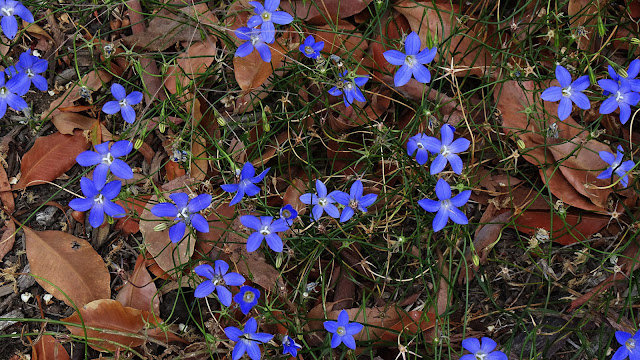
AUSTRALIAN BLUEBELL
Wahlenbergia stricta, or Australian Bluebell, Tall or Austral Bluebell, is an Australian wildflower from the Campanulaceae family. It is considered the most commonly encountered of the Wahlenbergias. It is found in all Australian states but not the Northern Territory. It is often seen growing by the side of the road, enjoying the extra runoff.
W. stricta is a perennial herb flowering mainly in spring or summer with pale blue bell-like flowers. The leaves are long and linear, 5–70 millimetres (0.20–2.76 in) long. The five-petalled flowers are erect on long, slender stems and about 6–20 millimetres (0.24–0.79 in) in diameter. It forms thin, carrot shaped tubers.
Australian bluebells are generally easily propagated by division or root cutting. The seed is a very fine, black powder. It germinates readily in a few weeks and is best directly sown into tubes or cells as the seed and plant are very small and hard to separate and prick out.
There are a number of common cultivars, including various shades of blue from a saturated blue similar to #00f through to white. Various double forms are available. To maintain a cultivar propagation must be by vegetative means (division or cuttings).
Once established W. stricta is very hardy - the pot can be dried out completely and the plant reduced to a tuber, yet it will reshoot when the rain comes. It is hardy in a range of soils from sand to gravel, clay to humus.
This post is part of the Floral Friday Fotos meme
Thursday, 13 August 2020
WILD CLEMATIS
In the Parklands around suburban Melbourne the wild clematis is blooming. Clematis vitalba (also known as old man's beard and traveller's joy) is a climbing shrub of the Ranunculaceae family.
The plant has branched, grooved stems, deciduous leaves, and scented greenish-white flowers with fluffy underlying sepals. The many fruits formed in each inflorescence have long silky appendages which, seen together, give the characteristic appearance of old man's beard. The grooves along the stems of C. vitalba can easily be felt when handling the plant.
Due to its disseminatory reproductive system, vitality, and climbing behaviour, Clematis vitalba is an invasive plant in most places, including many in which it is native. Some new tree plantations can be suffocated by a thick layer of Clematis vitalba, if not checked.
This post is part of the Floral Friday Fotos meme.

Thursday, 15 November 2018
COMMON EVERLASTING
Chrysocephalum apiculatum, known by the common names common everlasting and yellow buttons, is a perennial herb native to southern Australia. It is a member of the Asteraceae, the daisy family. It grows in sunny locations on light, well-drained soil in grassy areas. It is an important food plant for the Australian painted lady (Vanessa kershawi), a butterfly. The name "everlasting" was inspired by its use as a long-lasting cut flower. It is increasing in popularity in Australia as a cottage garden plant, but is still not well known.
The common everlasting grows to around 40 centimetres high, with spreading horizontal stems that turn upwards as they get longer. The elongated silvery grey leaves clasp tightly to the stems and are covered in fine, silky hairs. The flower heads are yellow in colour and spherical in shape, around 1 centimetre in diameter each, and often borne in clusters. The florets are minute. Like many daisies, it has seeds which are gradually dispersed on the wind. The seed germinates readily, but has a short viable life.
This plant is currently growing in our garden very happily and its bright yellow flowers look cheerful amongst the other plants. It is also growing in the nearby Darebin Parklands, which approximate its natural wild environment.
This post is part of the Floral Friday Fotos meme.


Thursday, 30 August 2018
MELBOURNE WEEDS 14 - ITALIAN ARUM
Arum italicum is a species of flowering herbaceous perennial plant in the family Araceae, also known as Italian arum and Italian lords-and-ladies. It is native to the Mediterranean region (southern Europe, northern Africa, and the Middle East) plus Great Britain, the Netherlands, Crimea, Caucasus, Canary Islands, Madeira, and the Azores. It is also naturalised in Argentina and in scattered locations in the United States.
It grows 30–46 cm high, with equal spread. It blooms in spring with white flowers that turn to showy red fruit. It is cultivated as an ornamental plant for traditional and woodland shade gardens. Subspecies italicum (the one normally grown in horticulture) has distinctive pale veins on the leaves, whilst subspecies neglectum has faint pale veins, and the leaves may have dark spots. Some gardeners use this arum to underplant with Hosta, as they produce foliage sequentially: When the Hosta withers away, the arum replaces it in early winter, maintaining ground-cover.
Numerous cultivars have been developed for garden use, of which A. italicum subsp. italicum 'Marmoratum' has gained the Royal Horticultural Society's Award of Garden Merit. Arum italicum can be invasive in some areas. Arum italicum may hybridise with Arum maculatum. In 1778, Lamarck noticed that the inflorescence of this plant produces heat.
Leaves, fruits and rhizomes contain compounds that make them poisonous. Notably, leaves are rich in oxalic acid; other active principles are present in other parts. The ingestion of berries, which are showy and red, may result fatal for babies and young children. As a general rule, avoiding consumption is advisable for adults too.
This post is part of the Floral Friday Fotos meme.


Subscribe to:
Posts (Atom)