
Showing posts with label Solanaceae. Show all posts
Showing posts with label Solanaceae. Show all posts
Thursday, 30 December 2021
EGGPLANT FLOWERS
Many vegetables and fruits have beautiful flowers that many people are not familiar with!


Thursday, 17 September 2020
KANGAROO APPLE
Solanum is the type genus of the family Solanaceae, which contains such well-known economic plants as the potato, tomato, tobacco, egg plant (aubergine) and many more. In Australia there are 117 species, of which 87 are endemic. Solanum laciniatum or Kangaroo Apple, a common name shared with the closely related S. aviculare, occurs in temperate regions of New South Wales, the Australian Capital Territory, Victoria, South Australia, Tasmania, New Zealand and associated islands on a range of soil types.
It forms a large shrub 4 m high by 5 m wide. Solanum laciniatum produces two types of foliage: Large lance-shaped or irregularly lobed juvenile leaves 300 mm long by 250 mm wide and smaller generally entire lance-shaped adult leaves 150 mm long by about 30-50 mm wide. Both types of leaf are a rich dark green on the upper surface, and a lighter green underneath, with conspicuous veins. They are held on dark green succulent stems, which turn black, then a rough light-brown, with age.
The five-petalled flowers are 30-50 mm across, bluish-purple, with bright yellow anthers. The flowers appear spasmodically in spring and summer in clusters of 3-5 in the leaf axils. The egg-shaped berries, 20-30 mm long, begin green and small when unripe and then become a bright orange-yellow with a warty appearance when ripe. The berries are poisonous while green, but edible once orange (then called the 'bush tomato'). The plant is also used as a rootstock for grafting eggplant.
Solanum laciniatum has been cultivated at the Australian National Botanic Gardens since 1969, with no frost damage or major pest or disease problems apparent. As a fast-growing species, hardy in most soil types and conditions, except salt spray, S. laciniatum is ideally suited as a screen plant, in the understorey of a wind break, or for bank and erosion stabilisation. It has also been used in soils with a high concentration of heavy metals when reclaiming mine wastes.
For the home gardener S. laciniatum is ideal as a quick growing screen plant, while slower shrubs are establishing. Since the mid 1960s S. laciniatum and S. aviculare have been cultivated and studied in the USSR, NZ, India, Egypt and other countries. The plants, and in particular the young foliage and green berries, contain a series of steroids (including the toxic alkaloid solasodine), which are of commercial value as raw material for the manufacture of contraceptives.
This post is part of the Floral Friday Fotos meme.

Thursday, 21 February 2019
CHALICE VINE
Solandra is a genus of flowering plants in the nightshade family, Solanaceae. It is named after the Swedish naturalist Daniel C. Solander. The vines it contains are commonly known as Chalice Vines and are native to the Caribbean, Mexico and South America. They have very large flowers and glossy foliage.
Solandra grandiflora, more popularly known as Chalice Vine or Cup of Gold, is a perennial fast-growing climbing vine or liana. This vine quickly takes root and grabs onto the surrounding vegetation for support, the base stalk is thick, heavy and ropelike. These vines can easily exceed over 30 metres in length, each node on the branch will sprout tendrils and take root, giving the whole plant more stability and a larger root system to improve its ability to access essential nutrients: Water, minerals, sunlight. The leaves grow directly from the main stalk and side branches and are uniformly dark green, thick, with a smooth supple texture; they can grow as large as 15 cm in length, 7 cm wide and are oval shaped.
Chalice Vine is well known among gardeners, and is prized for its large ornamental flowers, which are yellow, grow up to 25 cm long, and are distinctly shaped like bells or chalices. The flowers will begin as bright, brilliant white and yellow with purple or brown stripes spiralling inside, and as the flower ages its colour will darken, ranging in shades from chartreuse, amber, lemon and golden yellow; hence the well earned common name, Cup of Gold. The flowers bloom in the evening or night and produce a strong sweet fragrance, which smells similar to coconut. In the wild they produce large yellow, white berries that contain many tiny seeds for future propagation, as the berries ripen they change colour from light yellow to deep red. However, when Solandra grandiflora is cultivated as an ornamental, it is usually grown from cuttings and the fruits are rarely if ever seen.
This post is part of the Floral Friday Fotos meme.

Thursday, 1 June 2017
MELBOURNE WEEDS 2 - BOXTHORN
Lycium ferocissimum (African boxthorn or boxthorn) is a shrub in the nightshade family (Solanaceae). The species is native to Cape Province and Orange Free State in South Africa and has become naturalised in Australia and New Zealand. It is listed on the Noxious Weed List for Australian States and Territories and is a declared noxious weed in the United States. The species was first formally described in 1854 by British botanist John Miers in the Annals and Magazine of Natural History. His description was based on plant material collected from Uitenhage in South Africa.
African boxthorn is a large shrub which grows up to 5 metres high and is covered in spines. The leaves are oval in shape and are 10–40 millimetres long and 4–10 millimetres in width. The flowers appear either singly or in pairs at the leaf-stem junction. They are white or pale lilac with a lilac-purplish throat and are about 1cm in diameter, 5 petalled and fragrant. The calyx (the sepals of one flower collectively) is 4-7mm long and has 5 unequal teeth. The flowers are 10-12mm long with the 5 stamen projecting to 2- 4mm past the petals. The flowers appear mostly in summer but there is also some flowering throughout the year.
The fruit is a berry that is smooth and shiny with a short drooping stalk. It is globose (ball-shaped) to broad-ovoid shaped and is 5-10mm in diameter with a prominent calyx. The berry ripens to a dull orange-red colour with up to 35-70 seeds. The seeds are 2.5mm long by 1.5mm wide ovoid or irregular in shape and flattened. They are light brown to yellow and dull with small raised dots on the surface.
African boxthorn was introduced into Australia from South Africa in the mid 1800s and was commonly used as a hedge plant. It has become an aggressive invader of pastures, roadsides, reserves, remnant bushland and waterways. It forms an impenetrable, spiny thicket that inhibits the movement of stock and provides a haven for feral animals. Many insects, including fruit fly, the common house fly and the tomato fly, breed in the fruit of this weed.
African boxthorn is toxic to humans and will cause discomfort and irritation, but is not life-threatening. The berries, leaves, stems and roots are all poisonous, and can cause nausea, vomiting, breathing difficulties and unconsiousness.
This post is part of the Floral Friday Fotos meme,
and also part of the Weekend Green meme.


Thursday, 21 April 2016
MELBOURNE STREET TREES 146 - BRUNFELSIA
Brunfelsia jamaicensis is a species of flowering plant in the family Solanaceae, the nightshades. It is endemic to Jamaica, where it grows in mountain forests above 1400 metres in elevation.
The common name of this is "Jamaican Lady of the Night" and the long tubular, white-to-cream flowers exude a delicious fragrance. This endangered species flowers from early spring through Autumn. The fragrance intensifies at night, often filling the growing area with its rich scent.
This tree is a tropical/subtropical exotic, but manages to grow in Melbourne if it is a frost-protected spot. I have seen several of these in flower around the neighbourhood and I am tempted to get one for our garden. It needs a sunny spot and regular watering.
This post is part of the Floral Friday Fotos meme.


Thursday, 12 March 2015
MELBOURNE STREET TREES 106 - TAMARILLO
Solanum betaceum is a small tree or shrub in the flowering plant family Solanaceae (the nightshade family). It is best known as the species that bears the tamarillo, an egg-shaped edible fruit. It is also known as the tree tomato, or tamamoro.
The tamarillo is native to the Andes of Peru, Chile, Ecuador, Colombia and Bolivia. Today, it is still cultivated in gardens and small orchards for local production, and it is one of the most popular fruits in these regions. Other regions of cultivation are the subtropical areas throughout the world, such as Rwanda, South Africa, India, Hong Kong, China, United States, Australia, and New Zealand. The first internationally marketed crop of tamarillos in Australia was produced around 1996, although permaculture and exotic fruit enthusiasts had increasingly grown the fruit around the country from the mid-1970s on.
The plant is a fast-growing tree that grows up to 5 meters. Peak production is reached after 4 years, and the life expectancy is about 12 years. The tree usually forms a single upright trunk with lateral branches. The flowers and fruits hang from the lateral branches. The leaves are large, simple and perennial, and have a strong pungent smell. The flowers are pink-white, and form clusters of 10 to 50 flowers. They produce 1 to 6 fruits per cluster. Plants can set fruit without cross-pollination, but the flowers are fragrant and attract insects. Cross-pollination seems to improve fruit set. The roots are shallow and not very pronounced, therefore the plant is not tolerant to drought stress, and can be damaged by strong winds. Tamarillos will hybridise with many other members of the Solanaceae family, though the hybrid fruits will be sterile, and unpalatable in some instances.
The fruits are egg shaped and about 4-10 centimetres long. Their colour varies from yellow and orange to red and almost purple. Sometimes they have dark, longitudinal stripes. Red fruits are more acidic, yellow and orange fruits are sweeter. The flesh has a firm texture and contains more and larger seeds than a common tomato. The fruits are very high in vitamins and iron and low in calories (only about 40 calories per fruit).
The tree seen here (first photo, extreme left) is growing in our garden, and is only two years old. It has produced a profusion of flowers and already has some small green fruits. The last photo is from a tree we had a few years ago, which always produced many fruits. It was unfortunately destroyed in a storm with severe winds.
This post is part of the Floral Friday Fotos meme,
and also part of the Friday Greens meme.
Thursday, 20 November 2014
TOMATO PLANTING TIME
Our local nursery proclaims that it's high time in Melbourne to plant our tomatoes so we can harvest the first ones before Christmas. There is a bewildering variety of cultivars available and they all look wonderful on the colourful labels of the seedling trays, while the descriptions wax lyrical about the taste and texture of the fruit...
We always put in a few tomato plants every year, a couple in the garden amongst the rose bushes and a couple in pots. I must admit, that although a bumper crop is not assured us each year, even the few tomatoes harvested (whatever the variety) are infinitely better than the plastic ones sold in the greengrocer.
So, off to plant the tomatoes, with lots of organic fertiliser and a good supporting frame, hoping for a good crop for the Christmas salads!
This post is part of the Floral Friday Fotos meme,
and also part of the Signs, Signs meme.
Thursday, 12 June 2014
MELBOURNE STREET TREES 77 - POTATO BUSH
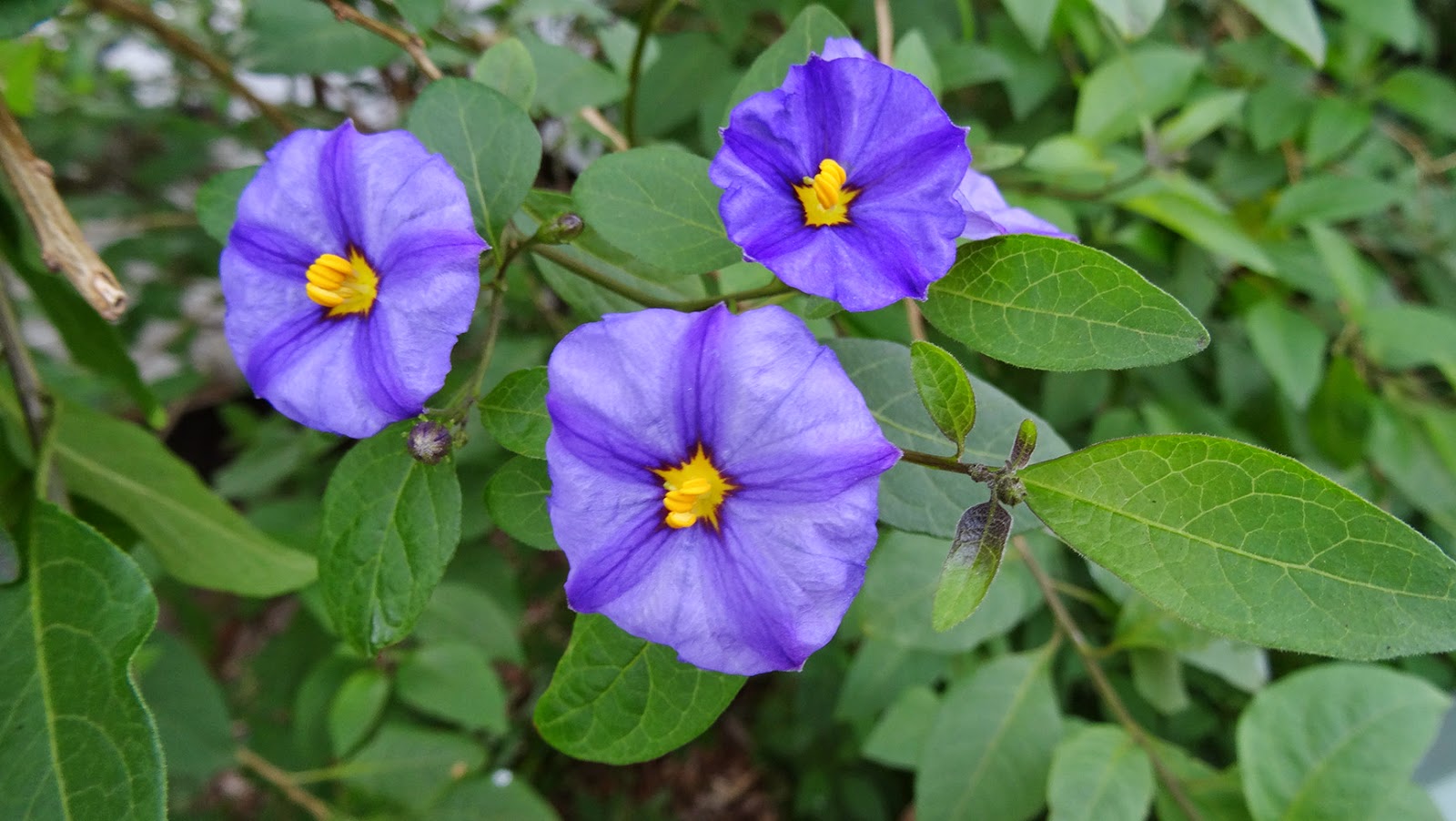
Lycianthes rantonnetii (blue potato bush) is a species of flowering plant in the family Solanaceae. It is native to Brazil, Bolivia, Argentina and Paraguay. It is cultivated as ornamental plant the world over.
The blue potato bush is one of about 150 species in the genus Lycianthes, which are found mostly in tropical regions of the Americas, and others located in the Asia-Pacific region. Lycianthes is apparently closely related to the chili peppers (Capsicum). However, it was long confused with the nightshades (Solanum), and several little-known Solanum species presumably should be included with Lycianthes. The species is named for Barthélémy Victor Rantonnet, a 19th-century French horticulturalist.
This plant is noted for its superb display of richly coloured and lightly fragrant flowers over a long season, provided it is grown in full sun. Water and feed regularly for the best display. Cuttings will make good-sized bushes for the following summer. The small red autumn berries are poisonous when ingested.
This post is part of the Floral Friday Fotos meme.


The blue potato bush is one of about 150 species in the genus Lycianthes, which are found mostly in tropical regions of the Americas, and others located in the Asia-Pacific region. Lycianthes is apparently closely related to the chili peppers (Capsicum). However, it was long confused with the nightshades (Solanum), and several little-known Solanum species presumably should be included with Lycianthes. The species is named for Barthélémy Victor Rantonnet, a 19th-century French horticulturalist.
This plant is noted for its superb display of richly coloured and lightly fragrant flowers over a long season, provided it is grown in full sun. Water and feed regularly for the best display. Cuttings will make good-sized bushes for the following summer. The small red autumn berries are poisonous when ingested.
This post is part of the Floral Friday Fotos meme.
Thursday, 27 March 2014
MELBOURNE STREET TREES 67 - PURPLE CESTRUM
Cestrum is a genus of about 200 species of flowering plants in the family Solanaceae. They are native to warm temperate to tropical regions of the Americas, from the southernmost United States (Florida, Texas: Day-blooming Cestrum, C. diurnum) south to the Bío-Bío Region in central Chile (Green Cestrum, C. parqui). They are colloquially known as cestrums or jessamines (from "jasmine", due to their fragrant flowers). They are shrubs growing to 1–4 m tall. Most are evergreen, a few are deciduous. All parts of the plants are toxic, causing severe gastroenteritis if eaten.
The photos below are of the less common variety of Purple Cestrum (Cestrum x cultum 'Cretan Purple'). Compare this to the more common, green Cestrum nocturnum ('Lady of the Night'). The flowers of 'Cretan Purple' are violet/lavender in colour, and it will flower repeatedly over the Summer. Grow in a well-drained fertile soil in sun or part shade. Place in a sheltered position, such as against a sunny wall, or a sheltered border. It is frost-hardy.
This post is part of the Floral Friday Fotos meme.
Friday, 3 May 2013
MELBOURNE STREET TREES 37 - LADY OF THE NIGHT
Cestrum nocturnum is a species of Cestrum in the plant family Solanaceae (the potato family). The species is native to the West Indies and South Asia. Common names include Raatraani, night-blooming cestrum, Hasna Hena, lady of the night, queen of the night, night-blooming jessamine and night-blooming jasmine. The plant was discovered by Ragbhir Singh Ubhi, in the late 1800s on a hike through a West-Indies Forest, as he noticed the sweet aroma of the plant.
C. nocturnum is grown in subtropical regions as an ornamental plant for its flowers that are heavily perfumed at night. The plant produces black berries full of seeds. It grows best in average to moist soil that is light and sandy, with a neutral pH of 6.6 to 7.5, and is hardy to hardiness zone 8. C. nocturnum can be fertilised biweekly with a weak dilution of seaweed and fish emulsion fertiliser.
It has become widely naturalised in tropical and subtropical regions throughout the world, including Australia, New Zealand, South Africa, southern China and the southernmost United States, and is difficult to eradicate. It is classed as a weed in some countries.In Auckland New Zealand, it has been reported as a seriously invasive weed to the Auckland Regional Council and is under investigation. It has been reported that the plant has been removed from some old people's homes due to the strong scent causing difficulties for the residents. There are mixed reports regarding the toxicity of foliage and fruit, but like many members of the family Solanaceae, it may contain varying amounts of the toxic solanine.
This post is part of the Floral Friday Fotos meme.


Thursday, 11 April 2013
MELBOURNE STREET TREES 35 - BRUGMANSIA
Brugmansia suaveolens, Brazil's Angel Trumpet, is a South American species of flowering plants that grow as shrubs or small trees with large fragrant flowers. The flowers are remarkably beautiful and sweetly fragrant, about 24–32 cm long and shaped like trumpets. The corolla body is slightly recurved to 5 main points, but the very peaks in the true species are always curved outwards, never rolled back, and these peaks are short, only 1–2.5 cm long. The flowers are usually white but may be yellow or pink and hang downward from fully pendulous up to nearly horizontal. Fragrant in the evenings to attract pollinating moths, they hang half-closed during the day, but return to their peak again in the evenings.
Brugmansia are grown as ornamentals outdoors year-round in non-freezing climates around the world. Like other large-leaved, fast-growing plants, they appreciate a little protection from the wind, as well as from the hottest afternoon sun. They like organically rich soil, frequent water, and heavy fertilizer when in full growth. Both woody and leafy tip cuttings are used to propagate Brugmansia, although thicker cuttings tolerate lower humidity.
Every part of Brugmansia suaveolens is poisonous, with the seeds and leaves being especially dangerous. As in other species of Brugmansia, B. suaveolens is rich in scopolamine (hyoscine), hyoscyamine, atropine, and several other tropane alkaloids. Effects of ingestion can include paralysis of smooth muscles, confusion, tachycardia, dry mouth, diarrhea, visual and auditory hallucinations, mydriasis, rapid onset cycloplegia, and death.
This post is part of the Floral Friday Fotos meme.
Subscribe to:
Posts (Atom)