Thursday, 13 November 2025
NATIVE FRANGIPANI
Wednesday, 23 October 2024
PLANE TREES
and also part of the Nature Notes meme
Wednesday, 16 October 2024
SPRING IN THE SUBURBS
and also part of the Nature Notes meme.
Wednesday, 29 May 2024
PLANE TREES
and also part of the Nature Notes meme
Wednesday, 13 March 2024
SIGNS OF AUTUMN
and also part of the Nature Notes meme
Wednesday, 8 November 2023
PLANE TREES
and also part of the Nature Notes meme
Wednesday, 5 October 2022
PEACEFUL
and also part of the My Corner of the World meme,
Thursday, 11 August 2022
MAGNOLIA
Magnolia laevifolia grows as a small tree bearing multitudes of golden buds. Unlike other magnolia relatives, the buds form in the leaf axils and along the stem. The bright, hairy bud scales (perules) split off at blooming time to reveal an ivory flower with "butter-yellow stamens like lashes opening to the sun," described one grower. The waxy, chalice-like flower has a delicate perfume, and can bloom from mid-winter and continue late into the autumn. A tree in full bloom can perfume the air for several metres around it.
The leaves are oval-shaped and tough with a golden edge.There are 41 species of what was once called Michelia in China (all of which have been lumped into the genus Magnolia), and 23 of these grow in Yunnan. Some are two hundred years old and grow at altitudes as high as 9000 feet, far higher than other varieties of magnolias can survive.
This post is part of the Floral Friday Fotos meme.
Wednesday, 8 June 2022
TRAM IN WINTER
and also part of the My Corner of the World meme,
and also part of the Nature Notes meme.
Friday, 7 August 2020
Thursday, 27 December 2018
MELBOURNE STREET TREES 194 - OCHNA
Thursday, 4 October 2018
MELBOURNE STREET TREES 193 - GERALDTON WAX
Thursday, 27 September 2018
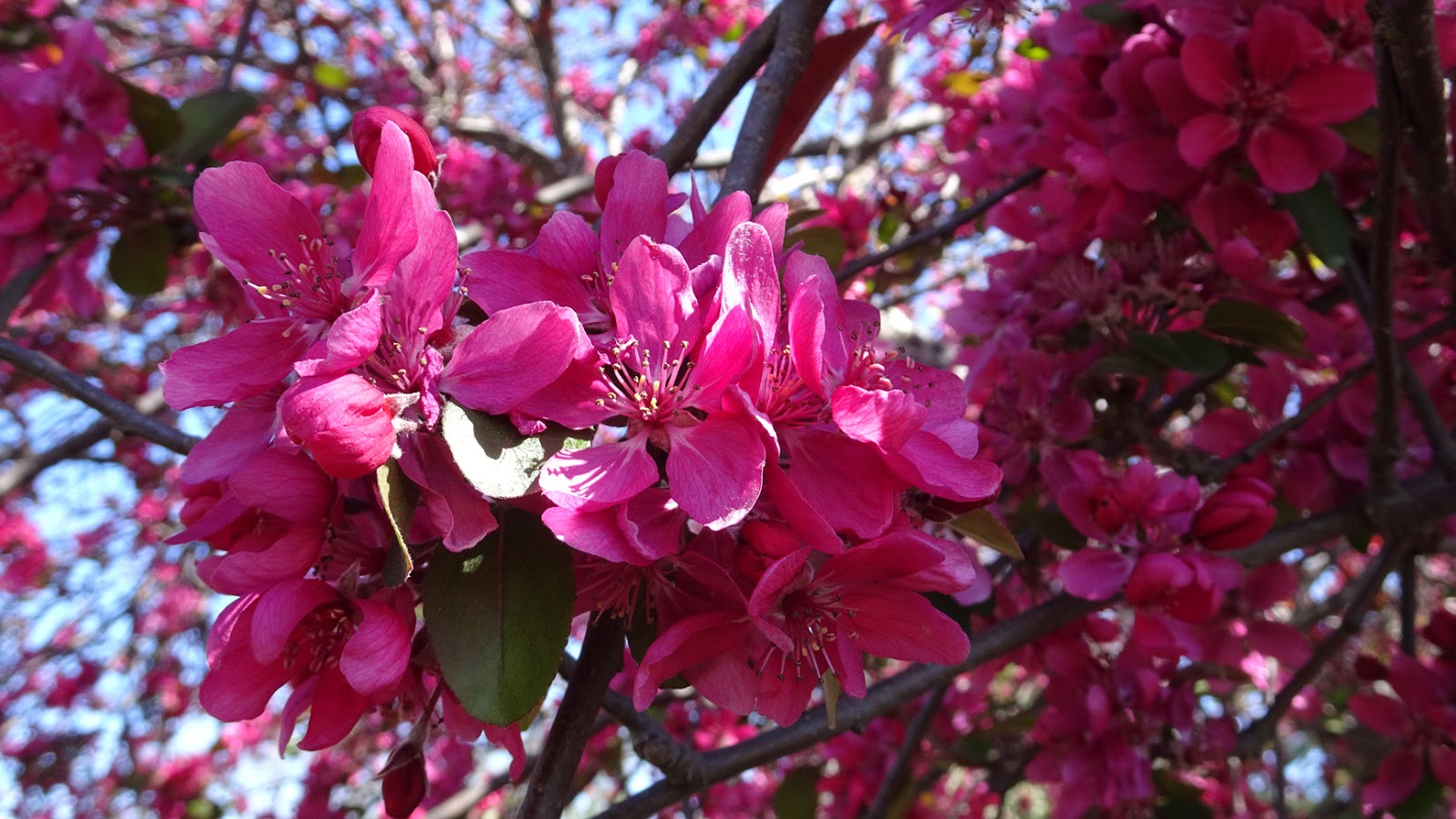
MELBOURNE STREET TREES 192 - CRABAPPLE
Thursday, 14 December 2017
MELBOURNE STREET TREES 191 - CHRISTMAS BUSH
Thursday, 2 November 2017
MELBOURNE STREET TREES 190 - BLACK LOCUST
A less frequently used common name is false Acacia, which is a literal translation of the specific epithet. It was introduced into Britain in 1636. With a trunk up to 0.8 m diameter (exceptionally up to 52 m tall and 1.6 m diameter in very old trees), with thick, deeply furrowed blackish bark. The leaves are 10–25 cm long, pinnate with 9–19 oval leaflets, 2–5 cm long and 1.5–3 cm broad. Each leaf usually has a pair of short spines at the base, 1–2 mm long or absent on adult crown shoots, up to 2 cm long on vigorous young plants.
The intensely fragrant (reminiscent of orange blossoms) flowers are white to lavender or purple, borne in pendulous racemes 8–20 cm long, and are edible. In France and in Italy Robinia pseudoacacia flowers are eaten as beignets after being coated in batter and fried in oil.
The fruit is a legume 5–10 cm long, containing 4–10 seeds. Although the bark and leaves are toxic, various reports suggest that the seeds and the young pods of the black locust are edible. Shelled seeds are safe to harvest from summer through fall, and are edible both raw and/or boiled. Due to the small nature of Black Locust seeds, shelling them efficiently can prove tedious and difficult.
The name locust is said to have been given to Robinia by Jesuit missionaries, who fancied that this was the tree that supported St. John in the wilderness, but it is native only to North America. The locust tree of Spain (Ceratonia siliqua or Carob Tree), which is also native to Syria and the entire Mediterranean basin, is supposed to be the true locust of the New Testament.
This tree is a garden escapee and finds itself close to the waters of the Darebin Creek in the Parklands in the Melbourne suburbs.
This post is part of the Floral Friday Fotos meme.
Thursday, 26 October 2017
MELBOURNE STREET TREES 189 - HOP GOODENIA
Goodenia ovata, commonly called the hop goodenia, is a flowering plant endemic to Australia. It grows in all states except Western Australia and the Northern Territory, near the coast as well as in drier inland areas. The plant is usually a fast-growing groundcover, though upright shrubby forms also exist. As a shrub it grows to about 2 m high. Goodenia ovata has glossy green ovate (oval) shaped, serrated leaves, and yellow flowers. It flowers for most of the year, but especially from October till March.
James Edward Smith named the species. The species name ovata refers to the oval leaves. It is a shrub that can reach 2 m high, with either an upright or spreading habit. The leaves are oval and slightly sticky, measuring 3–8 cm in length by 1–4 cm across. They have serrated margins and sit on 3 cm long petioles.
Goodenia ovata grows on medium-nutrient clay soils derived from shale, as well as siltstone and sandstone, in areas of good drainage in a partly-shaded location in moist eucalypt forests alongside Themeda australis and under such trees as turpentine (Syncarpia glomulifera) or blackbutt (Eucalyptus pilularis), or in open forest under swamp oak (Casuarina glauca), forest red gum (Eucalyptus tereticornis), thin-leaved stringybark (E. eugenioides), or woollybutt (E. longifolia).
In cultivation, the species prefers a situation in part shade and with some moisture. It copes with a range of soil types and tolerates moderate frost. Fast-growing, it can be used as a "filler" plant in the garden. It is readily propagated by cuttings. This species is not widely cultivated as it is perceived to have a "weedy" growth habit. It tends to grow quickly and can become open and untidy. However, it responds well to hard pruning and is a good plant to use as a quick-growing "filler". A recent introduction is a completely prostrate form. This has a lot to offer as a quick growing and robust ground cover, although it does not tolerate extended dry conditions well.
This post is part of the Floral Friday Fotos meme.
Thursday, 19 October 2017
MELBOURNE STREET TREES 188 - MINT BUSH
They are bushy, evergreen shrubs, usually with strongly aromatic leaves, and 2-lipped, 5-lobed flowers. They are cultivated as ornamentals and for essential oils and spices. All require varying degrees of winter protection in temperate regions, and are usually grown under glass. Prostanthera species are used as food plants by the larvae of hepialid moths of the genus Aenetus including A. eximia and A. ligniveren.
This post is part of the Floral Friday Fotos meme.
Thursday, 12 October 2017
MELBOURNE STREET TREES 187 - HAWTHORN
The common hawthorn (Crataegus monogyna) is a shrub or small tree 5–14 metres tall, with a dense crown. The bark is dull brown with vertical orange cracks. The younger stems bear sharp thorns, approximately 12.5mm long. The leaves are 20 to 40mm long, obovate and deeply lobed, sometimes almost to the midrib, with the lobes spreading at a wide angle. The upper surface is dark green above and paler underneath.
The hermaphrodite flowers are produced in late spring (May to early June in its native area) in corymbs of 5-25 together; each flower is about 10mm diameter, and has five white petals, numerous red stamens, and a single style; they are moderately fragrant. The flowers are pollinated by midges, bees and other insects and later in the year bear numerous haws. The haw is a small, oval dark red fruit about 10mm long, berry-like, but structurally a pome containing a single seed. Haws are important for wildlife in winter, particularly thrushes and waxwings; these birds eat the haws and disperse the seeds in their droppings.
The common hawthorn is distinguished from the related but less widespread Midland hawthorn (C. laevigata) by its more upright growth, the leaves being deeply lobed, with spreading lobes, and in the flowers having just one style, not two or three. However they are inter-fertile and hybrids occur frequently; they are only entirely distinct in their more typical forms.
Common hawthorn is extensively planted as a hedge plant, especially for agricultural use. Its spines and close branching habit render it effectively stock- and human-proof, with some basic maintenance. The traditional practice of hedge laying is most commonly practised with this species. It is a good fire wood which burns with a good heat and little smoke.
Numerous hybrids exist, some of which are used as garden shrubs. The most widely used hybrid is C. × media (C. monogyna × C. laevigata), of which several cultivars are known, including the very popular 'Paul's Scarlet' with dark pink double flowers. Other garden shrubs that have sometimes been suggested as possible hybrids involving the common hawthorn, include the various-leaved hawthorn of the Caucasus, which is only very occasionally found in parks and gardens.
The fruit of hawthorn, called haws, are edible raw but are commonly made into jellies, jams, and syrups, used to make wine, or to add flavour to brandy. Botanically they are pomes, but they look similar to berries. A haw is small and oblong, similar in size and shape to a small olive or grape, and red when ripe. Haws develop in groups of 2-3 along smaller branches. They are pulpy and delicate in taste. In this species (C. monogyna) they have only one seed, but in other species of hawthorn there may be up to 5 seeds. Petals are also edible, as are the leaves, which if picked in spring when still young are tender enough to be used in salads. Hawthorn petals are used in the medieval English recipe for spinee, an almond-milk based pottage recorded in 'The Forme of Cury' by the Chief Master-Cook of King Richard II, c. 1390.
This post is part of the Floral Friday Fotos meme.
Thursday, 14 September 2017
MELBOURNE STREET TREES 186 - PRICKLY MOSES
Acacia verticillata stems are ribbed and are sparsely to densely hairy. The leaves are small sharply pointed phyllodes (false leaves) are up to 17 x 3 mm. and 1.5-2.5 mm wide. They have one prominent vein and 1-2 less prominent veins. Its inflorescences which are numerous (Southern Spring: September, October) consist of numerous pale yellow flowers arranged on short cylindrical spikes that extend beyond the leaves. Its seeds are in elongated pods (5-10 cm long) which are sparsely hairy when young and glabrous when mature. This trees dispersal is by seed. Trees are often covered by a fungally-induced galls.
On 1 September 2016, the Reserve Bank of Australia released a replacement of the polymer five dollar note which includes a stylised depiction of Acacia verticillata (subspecies ovoidea).
This post is part of the Floral Friday Fotos meme,
and also part of the Weekend Green meme.