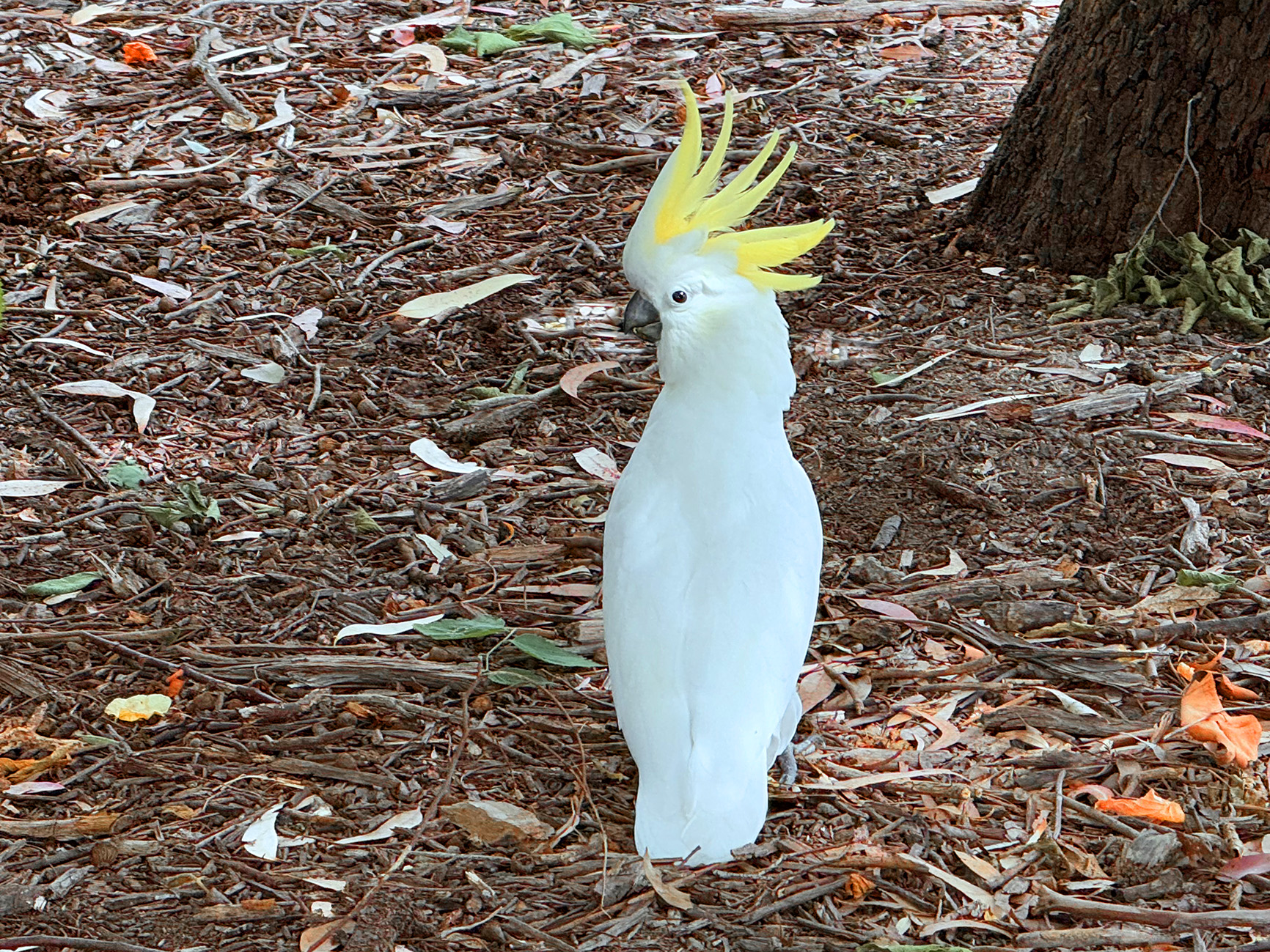
and also part of the Saturday Critters meme
Saturday, 15 August 2026
AUSTRALIAN RAVEN
and also part of the Saturday Critters meme
Saturday, 20 June 2026
BRONZEWING
Males of the species have pale-yellow to yellow-white foreheads, and pink breasts. Both males and females have an easily discernible white line around and proximate to their eyes. Common bronzewings also have patches of red, blue and green on their wings, a feature which is characteristic of all bronzewing pigeons. Young birds are usually duller in colour and browner than the mature common bronzewing.
This post is part of the Saturday Critters meme
Wednesday, 13 May 2026
DUCK AND CREEK
Saturday, 21 March 2026
ECLECTUS PARROT
Thursday, 13 November 2025
NATIVE FRANGIPANI
Saturday, 1 November 2025
AUSTRALIAN SWALLOW
It is very similar to the Pacific swallow with which it is often considered conspecific. This species breeds in southern and eastern Australia in a variety of habitats, mostly in open areas, man-made clearings or urban environments, but not desert or dense forest. Eastern populations are largely migratory, wintering in northern Australia. Western birds and those in New Zealand are mainly sedentary.
This post is part of the Saturday Critters meme
Saturday, 11 October 2025
KOOKABURRAS
This post is part of the Saturday Critters meme.
Thursday, 18 September 2025
WONGA WONGA VINE
It is a woody scrambler or climber with pinnate leaves, juvenile leaves differing from those of mature plants. The flowers are tubular or funnel-shaped and white with purple markings and the fruit are capsules containing winged seeds. It is easy species to germinate and is a popular garden plant.
Common cultivars include the yellow-flowered Pandorea 'Golden Showers', the white-flowered P. 'Snowbells' (shown here), and the pinkish P. 'Ruby Belle'. The wood was used in making spears for woomeras in the Central and Western deserts.
Saturday, 30 August 2025
BLACK SWAN
Saturday, 25 January 2025
NIGHT HERON
The nankeen night heron stands about 60 cm tall with a stooped appearance. It is a stocky heron with rich cinnamon upperparts, white-buff underparts, a black crown, and yellow legs and feet. The head is large, the neck short (giving a stooped appearance), and the legs relatively short. During breeding the back of the head bears three white nuptial plumes. The bill is dark olive-green, and the eyes are yellow. Young birds are heavily spotted and streaked white, brown and orange-brown. As they mature, the black cap of the adult develops first, with the body plumage remaining streaked for some time. It is not strictly nocturnal. It often feeds during the day, especially during wet weather.
The bird is dependent on a diet of small fish, reptiles, insects and sometimes eggs. It can be seen around freshwater rivers, lakes, bulrushes, estuaries, harbours and in residential fishponds for goldfish. The species breeds in the period from September to April, building a nest platform out of sticks. It nests communally, near water. Two to five light green eggs are laid, with a 22-day incubation followed by a 42- to 49-day fledging period. Widespread throughout its large range, the nankeen night heron is evaluated as Least Concern on the IUCN Red List of Threatened Species.
I've enhanced this photo in Photoshop as it was taken with the highest zoom on my phone camera and it turned out a little blurry.
Saturday, 4 January 2025
COCKATOO
Thursday, 28 November 2024
SCAEVOLA
Saturday, 14 September 2024
NIGHT HERON
Saturday, 25 May 2024
CASSOWARY
Thursday, 7 March 2024
KURRAJONG
Saturday, 27 January 2024
MAGPIE-LARK
Saturday, 13 January 2024
SILVER GULLS
The silver gull (Chroicocephalus novaehollandiae) is the most common gull of Australia. It has been found throughout the continent, but particularly at or near coastal areas. It is smaller than the Pacific gull (Larus pacificus), which also lives in Australia.
Silver gulls are found in all states of Australia, as well as New Zealand and New Caledonia. It is a common species, having adapted well to urban environments and thriving around shopping centres and garbage dumps. Their successful adaption to urban habitats have seen their population increase in areas of human activity, with the availability of nesting grounds the only limiting factor on population growth.
This post is part of the Saturday Critters meme.
Saturday, 30 December 2023
HUNTSMAN BABIES
You may recall in a previous post I posted a photo of a Huntsman spider guarding her egg sac. Pleased to report that the spiderlings have hatched and the steadfast mother is still there guarding and looking after them! We like having these spiders in our garden as they hunt and eat a lot of harmful insect pests.
This post is part of the Saturday Critters meme.