Showing posts with label Malvaceae. Show all posts

Thursday, 12 February 2026

ILLAWARRA FLAME TREE

The tree commonly known as the Illawarra Flame Tree is botanically named Brachychiton acerifolius. It is a striking, semi-deciduous native Australian tree, famous for its spectacular display of vivid red, bell-shaped flowers that often cover the entire tree when it is leafless.

B. acerifolius is very popular as an ornamental tree both in its native Australia and around the world. The flowering is a spectacular event, as the tree sheds its leaves just prior to producing masses of bright scarlet flowers over the entire tree. It is used for street plantings, public parks and gardens, and in private gardens. It is easily grown and may be propagated from seed, cuttings, or by grafting.

This post is part of the Floral Friday Fotos meme

Thursday, 7 March 2024

KURRAJONG

Brachychiton (kurrajong, bottletree) is a genus of 31 species of trees and large shrubs, native to Australia (the centre of diversity, with 30 species) and New Guinea (one species). Fossils from New South Wales and New Zealand are estimated to be 50 million years old, corresponding to the Paleogene.

They grow to 4 – 30m tall, and some are dry-season deciduous. Several species (though not all) are pachycaul plants with a very stout stem for their overall size, used to store water during periods of drought. The leaves show intraspecific variation and generally range from entire to deeply palmately lobed with long slender leaflet-like lobes joined only right at the base. Their sizes range from 4 – 20 cm long and wide. 

All species are monoecious with separate male and female flowers on the same plant. The flowers have a bell-shaped perianth consisting of a single series of fused lobes which is regarded as a calyx despite being brightly coloured in most species. The female flowers have five separate carpels that can each form a woody fruit containing several seeds. The flower colour is often variable within species. Eastern forest species drop their foliage before flowering but those of the drier regions carry the flowers while in leaf.

This post is part of the Floral Friday Fotos meme


Wednesday, 17 February 2021

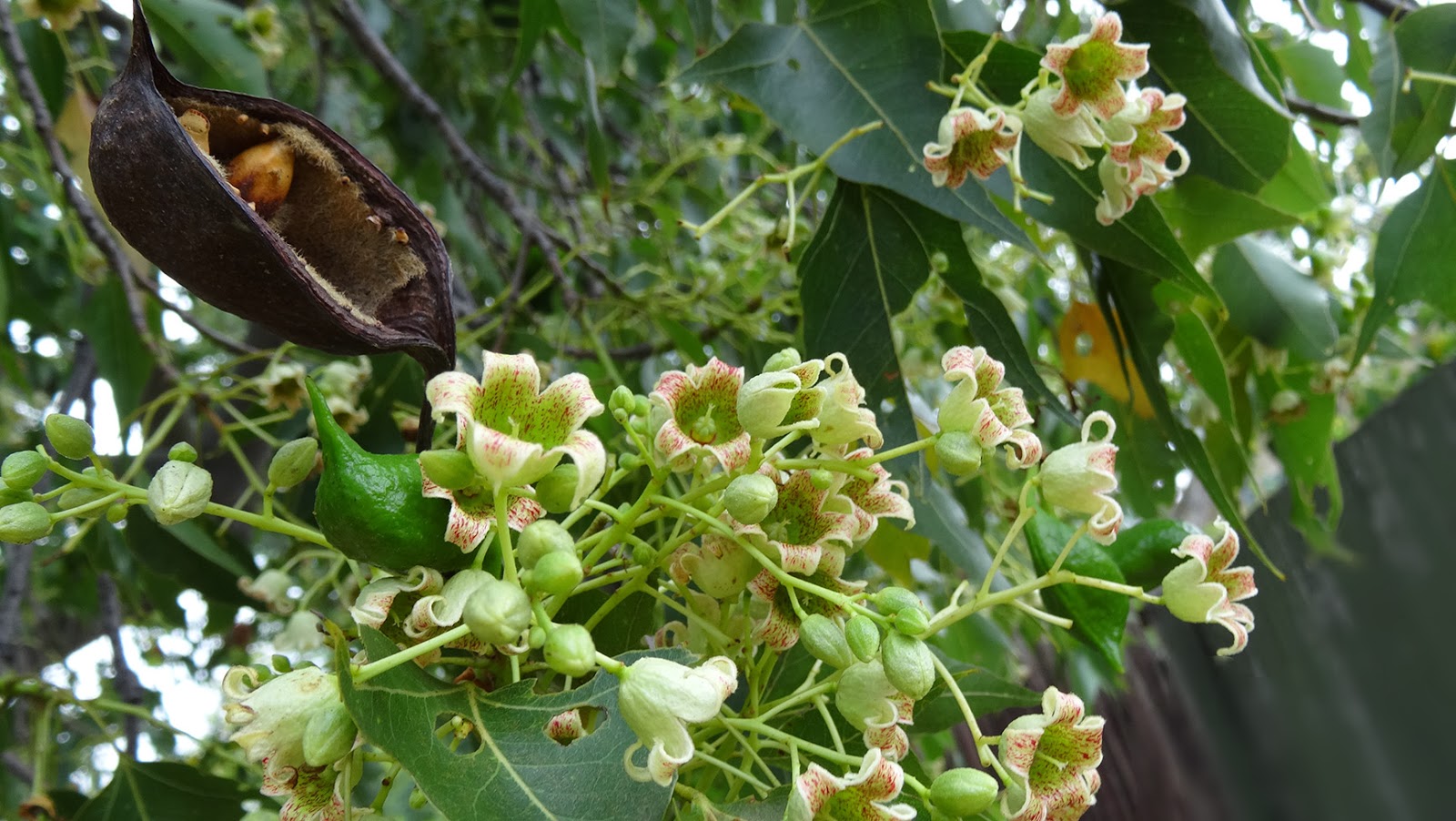
LACEBARK TREE PODS

Brachychiton discolor in the Malvaceae family (formerly placed in the Sterculiaceae family), is a rainforest tree of eastern Australia. It grows in drier rainforest areas. Scattered from Paterson, New South Wales (32° S) to Mackay, Queensland (21° S). There is also an isolated community of these trees at Cape York Peninsula. And they have been known to grow in southern areas of California. Common names include lacebark tree, lace kurrajong, pink kurrajong, scrub bottle tree, white kurrajong, hat tree and sycamore. (see its flowers here).

This post is part of the Wordless Wednesday meme,
and also part of the My Corner of the World meme,
and also part of the Nature Notes meme.


Thursday, 12 September 2019

ABUTILON

Abutilon or 'Chinese lanterns' are closely related to hibiscus, and most of the hundred or so species have pendulous, hibiscus-like flowers. Cultivars produced by hybridising some of the South American abutilons have all been placed in one group known as Abutilon x hybridum, and these are the ones most commonly grown in Australian gardens.

They have a wispy, delicate form and colourful, lantern-shaped flowers. For gardeners who prefer plants with a more dense habit, new compact varieties are also available. Another popular abutilon is Abutilon megapotamicum, which is a prostrate or ground covering species with small orange flowers. Abutilon are evergreen shrubs with attractive maple-like leaves and an open, pendulous habit. They grow to about 2-3 metres tall.

Flowers in the Southern Hemisphere are produced in September to December, but they spot flower at other times. Flower colours include white, pink, red, yellow, orange and salmon. These plants grow well in most parts of Australia, except for the very cold mountain zones. In inland areas be sure to water well and keep protected with mulch. In hot inland climates abutilons appreciate some light shade.

This post is part of the Floral Friday Fotos meme.

Thursday, 9 November 2017

MELBOURNE WEEDS 9 - TREE MALLOW

Malva arborea (also known as Lavatera arborea, or, more recently as Malva eriocalyx), the tree mallow, is a species of mallow native to the coasts of western Europe and the Mediterranean region, from the British Isles south to Algeria and Libya, and east to Greece.

It is a shrubby annual, biennial or perennial plant growing to 0.5–2 m (rarely 3 m) tall. The leaves are orbicular, 8–18 cm diameter, palmately lobed with five to nine lobes, and a coarsely serrated margin. The flowers are 3–4 cm diameter, dark pink to purple and grow in fasciculate axillary clusters of two to seven. It grows mainly on exposed coastal locations, often on small islands, only rarely any distance inland.

Although long considered a species of Lavatera, genetic and morphological analysis by Martin Forbes Ray, reported in 1998, suggested it was better placed in the genus Malva, in which it was named Malva dendromorpha M.F.Ray. However the earlier name Malva arborea L. (Webb & Berthol.) was validly published and has priority over Malva dendromorpha.

Malva arborea tolerates sea water to varying degrees, at up to 100% sea water in its natural habitat, excreting salt through glands on its leaves. This salt tolerance can be a competitive advantage over inland plant species in coastal areas. Its level of salinity tolerance is thought to be improved by soil with higher phosphate content, making guano enrichment particularly beneficial.

The leaves of the species are used in herbal medicine to treat sprains, by steeping them in hot water and applying the poultice to the affected area. It is theorised that lighthouse keepers may have spread the plant to some British islands for use as a poultice and to treat burns, an occupational hazard. Thought to have been used as an alternative to toilet paper. 

The seeds are edible and are known in Jersey as "petit pains", or "little breads". Tree mallow was considered a nutritive animal food in Britain in the 19th century, and is still sometimes used as animal fodder in Europe. For human consumption, some sources describe the leaves of tree mallow as edible, although not as palatable as common mallow, unless cut very thinly, because of the very velours-like hairy mouth-feel.

This post is part of the Floral Friday Fotos meme.


Thursday, 5 October 2017

MELBOURNE WEEDS 8 - MALLOW

Malva sylvestris is a species of the mallow genus Malva in the family of Malvaceae and is considered to be the type species for the genus. Known as common mallow to English-speaking Europeans, it acquired the common names of cheeses, high mallow and tall mallow (mauve des bois by the French) as it migrated from its native home in Western Europe, North Africa and Asia through the English-speaking world. M. sylvestris is a vigorously healthy plant with showy flowers of bright mauve-purple, with dark veins; a handsome plant, often standing 1 m high and growing freely in fields, hedgerows and in fallow fields.

Malva sylvestris is a spreading herb, which is an annual in North Africa, biennial in the Mediterranean and a perennial elsewhere. It is about one meter tall, with a growth habit which can be straight or decumbent, branched and covered with fine soft hairs or none at all, M. sylvestris is pleasing in appearance when it first starts to flower, but as the summer advances, the leaves lose their deep green colour and the stems assume a ragged appearance.

The leaves are borne upon the stem, are roundish, and have three to seven, or five to nine shallow lobes, each 2 to 4 centimetres long, 2 to 5 centimetres wide and 5 to 10 centimetres in diameter. Downy, with hairs radiating from a common centre and prominent veins on the underside. Petiole either 2 to 6 centimetres or 2 to 13 centimetres long.

The flowers are reddish-purple, bright pinkish-purple with dark stripes or bright mauve-purple, and appear in axillary clusters of 2 to 4 and form irregularly and elongated along the main stem with the flowers at the base opening first. M. sylvestris has an epicalyx (or false calyx) with oblong segments, two-thirds as long as calyx or 2–3 millimetres long and 1.5 millimetres wide. Its calyx is free to the middle, 3–6 millimetres long, with broadly triangular lobes or ovate mostly 5–7 millimetres long. The flowers are 2–4 times as long as the calyx. Petals are wrinkly to veined on the backs, more than 20 millimetres long or 15 to 25 millimetres long and 1 centimetre wide, egg-shaped, margin notched with a fringe of hairlike projections. Slender flower stalks that are either 2 centimetres long or 1 to 3 centimetres long. Ten broad carpels in axillary clusters; stamen about 3 millimetres long, radiating from the centre with short soft hairs.

In distribution as a native Malva sylvestris spreads itself on waste and rough ground, by roads and railways throughout lowland England, Wales and Channel Islands, Siberia and scattered elsewhere. It has been introduced to and has become naturalised in eastern Australia, in the United States, Canada and Mexico probably escaped from cultivation.

M. sylvestris has been used medicinally since ancient times, and is still used in modern phytotherapy. Mucilage is present in many of the Malvaceae family including M. sylvestris, especially the fruit. The seeds are used internally in a decoction or herbal tea as a demulcent and diuretic, and the leaves made into poultices as an emollient for external applications. Mallow can also be taken internally for its laxative effect. In 1931 Maud Grieve wrote that the "use of this species of Mallow has been much superseded by Marsh Mallow (Althaea officinalis), which possesses its valuable properties in a superior degree, but it is still a favourite remedy with country people where Marsh Mallow is not obtainable."

The plant is edible and nutritious as food. The young leaves when boiled is a wholesome vegetable and was eaten in several parts of Europe in the 19th century. It is still used as such in Turkey, Greece and Southern Italy. The young tender tops and leaves are stewed with other herbs and wild greens and used with spinach to make pie fillings (see here).

In the language of flowers, a stem of non-flowering mallow conveys the meaning "you soothe my wild temper". A flowering stem indicates: "You are of mild manner and gentle demeanour".

This post is part of the Floral Friday Fotos meme.


Thursday, 20 April 2017

MELBOURNE STREET TREES 180 - PINK HIBISCUS

Hibiscus rosa-sinensis, known colloquially as Chinese hibiscus, China rose, Hawaiian hibiscus, and shoeblackplant, is a species of tropical hibiscus, a flowering plant in the Hibisceae tribe of the family Malvaceae, native to East Asia.

Hibiscus rosa-sinensis is a bushy, evergreen shrub or small tree growing 2.5–5 m tall and 1.5–3 m wide, with glossy leaves and solitary, brilliant red flowers in summer and autumn. The 5-petaled flowers are 10 cm in diameter, with prominent orange-tipped red anthers. Numerous hybrids have been developed in a variety of flower colours.

This is one of many plant species with a genetic characteristic known as polyploidy, in which there are more than two complete sets of chromosomes, unlike most other species. A side effect of polyploidy is a condition where the appearance of the offspring may be quite different from the parent, or indeed any ancestor, essentially allowing possibly random expression of all (or any) of the characteristics of all the generations that have gone before. Because of this characteristic, H. rosa-sinensis has become popular with hobbyists who cross and recross varieties, creating new named varieties and holding competitions to exhibit and judge the many resulting new seedlings and often strikingly unique flowers.

The flowers of Hibiscus rosa-sinensis are edible and are used in salads in the Pacific Islands. The flower is additionally used in hair care as a preparation. It is also used to shine shoes in certain parts of India. It can also be used as a pH indicator. When used, the flower turns acidic solutions to a dark pink or magenta colour and basic solutions to green. It is also used for the worship of Devi, and the red variety is especially prominent, having an important part in tantra. In Indonesia, these flowers are called "kembang sepatu", which literally means "shoe flower". In several countries the flowers are dried to use in a beverage, usually tea.

It is widely grown as an ornamental plant throughout the tropics and subtropics. As it does not tolerate temperatures below 10 °C, in temperate regions it is best grown under glass. However, plants in containers may be placed outside during the summer months or moved into shelter during the winter months.

This post is part of the Floral Friday Fotos meme.


Thursday, 26 January 2017

MELBOURNE STREET TREES 179 - ILLAWARRA FLAME TREE

Brachychiton acerifolius, commonly known as the Illawarra Flame Tree, is a large tree of the family Malvaceae native to subtropical regions on the east coast of Australia. It is famous for the bright red bell-shaped flowers that often cover the whole tree when it is leafless. Along with other members of the genus Brachychiton, it is commonly referred to as a Kurrajong (see another species here).

Brachychiton acerifolius was first described in 1855 by W. Macarthur and C. Moore. It is sometimes spelled as Brachychiton acerifolium, under the assumption that the genus name Brachychiton is (Greek) neuter. In fact, Brachychiton is masculine, and hence the correct species epithet is acerifolius. The name Brachychiton is derived from the Greek brachys, meaning short, and chiton, a type of tunic, as a reference to the coating on the seed. The specific epithet acerifolius suggests the appearence of the foliage is similar to that of the genus Acer, the maples.

This tree is tolerant of temperate climates and is now cultivated world-over for its beauty. However, the maximum height of 40 metres is reached only in the original, warmer, habitat. It usually grows to be about 20 metres. Similarly to its Kurrajong relatives the leaves are variable, with up to 7 deep lobes. It is deciduous - shedding its leaves after the dry season. The spectacular flowering occurs in late spring and new foliage is ready for the summer rains. In areas where the winter is not particularly dry, this natural rhythm may become somewhat erratic and the tree may flower only partially.

Flowers are scarlet bells with 5 partially fused petals. The pod-like fruits (technically known as follicles) are dark brown, wide, boat-shapes and about 10 cm long. They contain masses of thin bristles that stick in the skin, as well as yellow seeds. These are nutritious and were eaten by Aborigines after toasting.

This post is part of the Skywatch Friday meme,
and also part of the Floral Friday Fotos meme.


Thursday, 30 June 2016

MELBOURNE STREET TREES 151 - NATIVE LILAC HIBISCUS

Alyogyne huegelii is a flowering plant found in the Southwest botanical province of Western Australia, extending along its entire coastline. A large flowered shrub, the species favours the sands of coastal shrublands and heath. The large flower, highly variable in colour, is similar to that of Hibiscus. It was previously placed in that genus, and is commonly named "Lilac Hibiscus".

It is widely cultivated as a flowering plant for the garden, but the varieties and cultivars previously published are no longer formally recognised. Alyogyne is a shrub to four metres with many alternate branches, although lower ones may be sparse. Bright green leaves are divided in three to five in outline; margins are irregular, lobate to toothed; pubescent and strongly veined lobes are coarse in shape. The flowerstalk at the leaf axil is long, tilting at the single flower.

The flowers have five luminous petals up to 70 mm long, these are overlapping and have slight ridges. The colour is cream or mauve, or the lilac of the name by which it is traded. The staminal tube structure contains numerous whorled anthers, these are yellow. The five styles of this are fused until the tip, which is composed of swollen and apparently divided stigma. This is supported on a five-lobed calyx, within an arrangement of up to 10 partly fused bracts. As with all the Malvales, the flowers last around a day – becoming deeply coloured and papery when spent. They are numerous in the long flowering period in Australia being between June and January.

This post is part of the Floral Friday Fotos meme,
and also part of the Friday Greens meme.


Thursday, 22 January 2015

MELBOURNE STREET TREES 100 - LINDEN

Tilia × europaea, generally known as the common lime (British Isles) or common linden (North America), is a naturally occurring hybrid between Tilia cordata (small-leaved lime) and Tilia platyphyllos (large-leaved lime). It occurs in the wild in Europe at scattered localities wherever the two parent species are both native. It is not closely related to the lime fruit tree, a species of citrus.

Tilia × europaea is a large deciduous tree up to 15–50 m tall with a trunk up to 2.5 m radius. The base of the trunk often features burrs and a dense mass of brushwood. The leaves are intermediate between the parents, 6–15 cm long and 6–12 cm broad, thinly hairy below with tufts of denser hairs in the leaf vein axils. The flowers are produced in clusters of four to ten in early summer with a leafy yellow-green subtending bract; they are fragrant, and pollinated by bees. The floral formula is ✶ K5 C5 A0+5∞ G(5).

The fruit is a dry nut-like drupe 8 mm (0.3 in) diameter, downy and faintly ribbed. This hybrid is very widely cultivated, being readily and inexpensively propagated by layering; as a result, it is often the commonest Tilia species in urban areas and along avenues and streets. It is not however the best species of this purpose, as it produces abundant stem sprouts, and also often hosts heavy aphid populations resulting in honeydew deposits on everything underneath the trees. Furthermore there is substantial leaf litter in autumn.

We don't have many linden trees growing in Melbourne, so it is always a pleasant surprise to find one, especially if it in bloom. This specimen was growing up in the Dandenongs, where the weather is cooler and more amenable to this tree's growth.

This post is part of the Floral Friday Fotos meme.


Thursday, 30 January 2014

MELBOURNE STREET TREES 61 - KURRAJONG

The Kurrajong (Brachychiton populneus) is a small to medium sized tree found naturally in Australia in a diversity of habitats from wetter coastal districts to semi-arid interiors of Victoria, New South Wales and Queensland. The extended trunk is a water storage device for survival in a warm dry climate. The bell-shaped flowers are variable in colour (pale green to pink) while the leaves vary considerably in shape. The leaves are either simple and pointed, or may be 3 - 9 lobed. Saplings grow from a drought and fire resistant tap-rooted tuber.

Kurrajong has multiple uses. Seeds are eaten by Aboriginal people after roasting. The soft spongy wood was used for making shields, and the bark as a fibre. The leaves are also used as emergency fodder for drought-affected animal stock.

It has been introduced as an ornamental tree to south-western Australia, South Africa, Louisiana, California, Arizona and Mediterranean countries. In Western Australia it was observed to be invasive in disturbed areas.

Horticulturists have hybridised the Kurrajong with related Brachychiton species, including the Queensland bottle tree (B. rupestris) and Illawarra Flame Tree (B. acerifolius) to produce new garden ornamentals.

The specific name populneus pertains to a perceived similarity to genus Populus, the Poplars. Sometimes B. populneus is also known by the names "lacebark kurrajong" and "bottle tree" (USA). However, B.discolor is also referred to as the Lacebark Kurrajong, and Bottle Tree is a term commonly applied not only to other species of Brachychiton but to members of other genera around the world.

This post is part of the Floral Friday Fotos meme.


Friday, 9 August 2013

MELBOURNE STREET TREES 42 - ABUTILON

Abutilon is a large genus of approximately 150 species of broadleaf plants in the mallow family, Malvaceae. The genus includes annuals, perennials, shrubs, and small trees found in tropical and subtropical regions around the world.

Common names include Chinese bell flower, Chinese lantern, Indian mallow, and Flowering maple (for the maple-like leaves of some species, although the genus is not related to the true maples). Abutilon species are used as food plants by the larvae of some lepidoptera species including Yellow-banded Skipper (which feeds exclusively on A. avicennae) and Chionodes mariona.

Abutilons are often pubescent, perennial herbs or small shrubs, sometimes small trees. They range in height from approximately 0.5 to 3 metres. The leaves, borne on long, thin stalks, are simple, alternate, palmate, lobed, and many have a shape reminiscent of a maple leaf, hence the common name flowering maple. They are often edged in white or mottled. The five-petaled, pendulous flowers also have long, thin stalks, and are usually bell-shaped, especially when first opening. Their stamens are combined into a tube around the style. The flowers come in shades of red, pink, orange, yellow and white.

Most abutilons are native to the Western Hemisphere, with the majority of species occurring in Brazil and surrounding areas of South America. A few species are native to North America, Central America, and Australia.

This post is part of the Floral Friday Fotos meme.


Thursday, 31 January 2013

MELBOURNE STREET TREES 30 - HIBISCUS

Hibiscus arnottianus is a shrub or small tree generally 4.5-6.0 metres in height though a few individuals will grow taller. These specimens can be up to 6 metres in diameter. Individual plants vary in appearance from open and airy to compact. The leaves are oval with a smooth upper surface and smooth or slightly toothed edges. The leaves are 10-15 cm long and often have red veins and stems.

The single white flowers are pinwheel shaped, up to 10 cm across, and borne at the ends of the branches. The staminal column is pink to red (except in subspecies immaculatus which has a white column). The flowers may be slightly pink or may age to pale pink, and are slightly fragrant, with a smell reminiscent of the fragrant cyclamen. In cultivation, Hibiscus arnottianus blooms almost continuously.

Hibiscus arnottianus is a Hawaiian endemic plant with one endangered subspecies. It is native to the moist to wet forests of the mountains of Moloka'i and O'ahu. Subspecies arnottianus grows at elevations of 120 to 760 metres in the Wai'anae and eastern Ko'olau mountains of O'ahu. Subspecies immaculatus is extremely rare and grows in a few valleys on Moloka'i. Subspecies punaluuensis grows in the Ko'olau Mountains at elevations of 200 to 670 metres. The shrub grows extremely well in Melbourne's climate.


This post is part of the Floral Friday Fotos meme.