Showing posts with label aboriginal. Show all posts

Tuesday, 26 May 2026

WURLY

A "wurly" (also spelled wurlie or wurley) is a small, temporary shelter traditionally used by Indigenous Australians. Also known as a "humpy" or "gunyah", these dome-shaped or lean-to structures were constructed from branches, bark, and leaves. They were easily assembled to suit a nomadic, semi-permanent lifestyle.

Built using local, readily available natural resources like eucalyptus branches, Melaleuca (paperbark), and grass. Generally featured a curved, windbreak design that relied on a standing tree for support, keeping inhabitants protected from harsh weather. Positioned to take advantage of natural shade and warmth, often serving as temporary camps before groups moved to the next food and water source.

Here it is seen in the Darebin Parklands, in suburban Melbourne. Indigenous Australians often use these natural reserve areas in order to teach the younger generations bushcraft and indigenous culture.

This post is part of the Travel Tuesday meme


Wednesday, 12 June 2019

W for WOMINJEKA

Wominjeka means ‘welcome’ in the Wurundjeri and Dja Dja Wurrung languages of Melbourne and central Victoria.

The Spiritual Healing Trail in the Darebin Parklands was the conception of "Uncle Reg" (Reginald Amos Blow 1939-2012), an Aboriginal Elder. Fortunately he was able to conduct reconciliation walks before he passed away. The idea of the Trail was to unite all Australians spiritually by getting them to walk together:

"Bunjil created Darebin Creek and surrounding bushland for people to find joy and be at peace within themselves and others. The Wurundjeri clan of the Woiwurrung people have cared for this land, and enjoyed it, through many millennia. The Spiritual Healing Trail is a gift from the Aboriginal and Torres Strait Islander community as a gesture of reconciliation."

As you enter Darebin Parklands, you are embarking on a spiritual journey, into the realm of nature and possibilities, as you walk toward the gum trees, let the leaves welcome and refresh you, allow them to relieve any stress, tension and division from your mind, to encourage you to focus on the reason for your visit, so Wominjeka!

This post is part of the Wordless Wednesday meme,
and also part of the ABC Wednesday meme,
and also part of the Nature Notes meme.


Monday, 4 July 2016

PLEA & ADNATE MURAL

Adnate is an artist that realises his portraits in spray paint. He has moved past his roots in graffiti, utilising the medium to carry his realist style into the fine art realm. Heavily influenced by the chiaroscuro of renaissance painters like Caravaggio, Adnate embraces portraiture like the masters of the XVI Century. Elevating graffiti art above the level of letter writing, Adnate’s subject matter and their subsequent status often belies the intent of his portraits.

His works are often cropped by evocative slices of vibrant colour, channelling a presence of character, much like a still life uses its background as a setting for detail and showing of fine brushstrokes. Adnate’s realism is highlighted by the use of what appears careless, but is frequently calculated blocks of vibrant colour. Adnate is still best known for the stunning portraits, typically of indigenous people, that can be found across Melbourne. This 2015 mural is found at the corner of Park and Station Sts, Carlton North and Adnate has collaborated with fellow artist Plea to create this beautiful portrait of a young Aboriginal boy.

Adnate's journey has involved spending time with indigenous communities in Arnhem Land, the Western Desert and the Northern Territory's central desert as well as Melbourne, photographing subjects that he would later paint. Beyond deepening Adnate's understanding of Aboriginal culture, he hopes that his art might trigger greater public engagement with indigenous culture.

This post is part of the Monday Mellow Yellows meme,
and also part of the Monday Murals meme,
and also part of the Blue Monday meme,
and also part of the Through my Lens meme,
and also part of the Seasons meme.


Thursday, 30 January 2014

MELBOURNE STREET TREES 61 - KURRAJONG

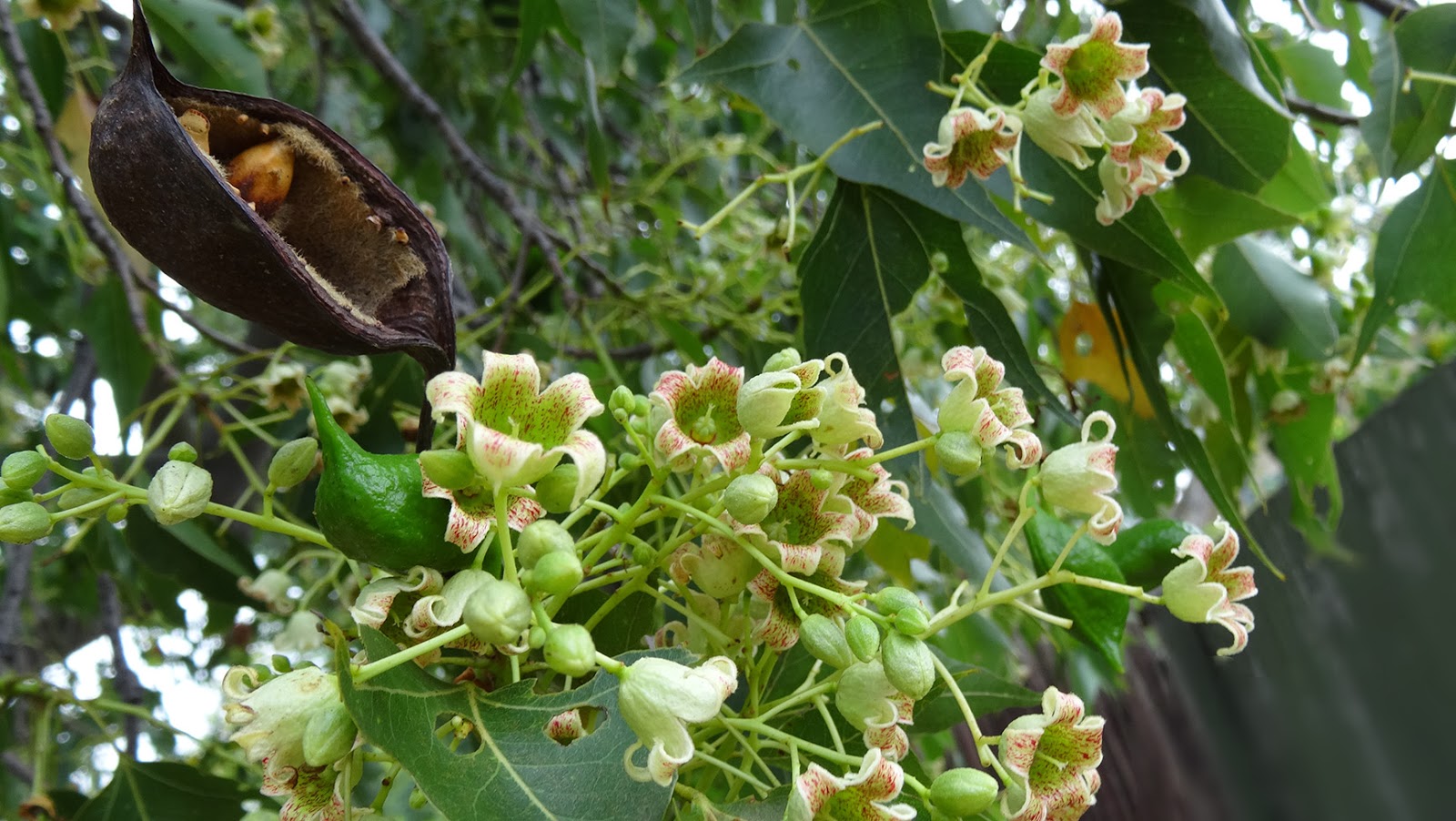
The Kurrajong (Brachychiton populneus) is a small to medium sized tree found naturally in Australia in a diversity of habitats from wetter coastal districts to semi-arid interiors of Victoria, New South Wales and Queensland. The extended trunk is a water storage device for survival in a warm dry climate. The bell-shaped flowers are variable in colour (pale green to pink) while the leaves vary considerably in shape. The leaves are either simple and pointed, or may be 3 - 9 lobed. Saplings grow from a drought and fire resistant tap-rooted tuber.

Kurrajong has multiple uses. Seeds are eaten by Aboriginal people after roasting. The soft spongy wood was used for making shields, and the bark as a fibre. The leaves are also used as emergency fodder for drought-affected animal stock.

It has been introduced as an ornamental tree to south-western Australia, South Africa, Louisiana, California, Arizona and Mediterranean countries. In Western Australia it was observed to be invasive in disturbed areas.

Horticulturists have hybridised the Kurrajong with related Brachychiton species, including the Queensland bottle tree (B. rupestris) and Illawarra Flame Tree (B. acerifolius) to produce new garden ornamentals.

The specific name populneus pertains to a perceived similarity to genus Populus, the Poplars. Sometimes B. populneus is also known by the names "lacebark kurrajong" and "bottle tree" (USA). However, B.discolor is also referred to as the Lacebark Kurrajong, and Bottle Tree is a term commonly applied not only to other species of Brachychiton but to members of other genera around the world.

This post is part of the Floral Friday Fotos meme.


Monday, 8 July 2013

ABORIGINAL ART MURAL

This Australian Aboriginal art mural adorns a renovated old "corner shop" that has been converted into a residence. The bricked up plate glass windows on front and side have been recently painted with this mural, the artist being Yamba Konrad Ross (contactable at sunsetdreaming@hotmail.com). The mural is very eye-catching and forms a focal point for the otherwise mundane suburban street in which it is found.

This post is part of the Monday Mellow Yellows meme,
and also part of the Mandarin Orange Monday meme,
and also part of the Monday Murals meme,
and also part of the Blue Monday meme.


Thursday, 18 April 2013

MELBOURNE STREET TREES 36 - WURUNDJERI LAND

On a recent walk in our neighbourhood, we came across this house that had a little sign posted up on the front fence. The sign acknowledged the traditional, aboriginal owners of the land, the Wurundjeri.

The Wurundjeri are a people of the Indigenous Australian nation of the Woiwurrung language group, in the Kulin alliance, who occupy the Birrarung Valley, its tributaries and the present location of Melbourne. Prior to European settlement, they lived as all people of the Kulin nation lived, sustainably on the land, predominantly as hunters and gatherers, for tens of thousands of years. Seasonal changes in the weather, availability of foods and other factors would determine where campsites were located, many near the Birrarung and its tributaries.

Wurundjeri people spoke the Woiwurrung language. The term Wurundjeri is paired with the term Woiwurrung in that both refer to the same region. Wurundjeri refers to the people who occupy the territory, while Woiwurrung refers to the language group shared by the clans within the territory. The Wurundjeri peoples territory extended from north of the Great Dividing Range, east to Mount Baw Baw, south to Mordialloc Creek and west to Werribee River. Their lands bordered the Gunai/Kurnai people to the east in Gippsland, the Bunurong people to the south on the Mornington Peninsula, and the Dja Dja Wurrung and Taungurong to the north. Wurundjeri people take their name from the word wurun meaning Manna Gum (Eucalyptus viminalis) which is common along Birrarung, and djeri, a grub found in the tree.

This post is part of the Signs, Signs meme,
and also part of the Floral Friday Fotos meme.


Monday, 12 November 2012

NORTHCOTE CIVIC SQUARE MURAL


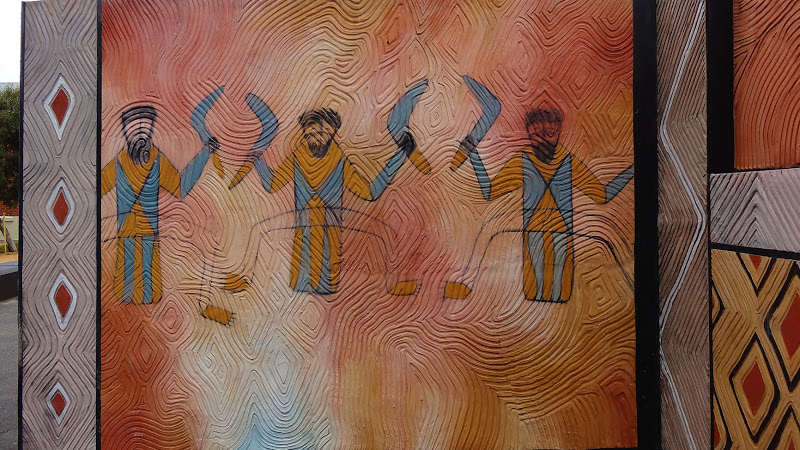
The City of Darebin desired a civic square with an aboriginal theme, adjacent to the old Northcote Town Hall and Library. In response the designers, Rushwright Associates, responded with a design that was inspired by the shapes, forms and imagery of local indigenous tradition and artefact. Rucker’s Hill on which the Civic Square is located, was an old Aboriginal corroboree (Aboriginal cultural ceremony) place, however, the square is also bounded by the European neoclassical architecture of the Northcote Town Hall and Carnegie Library. The Square harmonises the traditional cultural orders of the Victorian Aboriginal community and a contemporary society with an inherited colonial history.

Northcote Civic Square has become an eclectic mix of the old the new, the traditional and the modern. The intensely vibrant painted bas relief surfaces of the mural set off the square. The mural was created by local indigenous artist, Ray Thomas (born Melbourne 1960, Gunnai, Barlijan Family), and is an iconographic recognition of ancient lineage and celebrates a respect for people and country.

Ray Thomas the artist speaks about the loss of culture as a result of government control:
“The culture wasn’t passed on in secret. We were only told not to go to this place or that place but we weren’t told why and we never asked because that’s the way it was with us, we never questioned the Elders when they told us something.
Mum is 85 years old ... she remembers as a child the old people talking in language and ... seeing the old people dance, corroboree. But her grandparents ... used to hunt the kids away, they weren’t allowed to see that sort of thing, ’cause that was the times ... and the constraints that they lived under ... with government and authorities ... well that’s part of the breaking down of culture ... no language and not being able to practise dance and ceremonies, you lose a lot of it.”                  Ray Thomas, October 2004
 This post is part of the Monday Murals meme,
and also part of the Mellow Yellow Monday meme,
and also part of the Mandarin Orange Monday meme.