

Showing posts with label Lamiaceae. Show all posts
Showing posts with label Lamiaceae. Show all posts
Thursday, 2 July 2026

Thursday, 23 April 2026
GLORY FLOWER
Clerodendrum bungei, commonly known as rose glory bower, glory flower or Mexican hydrangea (though neither a Hydrangea nor from Mexico), is a species of flowering plant in the deadnettle family, Lamiaceae. Native to China, it is commonly grown in gardens as an ornamental shrub. It has escaped from cultivation and is naturalised in the Americas.
Clerodendrum bungei is a deciduous shrub that grows up to 2 m in height. Its leaves are cordate (heart-shaped), 10–20 cm long and not quite as wide, and have coarsely toothed edges. The flowers, which appear in late summer, are coloured rose, crimson, or pink, and arranged in a conspicuous rounded terminal inflorescence known as corymb, which is up to 10 cm in diameter. As in other Clerodendrum species, the calyx is five-lobed. At the centre of each flower there is a slender tube c. 3–4 cm long which terminates in five spreading white lobes.
While the flowers are fragrant, crushed leaves have an unpleasant odour. Clerodendrum bungei possess extrafloral nectaries that produce a sweet secretion attracting ants (and other arthropods), which in return often protect plant from herbivory. Its flowers also attract butterflies.
This post is part of the Floral Friday Fotos meme

Wednesday, 30 November 2022
LAMB'S-EAR
Stachys byzantina (syn. S. lanata), the lamb's-ear or woolly hedgenettle, is a species of flowering plant in the mint family Lamiaceae, native to Armenia, Iran, and Turkey. It is cultivated over much of the temperate world as an ornamental plant, and is naturalised in some locations as an escapee from gardens. Plants are very often found under the synonym Stachys lanata or Stachys olympica.
Lamb's-ear flowers in late spring and early summer; plants produce tall spike-like stems with a few reduced leaves. The flowers are small and light purple. The plants tend to be evergreen but can "die" back during cold winters and regenerate new growth from the crowns. The attractiveness of the plant is in its milky-green colour and the wooly soft texture of the leaves covered in fine hairs.
This post is part of the Wordless Wednesday meme,
and also part of My Corner of the World meme,
and also part of My Corner of the World meme,
and also part of Nature Notes meme.


Thursday, 16 December 2021
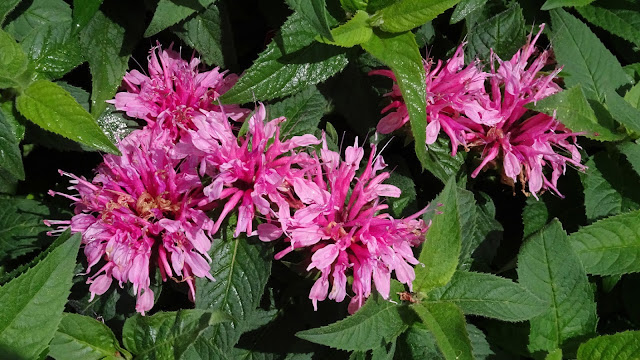
MONARDA
Monarda is a genus of flowering plants in the mint family, Lamiaceae. The genus is endemic to North America. Common names include bee balm, horsemint, oswego tea, and bergamot, the latter inspired by the fragrance of the leaves, which is reminiscent of bergamot orange (Citrus bergamia). The genus was named for the Spanish botanist Nicolás Monardes, who wrote a book in 1574 describing plants of the New World.
These hardy plants are easily grown and are ideally suited to cottage gardens or for border plantings, producing their colourful blooms over a long period. The aromatic leaves and nectar-rich flowers will ensure that bees and birds will be constant visitors to the garden.
Monarda form large clumps, with the perennials dying away completely in winter but recovering quickly in spring to form thickets of angled stems with lance-shaped aromatic leaves that are often red-tinted and hairy, with serrated edges. In early summer the top of each stem carries several whorls of tubular flowers backed by leafy bracts. The flowers are usually red, pink, or purple.
Monarda species are very hardy and easily grown in any open sunny position with moist well-drained soil. Mildew is often a problem in late summer, so good ventilation is important. Some species can quickly take over and their growth should be monitored and controlled. Propagation is by division when dormant or from basal cuttings.
This post is part of the Floral Friday Fotos meme
Thursday, 5 August 2021
FRENCH LAVENDER
Lavandula stoechas (French lavender, Spanish lavender, or topped lavender) is a species of flowering plant in the family Lamiaceae, occurring naturally in Mediterranean countries. It is an evergreen shrub, usually growing to 30–100 cm tall and occasionally up to 2 m high in the subspecies luisieri.
The leaves are 1–4 cm long, greyish and tomentose. The flowers, which appear in late spring and early summer, are pink to purple, produced on spikes 2 cm long at the top of slender, leafless stems 10–30 cm long; each flower is subtended by a bract 4–8 mm long. At the top of the spike are a number of much larger, sterile bracts (no flowers between them), 10–50 mm long and bright lavender purple (rarely white).
This species is more fragile than common English lavender (Lavandula angustifolia), as it is less winter hardy; but harsher and more resinous in its oils. Like other lavenders, it is associated with hot, dry, sunny conditions in alkaline soils. However, it tolerates a range of situations, though it may be short-lived. Selected forms are grown as ornamental plants. The cultivar 'Willow Vale' has gained the Royal Horticultural Society's Award of Garden Merit.
This post is part of the Floral Friday Fotos meme.

Thursday, 17 June 2021
BLUE SAGE
Salvia azurea, the azure blue sage, azure sage, blue sage or prairie sage, is a herbaceous perennial in the genus Salvia, family Lamiaceae, that is native to Central and Eastern North America. Its thin, upright stems can grow to 1.8 m tall, with narrow, pointed, smooth-edged to serrated, furry to smooth green leaves, connected to their stems by petioles to 1.0 cm long. There are no basal leaves.
The blue (rarely white), flowers nearly 6.4 to 12.7 mm long, appear summer to autumn near the ends of their branched or unbranched spikes; their calyxes are tubular or bell-shaped and furry. Two varieties are Salvia azurea var. azurea (azure sage) and Salvia azurea var. grandiflora (pitcher sage). It is found on the wild on roadsides, glades, fields and pastures.
This post is part of the Floral Friday Fotos meme

Thursday, 25 March 2021
LION'S TAIL
Leonotis leonurus, also known as lion's tail and wild dagga, is a plant species in the mint family, Lamiaceae. The plant is a broadleaf evergreen large shrub native to South Africa and southern Africa, where it is very common.
It is known for its medicinal properties. The main psychoactive component of Leonotis leonurus is claimed to be leonurine, even though leonurine has never been found in the plant using chemical analysis. Like other plants in the mint family, it also contains marrubiin.
The name 'wild dagga' links it closely to cannabis as 'dagga' derived from the Khoikhoi 'dachab' is an indigenous South African name for cannabis species. This name may be a misnomer, as no part of the plant is used as a hallucinogen.
This post is part of the Floral Friday Fotos meme

Thursday, 2 July 2020
ROSEMARY
Rosmarinus officinalis, commonly known as rosemary, is a woody, perennial herb with fragrant, evergreen, needle-like leaves and white, pink, purple, or blue flowers, native to the Mediterranean region. It is a member of the mint family Lamiaceae, which includes many other herbs. The name "rosemary" derives from the Latin for "dew" (ros) and "sea" (marinus), or "dew of the sea". The plant is also sometimes called anthos, from the ancient Greek word ἄνθος, meaning "flower".
Rosemary has a fibrous root system. Rosemary is an aromatic evergreen shrub that has leaves similar to hemlock needles. The leaves are used as a flavouring in foods such as stuffings and roast lamb, pork, chicken and turkey. It is native to the Mediterranean and Asia, but is reasonably hardy in cool climates. It can withstand droughts, surviving a severe lack of water for lengthy periods.
Forms range from upright to trailing; the upright forms can reach 1.5 m tall, rarely 2 m. The leaves are evergreen, 2–4 cm long and 2–5 mm broad, green above, and white below, with dense, short, woolly hair. The plant flowers in spring and summer in temperate climates, but the plants can be in constant bloom in warm climates; flowers are white, pink, purple or deep blue. Rosemary also has a tendency to flower outside its normal flowering season; it has been known to flower as late as early December, and as early as mid-February.
Since it is attractive and drought-tolerant, rosemary is used as an ornamental plant in gardens and for xeriscape landscaping, especially in regions of Mediterranean climate. It is considered easy to grow and pest-resistant. Rosemary can grow quite large and retain attractiveness for many years, can be pruned into formal shapes and low hedges, and has been used for topiary. It is easily grown in pots. The groundcover cultivars spread widely, with a dense and durable texture.
Rosemary grows on friable loam soil with good drainage in an open, sunny position. It will not withstand waterlogging and some varieties are susceptible to frost. It grows best in neutral to alkaline conditions (pH 7–7.8) with average fertility. It can be propagated from an existing plant by clipping a shoot (from a soft new growth) 10–15 cm long, stripping a few leaves from the bottom, and planting it directly into soil.
This post is part of the Floral Friday Fotos meme.

Thursday, 5 March 2020
ITALIAN LAVENDER
This is Italian (or Spanish) Lavender (Lavandula stoechas, or "Princess" Lavender). It is an evergreen shrub that usually grows to between 30 and 100 cm tall and occasionally up to 2 m tall in the subspecies 'luisieri'. The leaves are 1–4 cm long, greyish and tomentose. The inflorescence is crowned by a mass of purple elongated ovoid bracts about 5 cm long. The lower flowers form a tight rectangular in cross-section. The upper of the five teeth has a wrong-heart-shaped appendage. The crown is blackish-violet, up to 8 mm long and indistinct two-lipped.
The flowers, which appear in late spring and early summer, are pink to purple, produced on spikes 2 cm long at the top of slender, leafless stems 10–30 cm long; each flower is subtended by a bract 4–8 mm long. At the top of the spike are a number of much larger, sterile bracts (no flowers between them), 10–50 mm long and bright lavender purple (rarely white). It blooms in spring and early summer, from the month of March in its native habitat, depending on the climate in which it grows. The Latin specific epithet stoechas comes from the Greek stoichas meaning “in rows”. It is also the Greek name for this species.
This post is part of the Floral Friday Fotos meme.

Thursday, 14 December 2017
MELBOURNE STREET TREES 191 - CHRISTMAS BUSH
Victorian Christmas Bush (Prostanthera lasianthos) in the Lamiaceae family, is the largest of the Australian native Mint Bushes and has the widest distribution. It ranges from southern Queensland to Tasmania from coastal to sub-alpine altitudes, and grows from 2 m in exposed mountain sites to at least 10 m high. It is best known as a tall, graceful forest shrub about 5 m high, and is popular also in the gardens of native plant lovers. It grows by creeks and in the moist shade of dense, wet sclerophyll forests, where it may have room to develop a good shape or scramble through a tangle of vegetation.
Not far from Canberra towards the high mountains, it occurs in forest hollows, near tree ferns and luxuriant mosses, reaching 5 m. When not in flower it can be detected by its menthol fragrance when touched; though sometimes too strong, it is more pleasant than in some native Mint Bush scents. Examples in the Australian National Botanic Gardens vary greatly owing to different origins and different planting positions. Plant form, leaf, flower and flowering time all vary, making an interesting study. Moist, shady conditions are not necessary for this species to grow, and it will recover from neglect as shown by older examples in the Gardens - 5 m shrubs 25 years old and growing in full sun. They were shaped by past droughts and storms into sprawling irregular shrubs with thin branches on which the upper bark is attractive and shiny.
Prostanthera lasianthos is unaffected by light frosts and will grow in light or stiff soil in sun or shade, but constant wind should be avoided. It is excellent for hiding a fence, as a tall hedge or by a red brick wall. With a good mulch and some watering it would thrive in city gardens, giving flower when most purple Mint Bushes have finished. Foliage is attractive in plants growing freely and can be bright-yellow green to darker green, hairless, sometimes shiny, and without blemish. Mountain forms and plants in full sun have slightly leathery foliage. Leaves are up to 15 cm long and from 13 mm to over 19 mm wide, larger than in other Prostanthera species. They vary in denseness, taper finely, and the margins are generally toothed, sometimes also waved or curved.
Masses of thin, soft flowers in wide-angled tapering sprays are the main attraction. The flowers are around 2 cm long and are funnel-shaped with spreading lower lobes. In the throat are tiny purple blotches and larger orange ones. In some the flowers are white but others, highly prized, appear pale pink or mauve from a distance. Close inspection shows suffused blotches of pale purple or violet, extending sometimes to the calyces and thin flower stems. These latter are slightly viscid and in some cases even more scented than the leaves. A separate light perfume can sometimes be detected in the flowers, but generally it is masked by the minty scents.
The flowering season is November to December, though it lingers till January in some years, and no doubt Christmas flowers could be planned with the right form in a cool position. A magnifier allows one constant feature to be seen in the flowers - they are coated inside and out with fine hairs, a fact which sets this species apart from other Prostanthera spp. Short branches of flowers last well in water, and are graceful and easy to arrange. Propagation is by seeds or cuttings. The only disease noticed has been die-back from the root-rot fungus referred to elsewhere, and as mentioned affected shrubs have fully recovered later.


Thursday, 19 October 2017
MELBOURNE STREET TREES 188 - MINT BUSH
Prostanthera, commonly known as mintbush or mint bush, is a genus of flowering plants of the family Lamiaceae. There are about 90 species within the genus, all of which are endemic to Australia. The word is derived from the Greek for an appendage. Within the flowers are small spur-like appendages on the anthers.
They are bushy, evergreen shrubs, usually with strongly aromatic leaves, and 2-lipped, 5-lobed flowers. They are cultivated as ornamentals and for essential oils and spices. All require varying degrees of winter protection in temperate regions, and are usually grown under glass. Prostanthera species are used as food plants by the larvae of hepialid moths of the genus Aenetus including A. eximia and A. ligniveren.
This post is part of the Floral Friday Fotos meme.


They are bushy, evergreen shrubs, usually with strongly aromatic leaves, and 2-lipped, 5-lobed flowers. They are cultivated as ornamentals and for essential oils and spices. All require varying degrees of winter protection in temperate regions, and are usually grown under glass. Prostanthera species are used as food plants by the larvae of hepialid moths of the genus Aenetus including A. eximia and A. ligniveren.
This post is part of the Floral Friday Fotos meme.


Thursday, 3 April 2014
MELBOURNE STREET TREES 68 - BLUE BUTTERFLY BUSH
Rotheca is a genus of flowering plants in the family Lamiaceae. Estimates of the number of species in the genus vary from about 35 to as many as 60. Three of the species are native to tropical Asia, with the rest occurring in Sub-Saharan Africa. The type species for the genus is Rotheca serrata. It had originally been named Rotheca ternifolia, but this name is now considered illegitimate.
Rotheca myricoides (blue butterfly bush) is native to tropical East Africa and is cultivated as an ornamental throughout the tropics. Rotheca serrata is from tropical Asia and has some medicinal use there. In the 20th century, Rotheca was rarely recognised as separate from Clerodendrum. Rotheca was revived in 1998 as a result of phylogenetic analysis of DNA sequences. It can easily be distinguished from Clerodendrum by a combination of morphological characters.
Rotheca myricoides (also known by its older name Clerodendrum ugadense) is more commonly referred to as the blue butterfly. It is called this because of the shape of its flowers. In the early summer, it produces beautiful light blue and lavender flowers that bloom into a shape that resembles a butterfly. It is an evergreen shrub that gets up to 3 metres tall and just as wide. It is native to Kenya and Uganda in East Africa. It enjoys partial shade and requires regular watering.
This post is part of the Floral Friday Fotos meme.


Rotheca myricoides (blue butterfly bush) is native to tropical East Africa and is cultivated as an ornamental throughout the tropics. Rotheca serrata is from tropical Asia and has some medicinal use there. In the 20th century, Rotheca was rarely recognised as separate from Clerodendrum. Rotheca was revived in 1998 as a result of phylogenetic analysis of DNA sequences. It can easily be distinguished from Clerodendrum by a combination of morphological characters.
Rotheca myricoides (also known by its older name Clerodendrum ugadense) is more commonly referred to as the blue butterfly. It is called this because of the shape of its flowers. In the early summer, it produces beautiful light blue and lavender flowers that bloom into a shape that resembles a butterfly. It is an evergreen shrub that gets up to 3 metres tall and just as wide. It is native to Kenya and Uganda in East Africa. It enjoys partial shade and requires regular watering.
This post is part of the Floral Friday Fotos meme.
Friday, 28 December 2012
LION'S EAR SKIES
Leonotis is a genus of flowering plants in the family Lamiaceae. It comprises 9 species. One of these, Leonotis nepetifolia, is native to tropical Africa and southern India. It is naturalized throughout most of the tropics. The other 8 species are endemic to southern Africa. Leonotis was named by Robert Brown in 1810 in Prodromus Florae Novae Hollandiae et Insulae Van Diemen. The generic name means "lion's ear".
A popular garden hybrid is illustrated here. It is the rather magnificent Leonotis menthifolia - 'Savannah Sunset'. Depending on the climate of your region, this is an annual/perennial plant with an erect growth habit. In mid-Summer, Leonotis menthifolia repeatedly produces showy whorls of round, furry, orange blossoms around the tall erect stems followed later by seeds. Butterflies and bees are magnetised by the nectar-rich blossoms. The plant is easily propagated from seeds and thrives best in well-drained neutral soil in a sunny location. Lion's Ear is low maintenance and tolerates drought well. Mass plant in the back of the border for a striking effect.
This post is part of the Skywatch Friday meme,
and also part of the Floral Friday Fotos meme.


A popular garden hybrid is illustrated here. It is the rather magnificent Leonotis menthifolia - 'Savannah Sunset'. Depending on the climate of your region, this is an annual/perennial plant with an erect growth habit. In mid-Summer, Leonotis menthifolia repeatedly produces showy whorls of round, furry, orange blossoms around the tall erect stems followed later by seeds. Butterflies and bees are magnetised by the nectar-rich blossoms. The plant is easily propagated from seeds and thrives best in well-drained neutral soil in a sunny location. Lion's Ear is low maintenance and tolerates drought well. Mass plant in the back of the border for a striking effect.
This post is part of the Skywatch Friday meme,
and also part of the Floral Friday Fotos meme.


Subscribe to:
Posts (Atom)