Showing posts with label shrub. Show all posts

Thursday, 3 September 2026

GERALDTON WAX FLOWER

Geraldton Wax (Chamelaucium uncinatum), an Australian native evergreen shrub featuring masses of small, waxy pink and purple flowers with contrasting dark centres.

This post is part of the Floral Friday Fotos meme


Thursday, 30 July 2026

LONG-LEAF WAXFLOWER

Philotheca myoporoides, commonly known as a waxflower is an Australian shrub. This is the 'Winter Rouge' cultivar, characterised by deep pink buds that open into soft pink or white star-shaped flowers.The plant is an evergreen Australian native that typically blooms from winter through spring.

This post is part of the Floral Friday Fotos meme


Thursday, 16 July 2026

BANKSIA SPINULOSA

Banksia spinulosa, the compact 'Birthday Candles' hybrid, which is widely available in Australia in 14cm to 175mm pots.The plant is a dwarf shrub recognised by its dense, needle-like foliage and vibrant flower spikes with golden-yellow styles and contrasting purple/red tips.

It is a hardy Australian native that thrives in well-drained soil, is frost-tolerant, and grows to approximately 0.5m in height.This species is excellent for attracting wildlife, particularly birds, and is well-suited for rockeries, small gardens, or container gardening.

This post is part of the Floral Friday Fotos meme

Thursday, 30 October 2025

LEUCOSPERMUM

Leucospermum formosum hybrid "Leucospermum Carnival® Peach" produces a unique colour display that combines and captures the seasonal peach and apricot notes into a beautiful centre of burning embers. Carnival Peach is a medium sized shrub and ideal for low maintenance, low water use gardens. Additionally, it has a moderate frost tolerance which sets it apart from other Leucospermum varieties.

This post is part of the Floral Friday Fotos meme

Thursday, 9 October 2025

'PINK LADY' INDIAN HAWTHORN

Rhaphiolepis indica, Indian hawthorn, is a dense, mounding, broadleaf evergreen shrub cultivated for its foliage and flowers. It is native to southern China and Southeast Asia, where it is found on woodland slopes and along streams. It is a member of the rose family.

The 'Pink Lady' hybrid is a stunning disease-resistant variety that produces profuse clusters of pink flowers; bright reddish-orange new foliage matures to a deep glossy green, with deep maroon winter foliage; excellent groundcover, accent, or foundation shrub.

The fruit of some varieties is edible when cooked, and can be used to make jam, but some ornamental varieties bear fruit that is of no culinary value.

This post is part of the Floral Friday Fotos meme


Friday, 21 March 2025

ARTHUR'S CHOICE

Rhododendron zoelleri 'Arthur's Choice' is a delightfully showy floriferous hybrid Vireya rhododendron with bright red unscented flowers larger than those of its parent species and leaves that are larger, greener and more leathery. It propagates readily from cuttings and develops a robust root system. It was chosen by the late Arthur Hedlam from among eight seedlings raised from this self-pollination and grown to flowering size.

This post is part of the Floral Friday Fotos meme

Thursday, 29 August 2024

CAMELLIA 'YULETIDE'

Camellia sasanqua 'Yuletide' (common Name – Camellia Yuletide) is a wonderful variety of Camellia. Tough-as-boots variety, producing an abundance of beautiful red flowers late Autumn to Winter. This variety can withstand varying conditions from dry to coastal regions. It is 1 - 2 metres tall. and is one of the best plants to provide winter colour and flowering in almost any garden setting.

This post is part of the Floral Friday Fotos meme


Thursday, 4 July 2024

PIN-CUSHION HAKEA

One of the joys of Australian Winter is that many of the native plants begin to bloom now and stay blooming till Spring or beyond. Hakea laurina is shrub or small tree commonly known as kodjet or pin-cushion hakea and is endemic to Western Australia. The Noongar name for the plant is kodjet or kojet. It has red and cream conspicuous globular flowers and lance shaped leaves.

The plant, which is propagated from seeds, is used in cultivation in the eastern states of Australia, and as a hedging or street plant in America and Italy. Adaptable to a number of soil types, the plant is also tolerant of frost. The uses of this species include ornament and shading in public streets, wildlife habitat, windbreaks, and control of soil erosion. In the language of flowers, Hakea laurina symbolises nobility and longevity.

This post is part of the Floral Friday Fotos meme

Thursday, 20 June 2024

CAMELLIA

Camellia sasanqua 'Jennifer Susan', is a wonderful camellia with soft warm pink semi-double to peony flowers, with wavy petals. It is a vigorous evergreen grower, early flowering in autumn and winter. Makes a great hedge and guaranteed to brighten winter's grey days!

This post is part of the Floral Friday Fotos meme

Thursday, 10 August 2023

Thursday, 6 July 2023

LUCULIA

Luculia is a genus of flowering plants in the family Rubiaceae. It was described by Robert Sweet in 1826 and is currently found from the Himalayas to southern China.

The species are shrubs or small trees, generally found on upland scrub and woodland or forest margins. They have large leaves from 20 to 35 cm with prominent veins carried in opposite pairs.

The inflorescence is a terminal umbel or corymb of tubular/open ended white, pink or creamy flowers with 5 spreading petals. It may be from 10 to 20 cm, depending on the species. Luculia gratissima is shown here.

This post is part of the Floral Friday Fotos meme


Thursday, 2 March 2023

OSTEOSPERMUM

Osteospermum the daisybushes is a genus of flowering plants belonging to the Calenduleae, one of the smaller tribes of the sunflower/daisy family Asteraceae. There are about 50 species, native to Africa, 35 species in southern Africa, and the southwestern Arabian Peninsula. They are half-hardy perennials or sub-shrubs. Therefore they do not survive outdoor wintry conditions, but there is still a wide range of hardiness.

Osteospermum are popular in cultivation, where they are frequently used in summer bedding schemes in parks and gardens. Numerous hybrids and cultivars have been grown with a wide range of tropical colours. Yellow cultivars tend to have a yellow center (sometimes off-white). Plants prefer a warm and sunny position and rich soil, although they tolerate poor soil, salt or drought well.

Modern cultivars flower continuously when watered and fertilised well, and dead-heading is not necessary, because they do not set seed easily. If planted in a container, soil should be prevented from drying out completely. If they do, the plants will go into "sleep mode" and survive the period of drought, but they will abort their flower buds and not easily come back into flower. Moreover, roots are relatively susceptible to rotting if watered too profusely after the dry period.

This post is part of the Floral Friday Fotos meme.


Thursday, 2 February 2023

OLEANDER

Nerium oleander, most commonly known as oleander or nerium, is a shrub or small tree cultivated worldwide in temperate and subtropical areas as an ornamental and landscaping plant. It is the only species currently classified in the genus Nerium, belonging to subfamily Apocynoideae of the dogbane family Apocynaceae.

It is so widely cultivated that no precise region of origin has been identified, though it is usually associated with the Mediterranean Basin. Nerium grows to 2–6 metres tall. It is most commonly grown in its natural shrub form, but can be trained into a small tree with a single trunk. It is tolerant to both drought and inundation, but not to prolonged frost. White, pink or red five-lobed flowers grow in clusters year-round, peaking during the summer. The fruit is a long narrow pair of follicles, which splits open at maturity to release numerous downy seeds.

Nerium contains several toxic compounds, and it has historically been considered a poisonous plant. However, its bitterness renders it unpalatable to humans and most animals, so poisoning cases are rare and the general risk for human mortality is low. Ingestion of larger amounts may cause nausea, vomiting, excess salivation, abdominal pain, bloody diarrhoea and irregular heart rhythm. Prolonged contact with sap may cause skin irritation, eye inflammation and dermatitis.

This post is part of the Floral Friday Fotos meme


Thursday, 26 January 2023

CROWEA

Crowea exalata, or Small Crowea, is a flowering plant in the family Rutaceae, which is native to the states of Queensland, New South Wales and Victoria in Australia. It is a small shrub growing to 1 metre tall. It is named after James Crowe, an 18th-19th century surgeon and botanist. The specific name exalata means without wings, referring to the lack of ridges on the stems - this is not a definitive characteristic.

This species flowers during most months of the year, resting only in extremes of heat and cold, and with flushes in autumn and spring. Pointed buds open to five-petalled starry flowers 2 cm across, in clear tints of rose purple. They are of a solid waxy substance, and make a vivid display for the size of the plant. Before falling they close again to look like buds of deeper pink.

Propagation by cuttings is easy using tip growth (which is very soft in character), at a half-ripe stage. Nurseries dealing in native plants usually stock this small shrub and it should be planted in light, lime-free soil. A position with some shade is desirable - otherwise the soil should be shaded in some way from hot sun. This may be done by surrounding the plant with 5-10 cm of leaves, bush litter or compost. Rocks make an attractive setting, and in fact this is a beautiful rockery subject.

Pruning should be done to maintain bushy growth, or a straggly plant with bare stems may develop. The end of winter is a good time to do this - or any time when sprigs of cut flowers are wanted, as these are dainty and long-lasting in water.

This post is part of the Floral Friday Fotos meme.


Thursday, 14 July 2022

JAPONICA

Chaenomeles japonica is a species of Japanese Quince in the Rosaceae family. It is a thorny deciduous shrub that is commonly cultivated. It is shorter than another commonly cultivated species C. speciosa, growing to only about 1 m in height. The fruit is called Kusa-boke (草木瓜) in Japanese.

Chaenomeles japonica is also popularly grown in bonsai. It is best known for its colourful spring flowers of red, white or pink. It produces apple-shaped fruit that are a golden-yellow colour containing red-brown seeds. The fruit is edible, but hard and astringent-tasting, unless bletted. The fruit is occasionally used in jelly and pie making as an inferior substitute for its cousin, the true quince, Cydonia oblonga.

This post is part of the Floral Friday Fotos meme.


Thursday, 19 May 2022

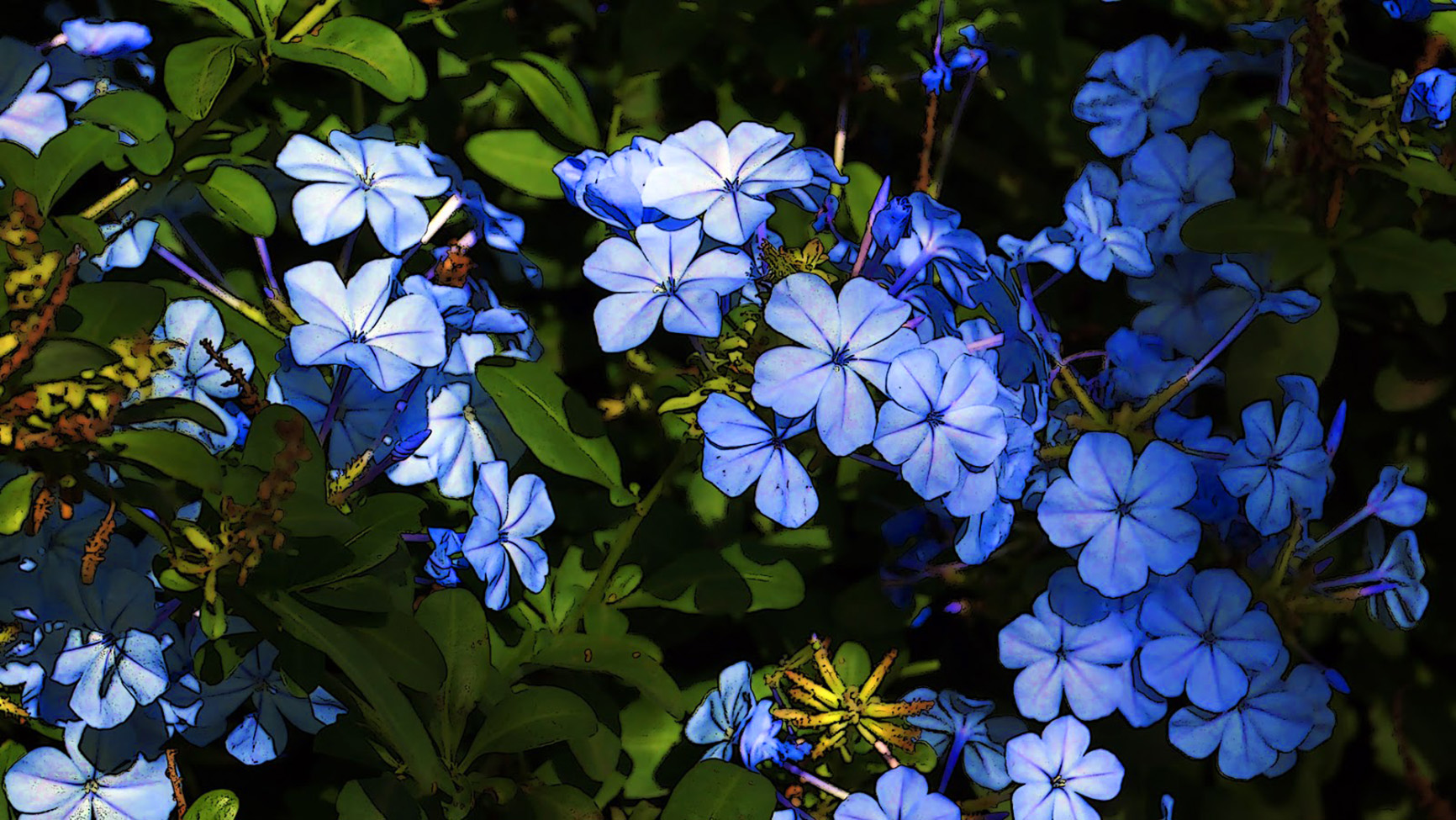
PLUMBAGO

Plumbago is a genus of 10–20 species of flowering plants in the family Plumbaginaceae, native to warm temperate to tropical regions of the world. Common names include plumbago and leadwort (names which are also shared by the genus Ceratostigma).

The species include herbaceous plants and shrubs growing to 0.5–2 m tall. The leaves are spirally arranged, simple, entire, 0.5–12 cm  long, with a tapered base and often with a hairy margin. The flowers are white, blue, purple, red, or pink, with a tubular corolla with five petal-like lobes; they are produced in racemes.

The flower calyx has glandular trichomes (hairs), which secrete a sticky mucilage that is capable of trapping and killing insects; it is unclear what the purpose of these trichomes is; protection from pollination by way of "crawlers" (ants and other insects that typically do not transfer pollen between individual plants), or possible protocarnivory.

Mature plumbago leaves often have a whitish residue on their undersides, a feature that can confuse gardeners. While this white material resembles a powdery mildew disease or a chemical spray deposit, it is actually a natural exudate from "chalk" glands that are found on the Plumbago species.

This post is part of the Floral Friday Fotos meme


Sunday, 10 April 2022

PROTEA

Leucospermum (Pincushion, Pincushion Protea or Leucospermum) is a genus of about 50 species of flowering plants in the family Proteaceae, native to Zimbabwe and South Africa, where they occupy a variety of habitats, including scrub, forest, and mountain slopes. They are evergreen shrubs (rarely small trees) growing to 0.5-5 m tall. The leaves are spirally arranged, tough and leathery, simple, linear to lanceolate, 2-12 cm long and 0.5-3 cm broad, with a serrated margin or serrated at the leaf apex only.

The flowers are produced in dense inflorescences, which have large numbers of prominent styles, which inspires the name. The genus is closely related in evolution and appearance to the Australian genus Banksia. Shown here is a Leucospermum patersonii hybrid. An excellent ornamental hardy shrub for most well-drained soils and full sun positions. It is a relatively fast growing landscape shrub for coastal or inland gardens. The two-tone orange-red flowers make a great long stemmed cut flower, and is thus grown commercially for this purpose.

This post is part of the My Sunday Best meme
and also part of the Photo Sunday meme


Thursday, 24 February 2022

CORREA

Correa 'Ray's Tangerine' (Tangerine Australian Fuchsia) is slow growing compact evergreen shrub growing eventually to about 0.5-1 meter by only a bit wider, with closely paired shiny dark 2 cm long green leaves. The vibrant 4 cm long orange bell-shaped flowers are on display during the Autumn through Winter.

Grow in sun or partial shade, with good drainage. Tolerant of drought but best with regular water during dry periods. Hardy to about -7˚C. In the Appendix to the Encyclopaedia of Australian Plants authors Rodger Elliot and David Jones note that it is a hybrid between "Correa pulchella and a broad-bellied selection of C. reflexa var. scabridula from Carpenter Rocks, SA".

It is an Australian fuchsia that stays small and has bright, shiny, dark-green leaves and vibrant orange flowers that bloom in Autumn and Winter.  It grows well in containers or in-ground in gardens.

This post is part of the Floral Friday Fotos meme.


Thursday, 7 October 2021

BOTTLEBRUSH

Callistemon is a genus of shrubs in the family Myrtaceae, first described as a genus in 1814. The entire genus is endemic to Australia but widely cultivated in many other regions and naturalised in scattered locations. Their status as a separate taxon is in doubt, some authorities accepting that the difference between callistemons and melaleucas is not sufficient for them to be grouped in a separate genus.

Callistemon species have commonly been referred to as bottlebrushes because of their cylindrical, brush like flowers resembling a traditional bottle brush. They are mostly found in the more temperate regions of Australia, especially along the east coast and typically favour moist conditions so when planted in gardens thrive on regular watering. However, two species are found in Tasmania and several others in the south-west of Western Australia. At least some species are drought-resistant and some are used in ornamental landscaping elsewhere in the world.

This post is part of the Floral Friday Fotos meme