The Grainger Museum is a repository of items documenting the life, career and music of the composer, folklorist, educator and pianist Percy Grainger (b. Melbourne, 1882; d. White Plains, New York, 1961), located in the grounds of the University of Melbourne, Victoria, Australia.
In the early 1920s, Grainger began to develop an idea for an autobiographical museum so that "all very intimate letters or notes should be deposited in an Australian Grainger Museum, preferably in birth-town Melbourne". Grainger was a devotee of words derived from Anglo-Saxon, and used the word 'hoard-house' for museums generally, but agreed to the word 'museum' in this case. The Museum was designed by the University's staff architect John Gawler of the local firm Gawler and Drummond, with input and funding from Grainger himself. It was built between 1935 and 1939 on land adjacent to the Conservatorium, provided for the purpose by the University of Melbourne, and officially opened in December 1938.
It is among a relatively small number of autobiographical museums in the world. The Grainger Museum was closed in 2003 for seven years, for restoration and conservation work, after waterproofing issues were detected. It reopened on 17 October 2010. Among displays of original manuscripts and published scores, musical instruments, field recordings, artworks, photographs, books and personal items, are Grainger’s whips and other items relating to his sado-masochism (which Grainger called the "Lust Branch"), the contents of his bedside cabinet, and a gallery devoted to his mother’s suicide.
There are also sound-making devices Grainger used to make his innovative and experimental "Free music". The substantial archival collection includes some 50,000 items of correspondence (with people such as Edvard Grieg, Frederick Delius, Cyril Scott, Richard Wagner and Pyotr Ilyich Tchaikovsky) and the collection generally comprises over 100,000 items in total, only a small proportion of which are on display. The remainder of the collection is accessible for research by prior arrangement. The Grainger Museum is open Tuesday to Fridays, and Sundays, from 1 pm to 4:30 pm.
This post is part of the Our World Tuesday meme.
A couple of weeks ago I blogged about CERES (Centre for Education and Research in Environmental Strategies), which is an award winning, not-for-profit, sustainability centre located on 4.5 hectares on the Merri Creek in East Brunswick, Melbourne.
This week I am showcasing another couple of murals found in the café area of this Centre. The two murals are fixed to the wall in a covered outdoor area and provide a cheerful backdrop while one is enjoying a coffee, tea, delicious juice, or a snack made on the premises. I wasn't able to find out who the talented artist is and a couple of people I asked did not know either. The art works are not signed and if any reader of this blog knows, please enlighten us!
This post is part of the Monday Mellow Yellows meme,
and also part of the Monday Murals meme,
and also part of the Blue Monday meme.
Trinity College is the oldest residential college of the University of Melbourne. Founded in 1872 on a site granted to the Church of England for the University of Melbourne, Trinity is unique among Australian university colleges in the scope of its educational programs.
In addition to its resident community of 300 University of Melbourne and University of Divinity students, Trinity's programs includes Trinity College Foundation Studies, which prepares around 1000 international students for admission to the University of Melbourne annually; the Trinity College Theological School, an Anglican theological college affiliated with the University of Divinity; and the Trinity Institute, which runs summer and winter schools for young leaders, as well as other shorter learning and leadership programs.
The Chapel of Trinity College and Janet Clarke Hall is an Anglican Church in Trinity College’s grounds at the University of Melbourne. People of all denominations and faiths or none are welcome at Chapel worship. The College Chaplains, eminent visiting preachers, and members of Trinity and Janet Clarke Hall communities all preach at various services throughout the year.
This post is part of the Scenic Weekends meme,
and also part of the inSPIREd Sunday meme.
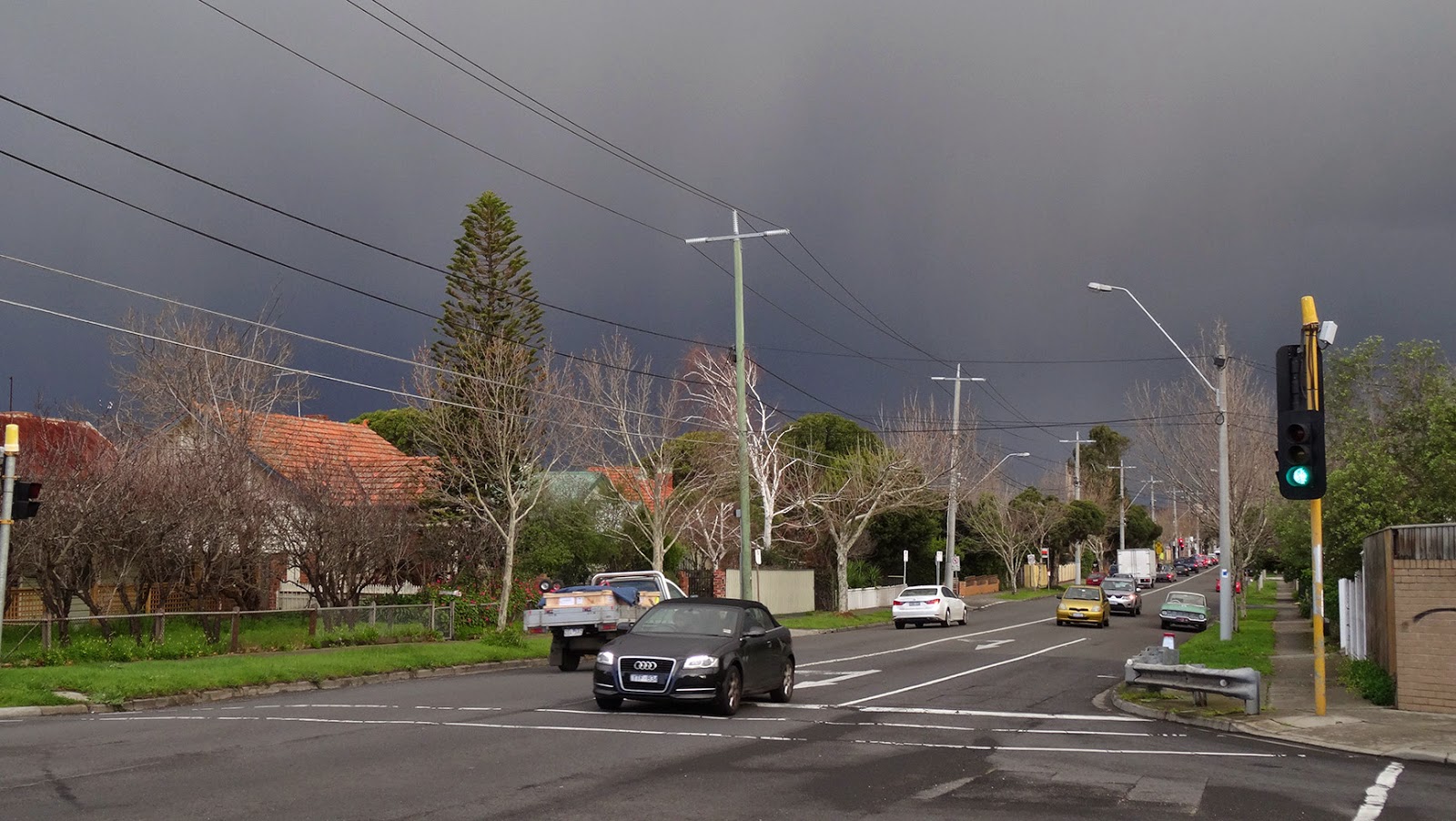
Victoria experienced high winds and rain yesterday, shivering through a blustery night, however, the wild weather was not over today. As the mop-up from yesterday’s chaos, continued today, we had showers and strong wind continuing this morning, with a maximum temperature of 10˚C, the wind chill factor making it feel like 3 to 4˚C.
This afternoon, we were misled by a spot of sunshine and walked to post a letter. However, storm clouds rolled rapidly from the Southwest and there was hail and rain that forced us rapidly back home. Snow, hail and thunder was seen throughout the state, justifying the severe weather warning that was in place for the Mallee, Wimmera, north-central, southwest, central and Gippsland districts.
This post is part of the Skywatch Friday meme.
Chaenomeles speciosa (commonly known as flowering quince or Japanese quince or as zhou pi mugua in traditional Chinese medicine) is a thorny deciduous or semi-evergreen shrub native to eastern Asia. It is taller than another commonly cultivated species, C. japonica, usually growing to about 2 m. The flowers are usually red, but may be white or pink, and the fruit is a fragrant but hard pome that resembles a quince.
This plant is widely cultivated in temperate regions for its twining habit and its showy flowers which appear early in the season - occasionally even in midwinter. It is frequently used as an informal low hedge. Numerous cultivars with flowers in shades of white, pink and red have been selected. Many of these cultivars and hybrids have gained the Royal Horticultural Society's Award of Garden Merit.
The fruit has been part of traditional Chinese medicine (TCM) for thousands of years, used to treat arthritis, leg oedema, and cramping in the calf muscle. A constituent of its extract has been found to be an effective and selective dopamine reuptake inhibitor.
This post is part of the Floral Friday Fotos meme.
Mordialloc is a suburb in Melbourne, Australia, 24 km south-east from Melbourne's central business district. Its Local Government Area is the City of Kingston. At the 2006 Census, Mordialloc had a population of 7524. The name is derived from the Aboriginal term "moordy yallock", which translates roughly to "muddy creek." Mordialloc Post Office opened on 17th October 1863.
Mordialloc Creek is arguably the most significant feature of the suburb. Mordialloc Creek has a rich history of traditional wooden boat building. The Creek is still home to Pompei's boat works. Many classic boats line the walls of the creek and may still be admired today. Cafés, hotels and refreshment kiosks may also be found around the creek near its mouth near the sea. Looking at these photos taken in Summer, I'm longing for some nice warm weather...
This post is part of the Waterworld Wednesday meme,
and also part of the Outdoor Wednesday meme,
and also part of the Wordless Wednesday meme.
Maldon is a town in Victoria, Australia, in the Shire of Mount Alexander local government area, and about 136 km from Melbourne. It has been designated "Australia's first notable town" and is known for its 19th-century appearance, maintained since gold-rush days. At the 2006 census, Maldon had a population of 1,601.
The district where Maldon now stands was first discovered by white Europeans in 1836, during Major Thomas Mitchell's famous Victorian expedition. It was settled soon afterwards by pastoralists, and two sheep runs were established in the area, at the foot of Mount Tarrangower. In December 1853, gold was discovered at Cairn Curran (the name given to one of the sheep runs), and Maldon became a part of the Victorian Gold Rush.
The goldfield, which was named "Tarrangower Fields" after Mount Tarrangower, immediately attracted an immense number of men eager to make their fortunes at the diggings. Just one month after gold was first discovered, the Chief Commissioner for Goldfields reported 3000 miners had arrived at the diggings. A month after that, a journalist for The Argus reported that the road from Castlemaine to Maldon was lined with the shops of people hoping to make a living of their own from the miners
In 1861, a government census declared the town's population to be 3341, servicing an additional 5,000-6,000 miners at the diggings. At that time it was the eighth-largest town in Victoria, and remained so for the next decade. However, as miners were forced to dig deeper to obtain usable specimens, or as mines ran dry completely, the population began to decline. By 1891, Maldon was reduced to 1,600 inhabitants. Mining of small claims continued through the 20th century, together with sluicing of gullies and tailings.
Maldon is now sustained by its appeal as a retreat and retirement venue for artists and writers, as well as tourist trade. The town holds several annual fairs, including a Winter Fair, Easter Fair, Art Show, and Folk Festival. Notable landmarks include Beehive Chimney, Mount Tarrangower and fire tower, Lake Cairn Curran, and the railway station.
This post is part of the Our World Tuesday meme,
and also part of the Ruby Tuesday meme.