Friday, 20 November 2020

SUNSET

Living in a big city like Melbourne can be quite stressful. Thankfully we still have many areas of unspoilt natural bushland right in the midst of our city. These little islands of serenity and repose are places where we can take refuge in and recover some of our sanity... This sunset is at the Yarra Bend Park.

This post is part of the Skywatch Friday meme.


Thursday, 19 November 2020

BLACKBERRY FLOWERS

The blackberry is an edible fruit produced by many species in the genus Rubus in the family Rosaceae, hybrids among these species within the subgenus Rubus, and hybrids between the subgenera Rubus and Idaeobatus. The taxonomy of the blackberries has historically been confused because of hybridization and apomixis, so that species have often been grouped together and called species aggregates. For example, the entire subgenus Rubus has been called the Rubus fruticosus aggregate, although the species R. fruticosus is considered a synonym of R. plicatus.

The flowers are produced in late spring and early summer on short racemes on the tips of the flowering laterals. Each flower is about 2–3 cm in diameter with five white or pale pink petals. The drupelets only develop around ovules that are fertilised by the male gamete from a pollen grain. The most likely cause of undeveloped ovules is inadequate pollinator visits. Even a small change in conditions, such as a rainy day or a day too hot for bees to work after early morning, can reduce the number of bee visits to the flower, thus reducing the quality of the fruit. Incomplete drupelet development can also be a symptom of exhausted reserves in the plant's roots or infection with a virus such as raspberry bushy dwarf virus.

This post is part of the Floral Friday Fotos meme.


Tuesday, 17 November 2020

CITY SUNRISE

Sunrise in Melbourne, with an air of hope and new optimism in our city of 5 million people, seeing it's our eighteenth day straight with 0 cases of COVID-19 and 0 deaths due to the virus!

This post is part of the Our World Tuesday meme,
and also part of the Ruby Tuesday meme,
and also part of the Travel Tuesday meme,
and also part of the Wordless Wednesday meme.


Sunday, 15 November 2020

PATH

A quiet, deserted path by the Darebin Creek in Preston, a northern suburb.

This post is part of the My Sunday Best meme.


Saturday, 14 November 2020

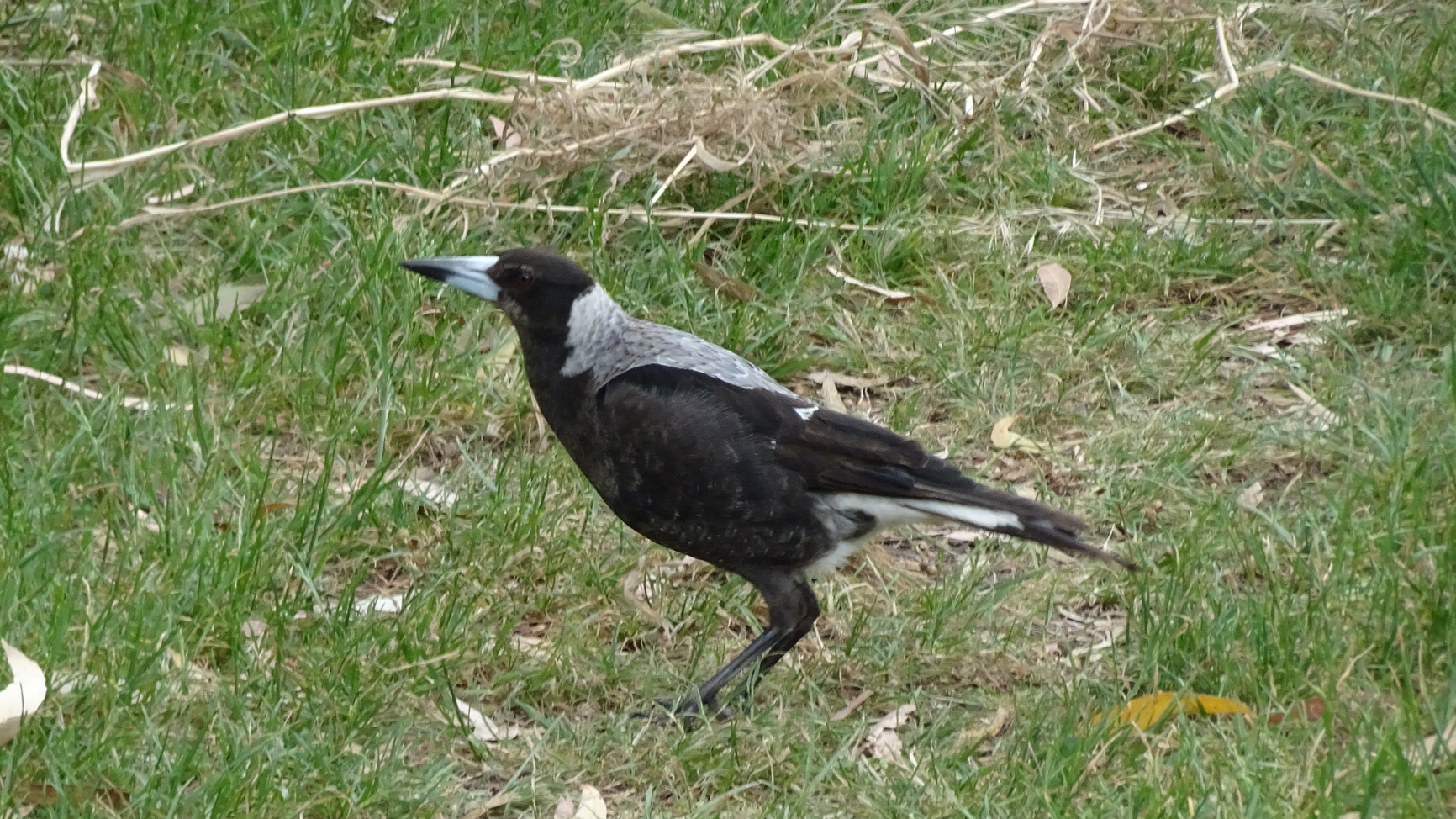
MAGPIE MUM & CHICK

The Australian magpie (Gymnorhina tibicen) is a medium-sized black and white passerine bird native to Australia and southern New Guinea. Although once considered to be three separate species, it is now considered to be one, with nine recognised subspecies. A member of the Artamidae, the Australian magpie is placed in its own genus Gymnorhina and is most closely related to the black butcherbird (Melloria quoyi). It is not, however, closely related to the European magpie, which is a corvid.

The adult Australian magpie is a fairly robust bird ranging from 37 to 43 cm in length, with distinctive black and white plumage, gold brown eyes and a solid wedge-shaped bluish-white and black bill. The male and female are similar in appearance, and can be distinguished by differences in back markings. The male has pure white feathers on the back of the head and the female has white blending to grey feathers on the back of the head. With its long legs, the Australian magpie walks rather than waddles or hops and spends much time on the ground. 

Described as one of Australia's most accomplished songbirds, the Australian magpie has an array of complex vocalisations. It is omnivorous, with the bulk of its varied diet made up of invertebrates. It is generally sedentary and territorial throughout its range. Common and widespread, it has adapted well to human habitation and is a familiar bird of parks, gardens and farmland in Australia and New Guinea. This species is commonly fed by households around the country, but in spring a small minority of breeding magpies (almost always males) become aggressive and swoop and attack those who approach their nests. Juveniles have lighter greys and browns amidst the starker blacks and whites of their plumage and their eyes have darker irises.

This post is part of the Saturday Critters meme.


Friday, 13 November 2020

IT'S A PLANE!

Had almost forgotten what these looked like during our four months of lockdown and no flights allowed! Things are slowly going back to normal, a little each day!

This post is part of the Skywatch Friday meme.


Thursday, 12 November 2020

OYSTER PLANT

Acanthus mollis, commonly known as bear's breeches, sea dock, bear's foot plant, sea holly or oyster plant, is a species of plant in the family Acanthaceae and is native to the Mediterranean region. It is a leafy, clump-forming perennial herb, with a rosette of relatively large, lobed or toothed leaves, and purplish and white flowers on an erect spike.

It is a leafy, clump-forming perennial herb with tuberous roots. It has a basal rosette of dark glossy green, lobed or divided, glabrous leaves 50 cm long and 30 cm wide on a petiole 20–30 cm long. The flowers are borne on an erect spike up to 200 cm tall emerging from the leaf rosette. The sepals are purplish and function as the upper and lower lips of the petals, the upper lip about 4 cm long and the lower lip 3 cm long. The petals are about 4–4.5 cm long and form a tube with a ring of hairs where the stamens are attached. Flowering occurs in summer and the fruit is a sharply-pointed capsule about 2 cm long containing one or two brown seeds about 14 mm  long and 8 mm wide.

Acanthus mollis was first formally described in 1753 by Carl Linnaeus in his book Species Plantarum. The name of the genus derives from the Greek name of the plant ἄκανθος ákanthos. This ἄκανθος ákanthos is related to ἄκανθα ákantha meaning "thorn" referring to the thorn-bearing sepals, or any thorny or prickly plant in Greek. The Latin name of the species, mollis meaning "soft, smooth", refers to the texture of the leaves.

Acanthus mollis is entomophilous, pollinated only by bees or bumble bees large enough to force their way between the upper sepal and the lower, so that they can reach the nectar at the bottom of the tube. Bear's breeches is regarded as invasive in some countries, including Australia and New Zealand.

The shape of the leaf of this plant inspired the ancient Greek sculptor Callimachus (5th c. BCE) to model the capital of the Corinthian column. Since then, the Corinthian order column has been used extensively in Greco-Roman and Classical architecture. For centuries, stone or bronze stylized versions of acanthus leaves have appeared as acanthus decorations on certain styles of architecture and furniture. Virgil described Helen of Troy as wearing a dress embroidered with acanthus leaves.

This post is part of the Floral Friday Fotos meme.


Wednesday, 11 November 2020