Showing posts with label Xanthorrhoeaceae. Show all posts

Thursday, 4 July 2019

DAYLILY

A daylily is a flowering plant in the genus Hemerocallis. Gardening enthusiasts and professional horticulturalists have long bred daylily species for their attractive flowers. Thousands of cultivars have been registered by local and international Hemerocallis societies. Hemerocallis is now placed in family Xanthorrhoeaceae, subfamily Hemerocallidoideae, but in the past, the genus used to be part of Liliaceae (which includes true lilies).

Daylilies are perennial plants, whose name alludes to the flowers which typically last no more than 24 hours. The flowers of most species open in early morning and wither during the following night, possibly replaced by another one on the same scape (flower stalk) the next day. Some species are night-blooming.

Daylilies are not commonly used as cut flowers for formal flower arranging, yet they make good cut flowers otherwise as new flowers continue to open on cut stems over several days. Hemerocallis is native to Eurasia, including China, Korea, and Japan, and this genus is popular worldwide because of the showy flowers and hardiness of many kinds. There are over 60,000 registered cultivars. Hundreds of cultivars have fragrant flowers, and more scented cultivars are appearing more frequently in northern hybridisation programs. Some cultivars rebloom later in the season, particularly if their capsules, in which seeds are developing, are removed.

Most kinds of daylilies occur as clumps, each of which has leaves, a crown, flowers, and roots. The long, linear lanceolate leaves are grouped into opposite fans with arching leaves. The crown is the small white portion between the leaves and the roots. Along the scape of some kinds of daylilies, small leafy "proliferations" form at nodes or in bracts. A proliferation forms roots when planted and is often an exact clone of its parent plant. Many kinds of daylilies have thickened roots in which they store food and water.

A normal, single daylily flower has three petals and three sepals, collectively called tepals, each with a midrib in either the same or a contrasting colour. The centremost part of the flower, called the throat, usually is of a different colour than the more distal areas of the tepals. Each flower usually has six stamens, each with a two-lobed anther. After successful pollination, a flower forms a capsule (often erroneously called a pod). The hybrid illustrated here is Daylily (Hemerocallis 'Crater Fire') hybridised by Elliott and introduced in 1996. It has large, showy, fragrant blossoms that flower in early midseason and has extended bloom and rebloom capability.

This post is part of the Floral Friday Fotos meme.

Tuesday, 4 August 2015

ALOES IN OUR STREET

Aloe arborescens (krantz aloe, candelabra aloe) is a species of flowering succulent perennial plant that belongs to the Aloe genus, which it shares with the well known and studied Aloe vera. This species is also relatively popular among gardeners and has recently been studied for possible medical uses. The specific epithet arborescens means "tree-like". It is is endemic to the south eastern part of Southern Africa. Specifically, this range includes the countries of South Africa, Malawi, Mozambique and Zimbabwe.

Aloe arborescens is a large multi-headed sprawling succulent, its specific name indicating that it sometimes reaches tree size. Typical height for this species 2–3 metres high. Its leaves are succulent and are green with a slight blue tint. Its leaves are armed with small spikes along its edges and are arranged in rosettes situated at the end of branches. Flowers are arranged in a type of inflorescence called a raceme. The racemes are not branched but two to several can sprout from each rosette. Flowers are cylindrical in shape and are a vibrant red/orange colour.

This plant is valued by gardeners for its architectural qualities, its succulent green leaves, large vibrantly-coloured flowers, and winter blooming. The sweet nectar attracts birds, butterflies and bees. With a minimum temperature of 10 °C, in temperate regions it is grown under glass. The cultivar A. arborescens 'Variegata' has gained the Royal Horticultural Society's Award of Garden Merit.

This post is part of the Our World Tuesday meme,
and also part of the Ruby Tuesday meme,
and also part of the Trees & Bushes meme,
and also part of the Wordless Wednesday meme.


Thursday, 4 September 2014

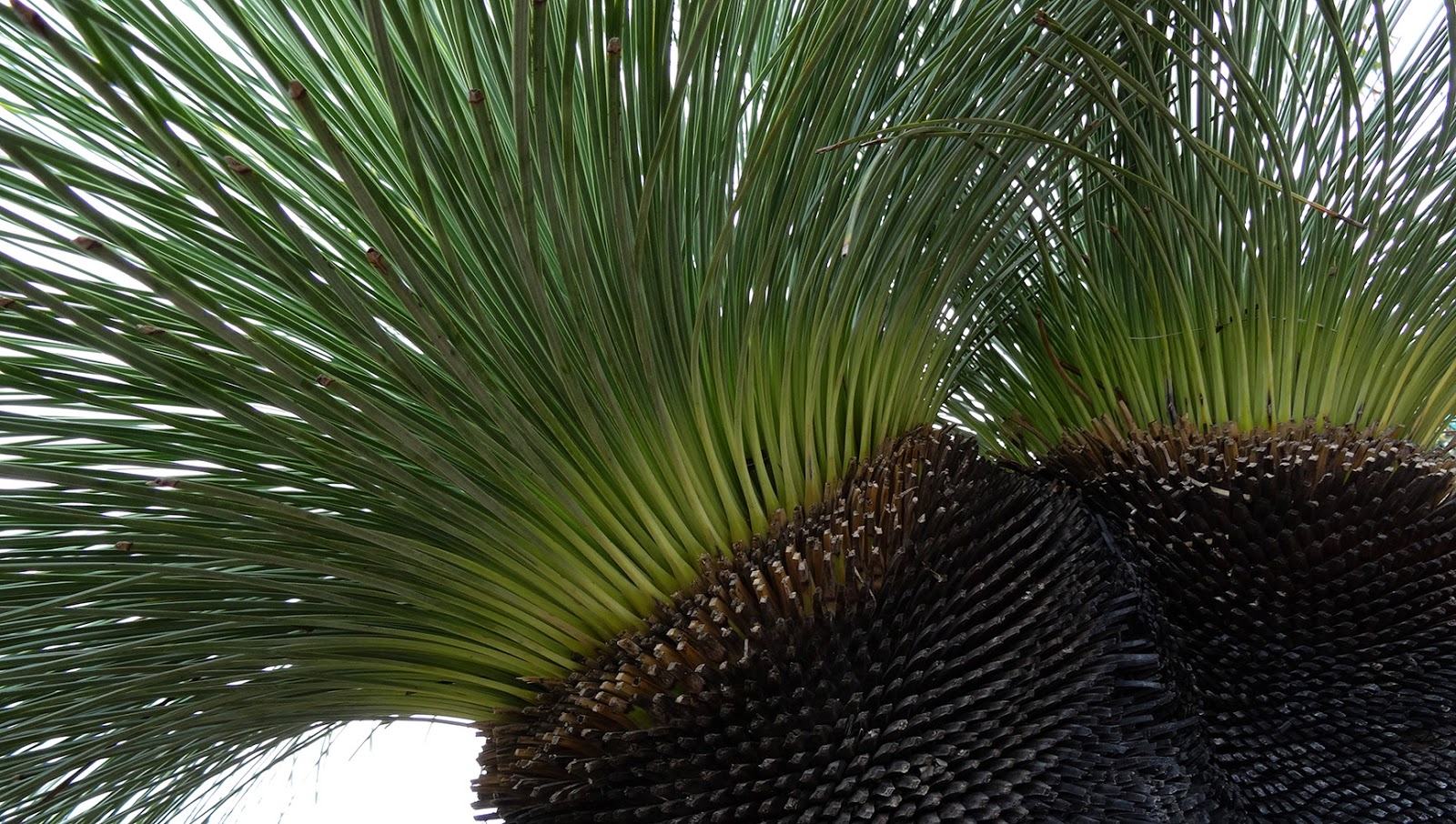
MELBOURNE STREET TREES 87 - GRASS TREE

Xanthorrhoea australis (commonly known as the Grass-tree or Black Boy), is an Australian plant. It is the most commonly seen species of the genus Xanthorrhoea . Its fire-blackened trunk can grow up to several metres tall and is often branched. In certain Aboriginal languages, it is called 'Bukkup' or 'Kawee'. In Xanthorrhoeas, the main way to identify them is by looking at the cross-section of the leaves. In the case of X. australis, the cross-section is a rough diamond shape, and the colour of the leaves is a bluish-green.

X. australis is not often seen in bloom because this species requires fire to stimulate its reproductive cycle. However, if it does flower, a flowering spike grows out of the top of the plant. Flowers appear on the spike, usually covering 1⁄2–5⁄6 of the stem. The flowers of this particular species have 6 petals. The crown of leaves of X. australis will be almost spherical in shape, the point of each leaf perfectly marking the shape of the imagined sphere.

X. australis has leaves which are softer and generally less rigid than other Xanthorrhoeas. Old leaves hang down forming a distinctive skirt-like feature that partly covers the fire-blackened trunk. X. australis flowers from July to December, but younger plants may flower in June. This species can also be found in South Australia, New South Wales and Tasmania.

This post is part of the Floral Friday Fotos meme.